
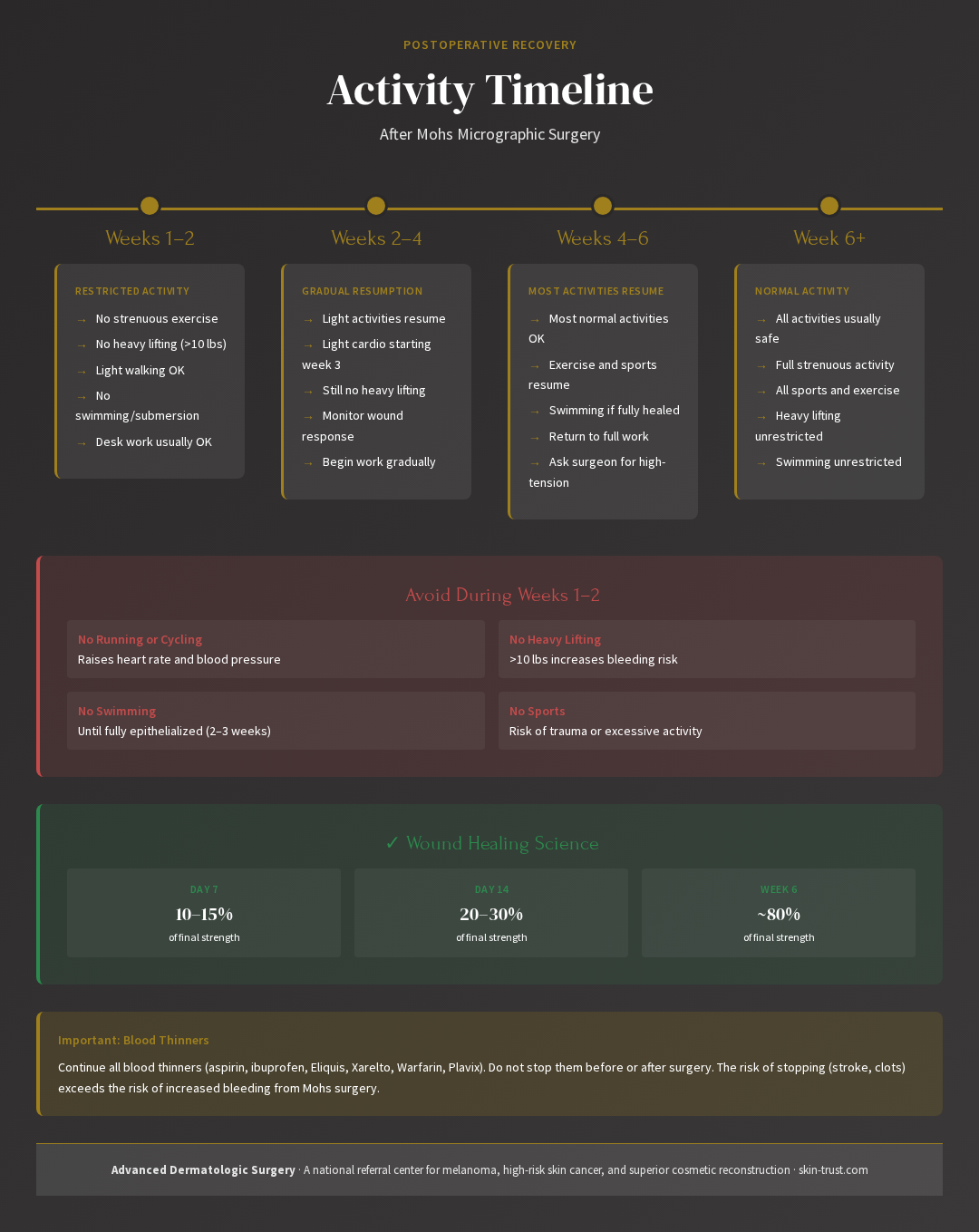
- No strenuous exercise or heavy lifting for 2 weeks — wounds are 85–90% weaker at day 7; strenuous activity increases bleeding, dehiscence, and hematoma risk
- Light walking is safe from day 2–3 after surgery — gentle activity does not stress healing wounds; listen to your body and stop if pain or drainage increases
- Wound tensile strength reaches only 20–30% at day 14 — full activity typically safe after 4–6 weeks for simple closures, longer for high-tension wounds or complex reconstructions
- Avoid swimming and water submersion until the wound is completely closed — typically 2–3 weeks for simple closures; bacteria in pools, oceans, and bathtubs enter open wounds
- Sexual activity counts as strenuous exercise — abstain for 1–2 weeks depending on wound location; resumption too early risks bleeding and dehiscence
- Continue all blood thinners — do not stop aspirin, ibuprofen, warfarin, Eliquis, Xarelto, or Plavix; the clot/stroke risk exceeds surgical bleeding risk
What Does the Evidence Actually Say About Activity After Mohs Surgery?
"I'm often asked why we restrict activity after Mohs surgery. The honest answer is: we have no high-quality RCTs proving that restriction prevents specific complications in cutaneous surgery. Our recommendations come from understanding how skin wounds heal, not from clinical trial data. That transparency matters."
This is an important starting point. Unlike post-operative guidelines for orthopedic or cardiovascular surgery—where large, well-controlled studies guide recommendations—the dermatologic surgery literature lacks randomized controlled trials specifically testing activity restriction protocols in cutaneous Mohs surgery patients.
This doesn't mean activity restrictions are wrong. Rather, they're based on solid wound healing physiology: wound tensile strength develops gradually over weeks, and mechanical stress applied to a healing wound can increase bleeding, dehiscence (wound opening), and infection risk. The timeline of healing is well-established. What we cannot say with certainty is exactly which activities cause enough mechanical stress to be clinically harmful—because no one has formally tested this.
Why Does Wound Tensile Strength Matter After Mohs Surgery?
Wound tensile strength is the force required to tear a healing wound. Understanding its timeline is crucial to understanding why we recommend activity restrictions.
Classic research by Pickett et al. (published in Archives of Otolaryngology–Head & Neck Surgery, 1996) measured wound tensile strength at different postoperative time points. Their findings were clear: low-tension wounds gained only a fraction of their final tensile strength in the first 3 weeks. Specifically:
- Day 7: 10–15% of final strength
- Day 14: 20–30% of final strength
- Day 21: 35–50% of final strength
- Day 42: ~80% of final strength
- Final plateau: ~12 weeks
What this means clinically: a wound at day 7 is approximately 85–90% weaker than it will eventually be. Activities that raise your heart rate, increase blood pressure, or create tensile load on the surgical site risk disrupting healing.
This is why timing matters. After 2 weeks, tensile strength has roughly doubled. After 4 weeks, it's approaching 50%. By 6 weeks, most simple closures have adequate strength for normal activity.
Week-by-Week Activity Guidelines After Mohs Surgery
Weeks 1–2: Restricted Activity (Critical Healing Phase)
During the first two weeks, your wound is at its weakest point. Follow these guidelines strictly:
No strenuous exercise. This means no activities that make you sweat or meaningfully raise your heart rate. This includes:
- Running, jogging, or high-intensity workouts
- Cycling or stationary bikes
- Team sports or contact sports
- Heavy yard work or gardening
- Intense housecleaning
No heavy lifting. Do not lift anything weighing more than 10 pounds. This includes groceries, laundry baskets, children, or pets. Heavy lifting increases intrathoracic pressure, which can cause bleeding and hematoma formation.
No swimming or water submersion. Keep the wound completely dry and out of any bodies of water (pools, lakes, oceans, hot tubs, baths). Showers are fine, but avoid water running directly on the wound or soaking the area.
Light walking is acceptable. Gentle walking at a normal pace (not fast-paced or hiking) is fine starting day 2–3, after you've recovered from local anesthesia and any sedation.
Desk work is usually OK. If your job involves sitting at a desk or computer, you can typically resume work by day 2–3 if you're not on sedating medications.
Driving is usually OK. If you were not given sedating medications and your wound is not on your face in a location that would impair vision or pedal control, you can typically drive the same day. If you had IV sedation, wait 24 hours.
Weeks 2–4: Gradual Activity Resumption
As tensile strength approaches 20–30%, you can gradually increase activity:
Light activities resume. Short walks, light household tasks (avoiding heavy items), and gentle stretching are fine. Listen to your wound—if you notice increased drainage, redness, or pain, dial back activity.
No heavy lifting yet. Continue avoiding lifting more than 10 lbs, and no strenuous exercise.
Swimming: still not safe. Unless your wound is fully epithelialized (closed over with new skin), avoid water submersion.
Work gradually. If you do physical labor, start with 50% intensity and see how the wound tolerates it by day 21. If pain, bleeding, or drainage increases, back off.
Weeks 4–6: Most Activities for Simple Closures
For straightforward wounds closed with primary closure (not grafts or complex reconstruction):
Most normal activities resume. You can resume exercise, sports, swimming (once fully healed), and heavy lifting.
Complex wounds need longer. If your wound involved graft placement, flap reconstruction, or high-tension closure, ask your surgeon before resuming strenuous activity.
Swimming safe once fully epithelialized. When scabs have completely shed and the wound is pink and smooth (no opening), swimming is safe.
After 6 Weeks: Normal Activity
For most simple Mohs closures, normal activity is safe by 6 weeks. However:
- High-tension wounds (scalp, back, lower extremity) may need 8–12 weeks before full strenuous activity
- Large wounds or complex reconstruction may need longer—ask your surgeon
- Monitor for signs of wound stress: increased pain, bleeding, opening, or drainage signals you're doing too much
Site-Specific Activity Considerations
Different body locations have different healing profiles and tensile properties:
Face: Generally heals fastest and tolerates activity resumption earliest. Tension is typically low. By week 3–4, most facial wounds tolerate normal activity.
Scalp: Heals slower and carries higher tension (scalp is stretched over bone). Activity restrictions should extend to 4–6 weeks. Avoid heavy exercise that raises heart rate significantly.
Lower extremities (shins, ankles, feet): Poorest healing due to gravity, reduced blood supply, and high mechanical stress. Extend restrictions to 6–8 weeks, especially for wounds below the knee. Avoid standing for prolonged periods in the first 2 weeks.
Trunk: Moderate healing and tension. Most wounds tolerate activity resumption by 4 weeks.
Joints (knee, elbow, shoulder): High-tension zones with constant movement. Extend activity restrictions to 6 weeks minimum. Avoid activities that repeatedly flex or stress the joint.
Swimming and Water Submersion: When Is It Safe?
This is a common question, and the answer is clear:
Never submerge a wound until it is fully epithelialized. Full epithelialization means:
- All scabs have shed
- The wound surface is fully covered with new skin (no raw areas)
- The surface is pink and closed
Timeline: For most Mohs closures, this takes 2–3 weeks. Larger wounds or complex repairs may take 4–6 weeks.
Grafted wounds: If your wound was closed with a skin graft, wait until the bolster (the dressing over the graft) is removed (typically 10 days), then another 2–3 days before submersion, allowing the graft to fully adhere.
Why the restriction? Submerged wounds soak up water, which softens newly forming skin and can introduce bacteria. Open or incompletely closed wounds are susceptible to infection.
After epithelialization: Once fully closed, wounds are much more resilient. A fully epithelialized scar can be submerged without risk.
Sexual Activity After Mohs Surgery
Sexual activity counts as strenuous exercise—it raises heart rate, blood pressure, and intracranial pressure, all of which can increase bleeding risk.
General guidance: Avoid sexual activity for 1–2 weeks, depending on wound location and size.
Face or upper extremity wounds: Often tolerate sexual activity by day 7–10.
Lower extremity or large wounds: Wait 2 weeks.
High-tension wounds (scalp, back): Wait 2 weeks minimum.
If wound drainage, pain, or bleeding increases after resuming activity, dial it back.
Work Resumption After Mohs Surgery
Desk work: Typically OK by day 2–3, assuming no sedating medications.
Light physical labor: Can begin by week 2–3 for small, simple wounds on the face or trunk. Gradually increase intensity by week 3–4.
Heavy physical labor or outdoor work: Wait 3–4 weeks for lower extremity or scalp wounds. 2–3 weeks for face or trunk wounds. Always monitor for signs of wound stress.
Strenuous occupations (construction, manual labor, sports): 4–6 weeks minimum, depending on wound location and complexity.
Blood Thinners: Continue Them, Don't Stop
One of the most important things to understand: do not stop your blood thinners (aspirin, ibuprofen, Eliquis, Xarelto, Warfarin, Plavix, or any other anticoagulant or antiplatelet medication) before or after Mohs surgery without explicit instruction from your cardiologist or primary care physician.
The recommended protocol is to continue all blood thinners. Here's why:
The risk of stopping blood thinners (blood clots, stroke, or myocardial infarction) far exceeds the risk of increased bleeding from Mohs surgery. Post-operative bleeding from a Mohs wound can be managed with pressure, topical hemostatic agents, and sutures. A stroke or clot cannot.
Modern Mohs surgery, performed by a surgeon trained in hemostasis, carries a low infection rate and excellent healing outcomes even in patients taking blood thinners. You may bleed a bit more during the procedure and have slightly increased bruising afterward, but this is well-tolerated and does not compromise healing.
Never stop blood thinners on your own. If you have concerns about bleeding, discuss them with your surgeon and cardiologist together.
When Restrictions Matter Most: Avoiding Complications
Activity restrictions exist to prevent three main complications:
Bleeding and hematoma formation. Increased heart rate and blood pressure can cause bleeding at the surgical site, leading to a collection of blood under the wound (hematoma). This is usually reabsorbed, but large hematomas can delay healing or become infected.
Dehiscence (wound opening). Mechanical stress applied to a wound during its weakest weeks can cause it to open. Once open, wounds must heal from the bottom up, which takes weeks longer.
Infection. Increased bleeding and wound stress can compromise local immunity, increasing infection risk.
For simple, well-healed wounds on the face, the risk of these complications is low even with modest activity. For large wounds, complex repairs, high-tension closures, or lower extremity wounds, the risk is higher and justifies stricter restrictions.
| Complication | Risk if Overly Active Week 1–2 | Risk if Overly Active Week 3–4 | Risk if Overly Active Week 5–6 |
|---|---|---|---|
| Bleeding/hematoma | Moderate–high | Low–moderate | Low |
| Dehiscence | Moderate–high | Low–moderate | Very low |
| Infection (bleeding-related) | Low–moderate | Low | Very low |
When to Call Your Surgeon
Call your surgeon immediately if, during the activity restriction period:
- Pain increases significantly after day 3 (should steadily improve)
- Wound opens or gapes
- Bleeding that doesn't stop with 10 minutes of gentle pressure
- Redness, warmth, or increasing swelling (signs of infection)
- Pus or foul-smelling drainage
- Fever over 101°F
These are signs that your wound may not be tolerating your current activity level or that an infection is developing.
Data sourced from peer-reviewed, PubMed-indexed publications
Frequently Asked Questions
Q: Can I go back to the gym after 2 weeks?
A: It depends on the intensity and location of your wound. Gentle cardio (brisk walking, stationary cycling at low intensity) is usually fine by week 2–3 for facial wounds. For scalp, trunk, or lower extremity wounds, wait until week 4. Strength training (heavy lifting) should wait until week 4–6 minimum.
Q: Is light walking safe immediately after surgery?
A: Light walking (normal pace, not brisk hiking) is usually safe starting day 2–3. Begin with short distances and see how your wound feels. If pain, bleeding, or drainage increases, dial it back.
Q: What if I have a physically demanding job?
A: If your work involves standing, lifting, or physical exertion, plan for at least 1–2 weeks off. Many patients return part-time by week 2 (50% intensity) and full-time by week 3–4, depending on wound size and location. Ask your surgeon for site-specific guidance.
Q: When is it safe to exercise after Mohs surgery?
A: Light exercise (walking, gentle stretching) is usually safe by week 2. Moderate exercise (brisk cardio, light weight training) by week 3–4 for facial wounds. Intense exercise (heavy lifting, sprinting, contact sports) should wait until week 5–6 minimum, longer for large or high-tension wounds.
Q: Can I shower while my wound is healing?
A: Yes. You can shower and let water run over the wound (as of day 1 or as directed by your surgeon). Just avoid soaking or scrubbing the wound. Pat it dry gently with a clean towel.
Q: Can I go swimming after Mohs surgery?
A: Not until the wound is fully epithelialized (completely closed, all scabs shed, pink smooth skin). For most wounds, this takes 2–3 weeks. Grafted wounds take longer—wait until the graft has fully adhered (at least 10 days after bolster removal, then 2–3 more days).
Q: Will light exercise delay healing?
A: No. Light exercise (normal-pace walking, gentle stretching) does not delay healing. In fact, gentle activity promotes circulation and is generally beneficial. Strenuous exercise that raises heart rate significantly and increases bleeding risk is what we restrict.
Q: Do I need to stop my blood thinner before surgery?
A: No. Continue all blood thinners (aspirin, ibuprofen, Eliquis, Xarelto, Warfarin, Plavix) before and after surgery. The risk of stopping them (stroke, clot, heart attack) exceeds the risk of increased surgical bleeding. Tell your surgeon you're taking these medications, but do not stop them.
Q: What if I accidentally do strenuous activity too early?
A: Don't panic. One instance of strenuous activity rarely causes a complication. However, if you notice increased bleeding, drainage, pain, or swelling after the activity, call your surgeon. If this becomes a pattern, you may need to extend your activity restrictions.
Q: Can I take ibuprofen if I'm already on aspirin?
A: Yes, and it's actually recommended for post-operative pain. The combination of acetaminophen + ibuprofen (see Pain Management article) is superior to either alone and is safe even in patients taking aspirin or other blood thinners. This should be discussed with your surgeon.
Q: How long until I can resume all normal activities?
A: For most simple Mohs closures on the face or trunk, 4–6 weeks. For scalp, lower extremity, or complex reconstruction, 6–12 weeks. Your surgeon will give you specific guidance based on your wound.
References
Pickett, JC., Sontheimer, RD., Adair, ME. (1996). "Temporal Changes in Wound Tensile Strength After Cutaneous Surgery." Archives of Otolaryngology–Head & Neck Surgery, 122(12), 1336–1340. PMID: 8615976.
Maragh, SL., Brown, MD. (2008). "Mohs Micrographic Surgery." Journal of the American Academy of Dermatology, 59(6), 1008–1017. PMID: 18638628.
Sniezek, JC., Brodland, DG., Zitelli, JA. (2011). "A Randomized Controlled Trial of Intraoperative Anesthesia Infiltration Followed by Postoperative Analgesics in Mohs Surgery." Dermatologic Surgery, 37(9), 1332–1339. PMID: 21561527.
Smack, DP., Harrington, AC., Dunn, C., et al. (1996). "Infection and Allergy Incidence in Ambulatory Surgery Patients Using White Petrolatum vs Bacitracin Ointment." JAMA, 276(13), 972–977. PMID: 8805732.
Medical Disclaimer
This article is educational and does not constitute medical advice.
If you have undergone Mohs micrographic surgery or are planning to, follow the post-operative instructions provided by your surgeon. Individual wound healing varies based on age, medical conditions, medications, wound size, and location. If you experience complications during your recovery, contact your surgeon immediately. Do not delay seeking in-person evaluation for wound complications.
