
- Most Mohs surgery patients do not need opioids — pain is typically mild to moderate (3–5/10) and well-controlled with acetaminophen and ibuprofen
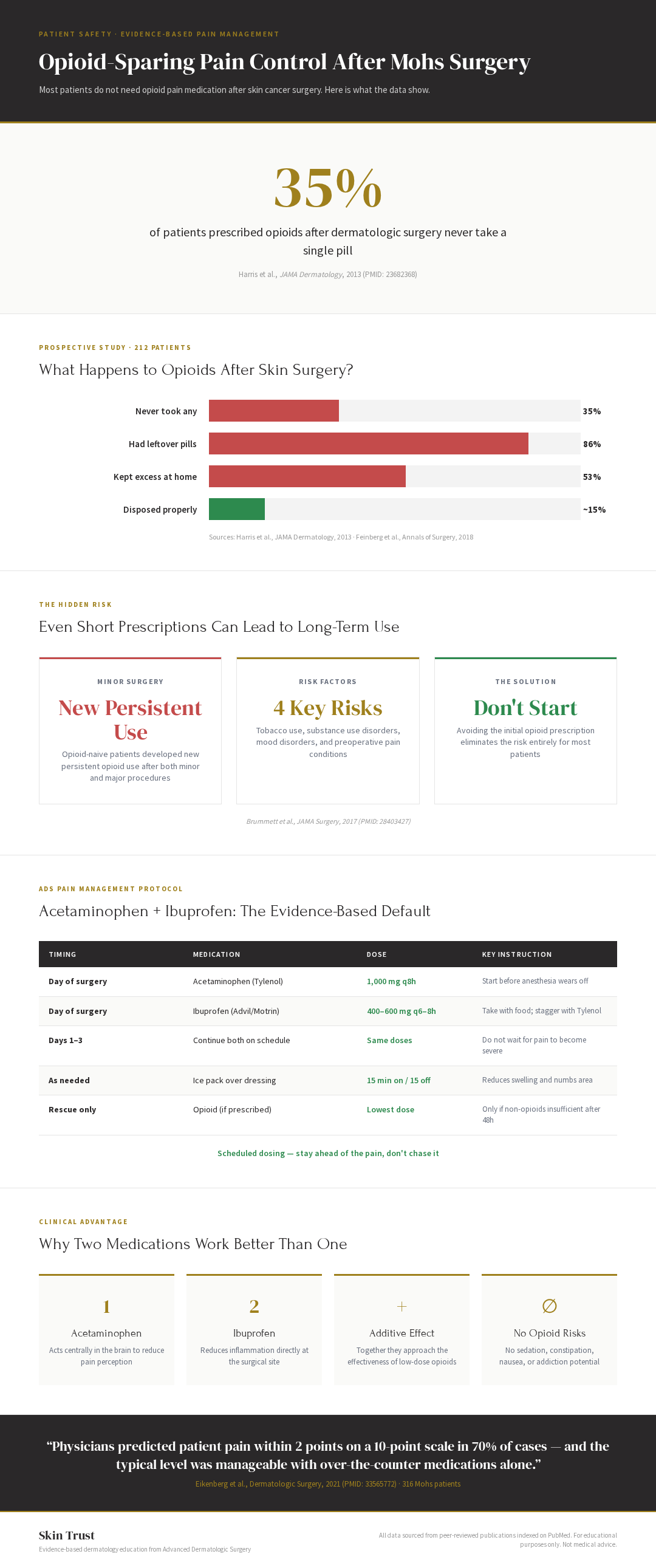
- 35% of patients prescribed opioids never take any; 86% have leftovers that stay in home medicine cabinets — unused pills create diversion, accidental pediatric exposure, and risk of misuse
- Acetaminophen 1000 mg + ibuprofen 400 mg together provides superior pain control to opioids in randomized trials — codeine and opioids add side effects (nausea, constipation, drowsiness) without pain advantage
- Short-term opioid prescriptions can lead to new persistent opioid use even in opioid-naive patients — the risk is documented and real, particularly in patients with mood disorders or substance use history
- Evidence-based pain management defaults to non-opioid approaches — opioids are reserved for exceptional pain that does not respond to standard protocols
- Setting realistic pain expectations before surgery is powerful — patients informed that pain is mild soreness (not severe pain) consistently report better pain control
Evidence Snapshot
- Most opioids go unused: 35% of patients prescribed opioids after dermatologic surgery never take any; 86% have leftover pills (Harris et al., 2013)
- Minor surgery can seed chronic use: New persistent opioid use occurs after both minor and major surgical procedures in opioid-naive patients (Brummett et al., 2017)
- Evidence base: This article cites 6 PubMed-indexed studies including prospective surgical pain evaluations, systematic reviews of postoperative opioid use, and prescribing pattern analyses
How much pain should I expect after Mohs surgery?
Most patients report mild to moderate pain after Mohs surgery — typically peaking the evening of surgery and improving significantly by day two. On a 0-to-10 pain scale, the average is well within the range manageable with over-the-counter medications.
The fear of post-surgical pain is one of the biggest anxieties patients have before Mohs surgery. Many expect it to be excruciating. The reality, confirmed by prospective studies, is reassuringly different.
Eikenberg and colleagues prospectively evaluated 316 patients undergoing Mohs micrographic surgery, asking both the surgeon and the patient to independently rate expected and actual pain on a 0-to-10 scale. Key findings:
- Physician predictions correlated significantly with actual patient pain (p < .001)
- Physician estimates were within 2 points of patient-reported pain in 70% of cases
- Most patients reported evening pain well within the range manageable with acetaminophen and ibuprofen alone
"The single most effective thing a surgeon can do for pain management happens before picking up a scalpel — it is setting expectations. When patients know that the typical experience is mild soreness, not severe pain, they approach recovery with the right mindset. And their mindset matters. Patients who expect severe pain are more likely to perceive mild pain as inadequately controlled. Patients who are told the truth — that this will feel like a bad bruise, not a broken bone — consistently report better experiences."
— Dermatologic Surgery Expert
How many patients actually need opioids after skin surgery?
A prospective study of 212 dermatologic surgery patients found that only 34% were prescribed opioids — and of those, 35% never took a single pill. Among those who filled prescriptions, 86% had leftover medication and 53% planned to keep the excess at home.
The most detailed study of opioid use after dermatologic surgery was published by Harris and colleagues in JAMA Dermatology in 2013. They prospectively followed 212 patients through their surgical and postoperative experience. The findings are striking:
- Only 34% of patients (72 of 212) received opioid prescriptions
- 35% of those prescribed opioids (25 of 72) never used any
- 86% of patients who filled prescriptions (49 of 57) had leftover pills
- 53% of patients with leftover pills (26 of 49) planned to keep them at home
This means that for every 100 dermatologic surgery patients prescribed opioids, roughly 35 never take a pill, and another 40+ take only a fraction of what was prescribed. The vast surplus ends up in medicine cabinets — available for diversion, accidental ingestion by children, or misuse.
A broader systematic review by Feinberg and colleagues confirmed this pattern across all surgical specialties: the majority of postoperative patients consumed 15 pills or fewer, and 70% of patients kept excess opioids rather than disposing of them properly (Feinberg et al., 2018).
Where the unused pills go
| What Happens to Leftover Opioids | Percentage |
|---|---|
| Kept at home (medicine cabinet, drawer) | 53% |
| Planned proper disposal | 4–59% (varies by study) |
| Given to family/friends | Not tracked but documented in literature |
| Available for accidental pediatric ingestion | Any pills kept at home |
Source: Harris et al., 2013, Feinberg et al., 2018
Data sourced from peer-reviewed, PubMed-indexed publications
Can a short opioid prescription after minor surgery lead to long-term use?
Yes. A landmark 2017 study in JAMA Surgery found that new persistent opioid use occurs after both minor and major surgical procedures — even in patients who had never taken opioids before. The risk is not theoretical; it is documented.
This is the finding that should concern every patient and every prescriber. Brummett and colleagues studied opioid-naive patients — people with no prior opioid prescriptions — who underwent various surgical procedures. They found that new persistent opioid use occurred after both minor and major surgery, challenging the assumption that a short postoperative prescription is always harmless.
The risk factors for progression to chronic use included tobacco use, alcohol and substance use disorders, mood disorders, and preoperative pain conditions. But the key takeaway is that the initial prescription — even a short one — opens a door that is difficult to close for some patients.
This is why the default at Your surgeon should a non-opioid approach. The goal is not to withhold pain medication from patients who need it — it is to avoid exposing the majority who do not need it to a medication class with documented addiction potential.
What does an opioid-sparing pain protocol look like?
The evidence supports a default regimen of scheduled acetaminophen (Tylenol) and ibuprofen (Advil/Motrin), with ice and elevation, as first-line pain management after Mohs surgery. This approach controls pain effectively for the vast majority of patients.
The approach Dr. Hocker uses at Your surgeon should straightforward and evidence-based:
ADS post-surgical pain management protocol
| Time | Medication | Dose | Notes |
|---|---|---|---|
| Day of surgery | Acetaminophen (Tylenol) | 1,000 mg every 8 hours | Start before local anesthesia wears off |
| Day of surgery | Ibuprofen (Advil/Motrin) | 400–600 mg every 6–8 hours | Take with food; stagger with acetaminophen |
| Days 1–3 | Continue both on schedule | Same doses | Do not wait for pain to become severe |
| As needed | Ice pack over dressing | 15 minutes on / 15 minutes off | Reduces swelling and numbs the area |
| As needed | Elevation | Keep surgical site above heart level | Reduces throbbing, especially for facial surgery |
| Rescue only | Opioid (if prescribed) | Lowest effective dose, fewest pills | Only if acetaminophen + ibuprofen insufficient after 48 hours |
The critical principle is scheduled dosing — taking acetaminophen and ibuprofen on a regular schedule for the first 48 hours rather than waiting until pain becomes severe. Staying ahead of the pain is far more effective than chasing it.
Why acetaminophen + ibuprofen together?
These two medications work through different mechanisms: acetaminophen acts centrally in the brain, while ibuprofen reduces inflammation at the surgical site. Together, they provide additive pain relief that clinical studies have shown approaches the effectiveness of low-dose opioids — without the sedation, constipation, nausea, or addiction risk.
What should I do if I am prescribed opioids?
If your surgeon prescribes opioid medication, use it only if acetaminophen and ibuprofen are inadequate. Take the lowest effective dose for the shortest time. Dispose of unused pills safely — do not keep them in your medicine cabinet.
For a small percentage of patients — particularly those undergoing large or complex reconstructions, or those with pre-existing pain conditions — opioid medication may be appropriate for a short period. If you receive an opioid prescription:
- Try non-opioid medications first — give acetaminophen + ibuprofen at least 24–48 hours before deciding they are inadequate
- Take the lowest effective dose — if half a pill controls your pain, take half a pill
- Stop as soon as you can — most patients who need opioids after skin surgery need them for 1–2 days, not a week
- Dispose of unused pills safely — do not keep leftover opioids in your home
Safe disposal options
| Method | Where |
|---|---|
| Drug take-back programs | DEA National Prescription Drug Take-Back Day (held annually); year-round collection at many pharmacies |
| FDA-approved disposal | Mix with coffee grounds or cat litter in a sealed bag and place in household trash |
| Pharmacy drop-off | Many CVS, Walgreens, and independent pharmacies have disposal kiosks |
| Do NOT | Flush down the toilet (except specific medications on the FDA flush list) |
How does this fit into the bigger picture of the opioid crisis?
Surgical prescriptions are a documented entry point for chronic opioid use. Reducing unnecessary post-surgical opioid prescribing — particularly after minor outpatient procedures — is one of the most actionable steps the medical system can take.
The opioid epidemic in the United States has claimed over 500,000 lives since 1999. While the crisis involves many factors — illegal fentanyl, heroin, and diversion — surgical prescriptions remain a significant and preventable entry point.
The evidence is clear: patients who receive even short opioid prescriptions after surgery are at measurably higher risk of continuing to use opioids long-term (Brummett et al., 2017). Dermatologic surgery — which is almost entirely outpatient, under local anesthesia, and associated with mild-to-moderate pain — is exactly the setting where non-opioid defaults should be standard.
The recommended protocol is to Dr. Hocker has implemented an opioid-sparing protocol as the default for every patient. Opioids are available when genuinely needed, but they are not the starting point.
How approaches pain management
| Dimension | Average Practice | |
|---|---|---|
| Board Certifications | 3 (Dermatology, Dermatopathology, MSDO — all through ABD/ABMS) | 1–2 |
| Default pain protocol | Acetaminophen + ibuprofen (opioid-sparing) | Varies — many still default to opioid Rx |
| Pre-surgical pain counseling | Yes — realistic expectations set for every patient | Variable |
| Infection Rate | 0.43% (23,000+ cases) | 2.5–8.7% (published literature) |
| Training | Harvard Medical School, Mayo Clinic | Varies |
Frequently Asked Questions
Will Mohs surgery hurt during the procedure?
No. Mohs surgery is performed under local anesthesia — the same type of numbing used for dental work. You will feel the initial injection (a brief sting), but the surgical area is completely numb during the procedure. Most patients report feeling pressure but no pain during the surgery itself.
What is the worst pain day after Mohs surgery?
Typically the evening of surgery and the first morning after. By day two, most patients report significant improvement. By day three to four, most patients have returned to their normal routine with minimal or no discomfort.
Can I take ibuprofen if I am on a blood thinner?
This is a question for your prescribing physician. At ADS, we generally continue all medications during surgery (see our blood thinners article), but adding ibuprofen to an existing anticoagulant regimen requires individualized guidance. Acetaminophen (Tylenol) does not affect blood clotting and is safe for virtually all patients.
My surgeon prescribed 30 opioid pills. Do I need that many?
Almost certainly not. Data shows that the majority of surgical patients use 15 pills or fewer, and many use zero. If you are prescribed opioids, start with non-opioid medications and only use the opioid if those are inadequate. You may not need any of the 30 pills.
I have a history of substance use. What should I tell my surgeon?
Tell your surgeon. This is critical information that directly affects your pain management plan. Surgeons who know about your history can create a safe plan — potentially involving non-opioid alternatives, limited prescriptions, or coordination with your addiction medicine provider. This is not information to withhold out of embarrassment; it is information that keeps you safe.
Is it normal to have zero pain after Mohs surgery?
Yes — some patients report no significant pain at all. This is especially common for procedures on the trunk and extremities. Facial procedures — particularly around the nose and lips — tend to be more uncomfortable, but even these are typically well-controlled with acetaminophen and ibuprofen.
What if acetaminophen and ibuprofen genuinely are not enough?
If you have taken both medications on schedule for 24–48 hours and are still experiencing pain that significantly limits your function, contact your surgeon's office. They can evaluate whether a short course of opioid medication is appropriate for your specific situation. The goal is not to suffer — it is to start with the safest effective option first.
Can I drive after Mohs surgery if I don't take opioids?
Generally yes, as long as you feel comfortable and the surgical dressing does not impair your vision. Patients on opioid medications should not drive. This is another advantage of the non-opioid approach — it preserves your ability to return to normal activities immediately.
References
Harris K, Curtis J, Larsen B, et al. Opioid pain medication use after dermatologic surgery: a prospective observational study of 212 dermatologic surgery patients. JAMA Dermatology. 2013;149(3):317-321. PMID: 23682368
Brummett CM, Waljee JF, Goesling J, et al. New persistent opioid use after minor and major surgical procedures in US adults. JAMA Surgery. 2017;152(6):e170504. PMID: 28403427
Feinberg AE, Chesney TR, Srikandarajah S, Acuna SA, McLeod RS. Opioid use after discharge in postoperative patients: a systematic review. Annals of Surgery. 2018;267(6):1056-1062. PMID: 29215370
Eikenberg JD, Taylor S, Lockhart ER, Prickett K, Phillips MA. Postoperative pain after Mohs surgery: physician perceptions and how those perceptions influence opioid prescribing practices. Dermatologic Surgery. 2021;47(2):170-173. PMID: 33565772
This content is provided for educational purposes only and does not constitute medical advice. Pain management decisions should be made in consultation with your surgeon based on your individual procedure, medical history, and personal risk factors. If you are experiencing a medical emergency or are in crisis related to substance use, call 911 or the SAMHSA National Helpline at 1-800-662-4357. Neither nor Thomas L.H. Hocker, M.D., M.Phil. assumes liability for actions taken based on this information.
