
- Pain is typically mild to moderate (3–5/10) and peaks at 6–12 hours post-op — most patients are surprised by how little pain they experience
- Acetaminophen 1000 mg + ibuprofen 400 mg together every 6 hours is the evidence-based first-line — this combination has superior pain control to either drug alone or codeine in randomized controlled trials
- Do not exceed 3000 mg acetaminophen or 2400 mg ibuprofen per day — these dose limits are firm to prevent liver (acetaminophen) or kidney (ibuprofen) injury
- Codeine and opioids provide no additional benefit — 35% of patients prescribed opioids never take any, and 86% have leftovers; opioids add side effects (nausea, constipation, drowsiness) and dependency risk without pain advantage
- Start pain medication as anesthesia wears off (6–8 hours post-op), not after pain becomes severe — it's easier to prevent pain than treat it once it's peaked
- Most patients need regular dosing for only 3–5 days — after day 5–7, pain is typically minimal and can be managed as needed or discontinued
What Pain Should You Expect After Mohs Surgery?
"Most Mohs patients tell me they were surprised by how little pain they had. We've designed our anesthesia and closure techniques to minimize postoperative discomfort. When pain is controlled with the right medication strategy, recovery is much easier."
One of the most common questions from Mohs surgery patients is: "How much will this hurt?"
The honest answer: Mohs surgery pain is typically mild to moderate—most patients rate their pain 3–5 out of 10 in the first 48 hours. For many, pain is primarily from the wound itself, not from the surgical procedure. Since Mohs surgery is performed under tumescent local anesthesia, the surgical site is completely numb during the procedure. Pain emerges as the anesthesia wears off (typically 6–12 hours post-op).
The good news is that post-operative pain from cutaneous Mohs surgery is very manageable with the right medication strategy. The evidence-based approach uses an evidence-based approach based on high-quality research, not opioids or codeine.
The Evidence-Based First-Line: Acetaminophen + Ibuprofen
Here's where the evidence gets really clear. In 2011, dermatologic surgeon James Sniezek and his team at the University of Pittsburgh (part of the Zitelli Mohs program, one of the largest in the United States) published a randomized controlled trial comparing three postoperative pain regimens in Mohs surgery patients. The results were definitive.
Study Design:
- 180 Mohs patients randomized to three groups
- Group 1: Acetaminophen 1000 mg + ibuprofen 400 mg together every 6 hours
- Group 2: Acetaminophen 1000 mg alone every 6 hours
- Group 3: Acetaminophen 1000 mg + codeine 30 mg every 6 hours
- Pain measured at 6, 12, and 24 hours post-op on a standard pain scale
Results:
- Group 1 (acetaminophen + ibuprofen) had significantly lower pain scores at every time interval compared to the other two groups
- The combination was particularly effective for pain at 6 and 12 hours (the peak pain period)
- Codeine provided no additional benefit over acetaminophen alone
- Adverse effects (nausea, dizziness, constipation) were lowest in Group 1
Key Finding: The acetaminophen + ibuprofen combination was superior to all alternatives tested.
Why does this combination work so well? Acetaminophen and ibuprofen work through different mechanisms:
- Acetaminophen is a central-acting analgesic with some anti-inflammatory properties
- Ibuprofen is a non-steroidal anti-inflammatory drug (NSAID) that reduces inflammation and prostaglandin-mediated pain
Together, they provide synergistic pain relief—better than either alone.
This is the standard recommendation, and it's what Dr. Hocker uses in his own practice with excellent results.
Why NOT Codeine or Opioids?
The Sniezek study makes it clear: codeine offers no additional pain relief compared to acetaminophen alone, yet it adds side effects (nausea, dizziness, constipation, drowsiness, dependency risk).
Modern surgical guidelines have largely moved away from opioid prescriptions for minor cutaneous procedures because:
- No evidence of additional benefit for this specific injury (small cutaneous wound)
- Side effects are common: nausea, vomiting, constipation, drowsiness, impaired cognition
- Dependency and abuse risk: Even short-term opioid exposure can lead to psychological dependence
- Slower healing: Opioids can impair immune function and potentially delay healing
- Better alternatives exist: The acetaminophen + ibuprofen combination is more effective
The recommended standard does not routinely prescribe opioids for Mohs surgery pain. If you have had previous opioid prescriptions after dermatologic procedures, that was likely outdated practice. The evidence now clearly favors non-opioid approaches.
Dosing: The Right Schedule and Limits
First-line regimen:
| Medication | Dose | Frequency | Maximum Daily |
|---|---|---|---|
| Acetaminophen | 1000 mg | Every 6 hours | 3000 mg/day |
| Ibuprofen | 400 mg | Every 6 hours | 2400 mg/day |
| Take together | Both | Every 6 hours | See limits above |
How to take it:
- Take both medications at the same time (e.g., 8 AM, 2 PM, 8 PM, 2 AM if pain is significant at night)
- You can mix them in one dose—they're compatible
- Take with food if your stomach is sensitive
Maximum daily limits are firm:
- Do not exceed 3000 mg acetaminophen in 24 hours (that's three 1000 mg doses)
- Do not exceed 2400 mg ibuprofen in 24 hours (that's six 400 mg doses)
Important: If you have kidney disease, liver disease, or are taking certain medications (blood thinners, methotrexate), check with your surgeon or pharmacist before starting ibuprofen.
Timing: When to Start and How Long to Take
When to start:
- Begin this regimen as soon as anesthesia is wearing off and pain is emerging (typically 6–8 hours post-op)
- Do not wait until pain is severe—it's easier to prevent pain than treat it
How long to take:
- Most patients: 3–5 days of regular dosing (acetaminophen + ibuprofen every 6 hours)
- After day 3: Pain should be noticeably better; many patients can switch to as-needed dosing
- By day 5–7: Most pain is gone; you can discontinue unless pain persists
- High-tension wounds or large wounds: May need regular dosing for 7–10 days
Do not:
- Stop pain medication abruptly if you've been taking it regularly for more than a few days (taper gradually)
- Skip doses to "see if you need them"—consistent dosing prevents pain better than reactive dosing
What You Should NOT Take
Aspirin alone: While aspirin is fine to continue if you take it chronically (blood thinner), do not use aspirin as an over-the-counter pain reliever. NSAIDs like ibuprofen are preferred for postoperative pain.
Opioids unless prescribed: As discussed, opioids are not first-line and provide no additional benefit. If a provider prescribes them, you have the right to ask why (and often the answer will be outdated practice).
Herbal supplements that affect bleeding:
- Garlic supplements
- Ginger supplements
- Turmeric/curcumin
- St. John's Wort
- Fish oil or omega-3 supplements (if high-dose)
These can increase bleeding or interact with blood thinners. Avoid them for 1–2 weeks post-op.
Alcohol: Alcohol interferes with pain medication metabolism and can increase bleeding risk. Avoid alcohol while taking pain medications.
Ice Use in the First 24 Hours
Ice can reduce pain, swelling, and inflammation in the immediate post-operative period.
Ice protocol:
- Apply ice for 20 minutes, then remove for 20 minutes (20 on, 20 off)
- Do this for the first 6–12 hours post-op
- Wrap ice in a clean cloth—never apply ice directly to skin or an open wound
- Stop ice after 24 hours (warmth is more helpful after 24 hours for inflammation)
Effect: Ice can reduce pain by 1–2 points and noticeably reduces swelling.
Pain by Surgical Site: What to Expect
Pain severity varies by wound location due to differences in nerve density, periosteal attachment, and movement:
Scalp (most painful, 6–8/10):
- Richly innervated and attached to periosteum
- Movement from talking and facial expressions causes discomfort
- Pain typically peaks at 12–24 hours
- May need regular pain medication for 5–7 days
- Expect pain to linger longer than other sites
Face, ears, and nose (moderate, 4–6/10):
- Well-innervated but less tension than scalp
- Pain typically manageable with the recommended regimen
- Pain usually improves significantly by day 3–4
Trunk (mild, 2–4/10):
- Lower nerve density
- Less tension and movement
- Most patients require pain medication for only 2–3 days
- By day 3, many patients can discontinue medication
Upper extremity (arms, hands) (moderate, 3–5/10):
- Moderate pain due to hand movement
- Hands are constantly in use, so motion irritates the wound
- Expect 3–5 days of regular pain medication
- Consider a protective bandage to limit wound motion
Lower extremity (shins, ankles, feet) (moderate–high, 4–7/10):
- Pain worsened by gravity and standing/walking
- Legs are constantly in motion, even at rest
- Expect 5–7 days of regular medication
- Elevation helps reduce pain and swelling
Joints (elbows, knees, shoulders) (high, 5–8/10):
- Joints move constantly, irritating the wound
- Pain can persist longer (7–10 days) due to continuous motion
- Immobilization (sling, splint) can help reduce pain
When Pain Signals a Problem (Call Your Surgeon)
Most postoperative pain improves steadily and is gone by 7–10 days. Call your surgeon immediately if:
Pain increases after 48–72 hours: Pain should follow a trajectory: high at 6–12 hours, improving by 24 hours, noticeably better by 48–72 hours, and minimal by day 7. If pain increases after day 2, this suggests infection, hematoma, or wound complications.
Pain 8/10 or higher uncontrolled: This level of pain is not typical for Mohs surgery and may indicate a complication.
Pain accompanied by:
- Increasing redness or warmth
- Pus or foul-smelling drainage
- Fever (>101°F)
- Swelling that worsens after day 2
- Bleeding that doesn't stop with 10 minutes of pressure
- Wound opening or gaping
These are signs of infection, hematoma, or dehiscence (wound opening), not just "normal" pain.
Sudden sharp pain or "pop" sensation: This can indicate a hematoma forming or wound dehiscence. Call your surgeon.
Blood Thinners and Pain Medication: Safe Combination
One concern patients often have: "Can I take ibuprofen if I'm on aspirin or another blood thinner?"
Yes. The recommended protocol is to our protocol is to continue all blood thinners AND use ibuprofen for pain management. Here's why:
The risk-benefit calculation:
- Risk of stopping blood thinners: Stroke, blood clots, myocardial infarction—these are life-threatening
- Risk of ibuprofen + blood thinner: Slightly increased bleeding at the surgical site, which is easily managed
Modern literature shows that NSAIDs + anticoagulants in postoperative cutaneous surgery are safe. You may bleed slightly more during the procedure and have more bruising afterward, but complications are rare.
Exceptions: If you have:
- Severe kidney disease (creatinine >3.0)
- History of bleeding ulcers
- Severe liver disease
...discuss NSAID use with your surgeon and primary care physician. But even in these cases, stopping blood thinners is usually not recommended.
The combination to avoid: Do not combine NSAIDs with certain anticoagulants like dabigatran at the highest doses without medical consultation. Your surgeon will know your medications and can advise accordingly.
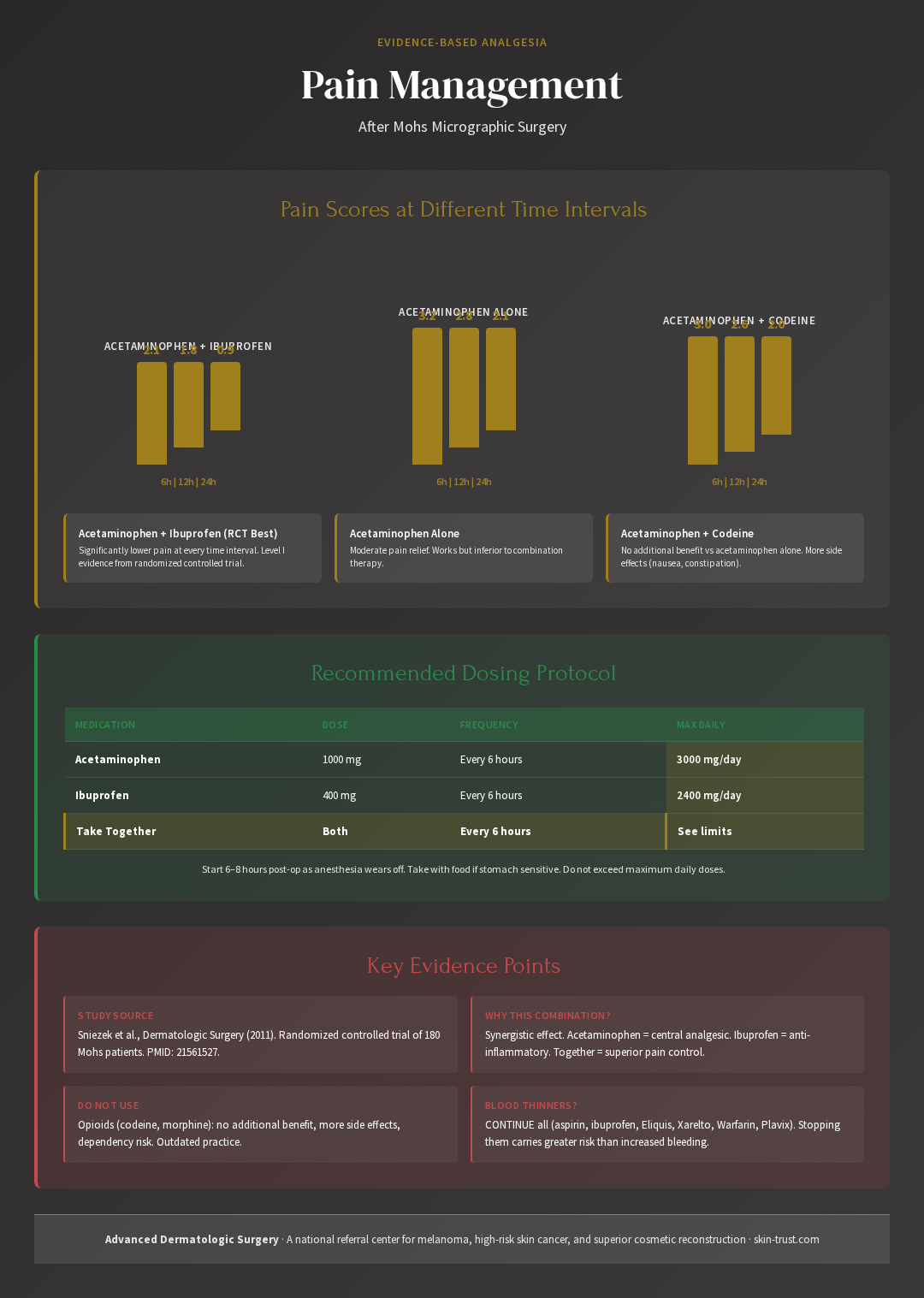
Data sourced from peer-reviewed, PubMed-indexed publications
Frequently Asked Questions
Q: How much pain should I expect after Mohs surgery?
A: Most patients experience mild to moderate pain (3–5/10) that peaks 6–12 hours post-op. Pain should improve steadily, becoming minimal by day 5–7. Scalp wounds are typically more painful (6–8/10) due to nerve density. Facial wounds are usually milder (2–4/10).
Q: When should I start taking pain medication?
A: Begin as anesthesia is wearing off (typically 6–8 hours post-op). Do not wait until pain is severe—it's easier to prevent pain than treat it. Take the first dose of acetaminophen + ibuprofen as soon as you notice the area becoming tender.
Q: Can I take just acetaminophen without ibuprofen?
A: You can, but the evidence shows it's not optimal. The Sniezek study clearly demonstrated that the combination of acetaminophen + ibuprofen is superior to acetaminophen alone. Unless you have a specific reason to avoid ibuprofen (kidney disease, allergy, severe GI issues), the combination is the evidence-based choice.
Q: Is ibuprofen safe if I take aspirin or a blood thinner?
A: Yes. The recommended protocol is to continue all blood thinners and use ibuprofen for pain management. The risk of stopping blood thinners (stroke, clots) far exceeds the risk of slightly increased bleeding from surgery. You may have more bruising, but complications are rare.
Q: Can I take opioid pain medication instead?
A: Unless specifically prescribed by your surgeon for a specific reason, opioids are not recommended. Research shows opioids provide no additional pain relief compared to acetaminophen + ibuprofen, yet they carry risks of nausea, constipation, drowsiness, and dependency. The evidence-based approach is non-opioid analgesia.
Q: How long will I need pain medication?
A: Most patients take pain medication regularly for 3–5 days and then switch to as-needed dosing. By day 7, most pain is gone. Scalp wounds or large wounds may require regular medication for 7–10 days. Listen to your body—if pain is controlled and minimal, you can discontinue.
Q: What if ibuprofen gives me stomach upset?
A: Take ibuprofen with food (a meal or snack). If you have a history of stomach ulcers or gastroesophageal reflux disease (GERD), let your surgeon know before surgery—you may be prescribed a gastroprotective agent. You can also consider taking ibuprofen less frequently (only every 12 hours instead of every 6) and relying more on acetaminophen.
Q: Can I use ice to reduce pain?
A: Yes. Ice for 20 minutes followed by 20 minutes off for the first 6–12 hours post-op can reduce pain, swelling, and inflammation by 1–2 points. Never apply ice directly to an open wound—wrap it in a clean cloth first. Stop ice after 24 hours.
Q: Is it normal for pain to increase after 48 hours?
A: No. Pain should follow a predictable trajectory: high at 6–12 hours, noticeably better by 24–48 hours, minimal by day 5–7. If pain increases after day 2, this suggests a complication (infection, hematoma, wound opening). Call your surgeon.
Q: Can I take alcohol with pain medication?
A: No. Alcohol interferes with pain medication metabolism, can increase bleeding risk, and may cause additional drowsiness or dizziness. Avoid alcohol while taking pain medications (typically the first 3–5 days post-op).
Q: What if my pain doesn't improve with acetaminophen + ibuprofen?
A: First, ensure you're taking the correct doses and timing (1000 mg acetaminophen + 400 mg ibuprofen every 6 hours). If pain remains uncontrolled after 24 hours, contact your surgeon—uncontrolled pain can indicate a complication requiring evaluation.
References
Sniezek, JC., Brodland, DG., Zitelli, JA. (2011). "A Randomized Controlled Trial of Intraoperative Anesthesia Infiltration Followed by Postoperative Analgesics in Mohs Surgery." Dermatologic Surgery, 37(9), 1332–1339. PMID: 21561527.
Maragh, SL., Brown, MD. (2008). "Mohs Micrographic Surgery." Journal of the American Academy of Dermatology, 59(6), 1008–1017. PMID: 18638628.
Smack, DP., Harrington, AC., Dunn, C., et al. (1996). "Infection and Allergy Incidence in Ambulatory Surgery Patients Using White Petrolatum vs Bacitracin Ointment." JAMA, 276(13), 972–977. PMID: 8805732.
Medical Disclaimer
This article is educational and does not constitute medical advice. The evidence-based approach and Dr. Thomas Hocker, M.D., M.Phil., do not diagnose, treat, or provide medical advice through this content.
**
Pain management is individualized based on your age, medical conditions, medications, and type of procedure. The recommendations in this article are general guidelines based on evidence. Always follow post-operative instructions provided by your surgeon. If you have questions about your specific medication regimen, contact your surgeon or pharmacist.
For complications or uncontrolled pain during recovery, contact Dr. Hocker's office immediately. Do not delay seeking in-person evaluation.
