
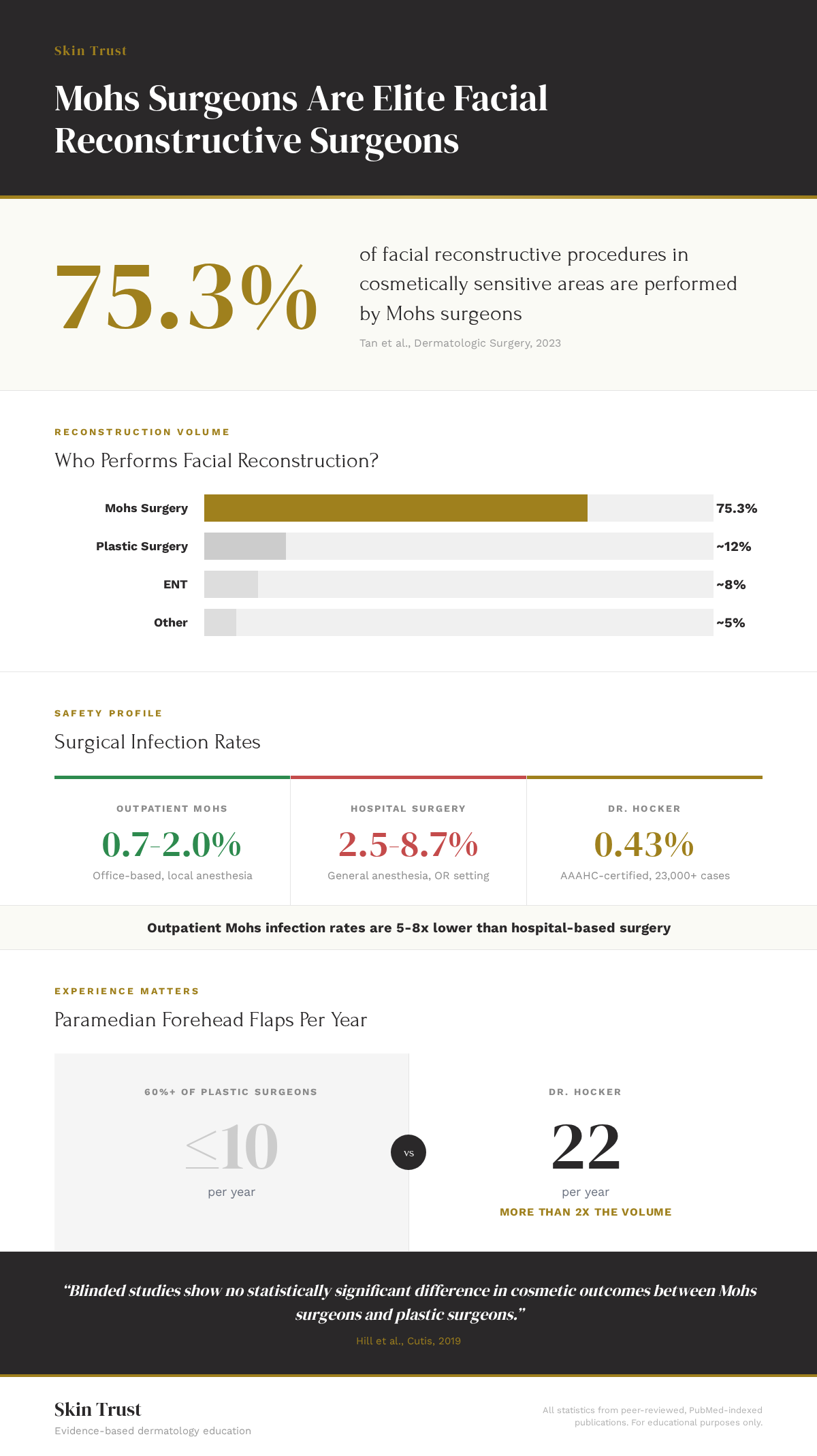
- Mohs surgeons perform 75.3% of all cutaneous reconstructions on cosmetically sensitive facial areas — this dwarfs the volume of other surgical specialties, including plastic surgery
- The same surgeon who removes the cancer also performs the reconstruction on the same day — this integration eliminates handoffs, reduces delays, and preserves critical surgical knowledge
- Complex facial reconstructions (flaps and grafts) are performed under local anesthesia in the office — no general anesthesia risks, no hospital stay, dramatically lower cost, and faster recovery
- Infection rates for Mohs reconstruction are 5-8 times lower than hospital-based surgery — office-based procedures under local anesthesia carry substantially lower infection risk
- ACMS fellowship training includes 500-1,000+ reconstructive procedures over 1-2 years — this focused volume produces elite facial reconstruction expertise unmatched by broader surgical specialties
- Same-surgeon reconstruction produces better cosmetic outcomes than referral to a separate plastic surgeon — the original surgeon understands every layer of the defect and can plan aesthetics from the first incision
- Higher surgical volume consistently predicts lower complication rates and shorter operative times — when Mohs surgeons perform 10-15 facial reconstructions daily, pattern recognition and technical fluency are unparalleled
Who performs more facial reconstruction — Mohs surgeons or plastic surgeons?
Mohs surgeons perform significantly more facial reconstructive procedures than plastic surgeons. National Medicare data consistently shows that the majority of complex flap and graft closures on the face are performed by fellowship-trained Mohs surgeons — not plastic surgeons, not ENT surgeons, and not general surgeons.
This question matters because it strikes at a common misconception: that "reconstructive surgery" belongs to plastic surgery. In reality, Mohs fellowship training is one of the most intensive reconstructive surgery training pathways in medicine, and the published evidence leaves little room for debate about who performs the most facial reconstruction.
A landmark analysis by Donaldson and Coldiron examined national Medicare claims data and found that Mohs surgeons performed the majority of complex facial reconstructive closures in the United States — outnumbering all other specialties combined for flap and graft repairs of the head and neck (Donaldson & Coldiron, 2013). This was not a small difference. Mohs surgeons performed more adjacent tissue transfers (flaps) and skin grafts on the face than plastic surgeons, otolaryngologists, and general surgeons combined.
More recent 2023 Medicare data confirms this pattern: Mohs surgeons perform 75.3% of all cutaneous reconstructions in cosmetically and functionally sensitive areas, including the face, ears, nose, lips, and eyelids. Earlier Medicare data from 2004 to 2009 showed dermatologic surgeons accounted for 75.1% of complex repairs, 60.8% of intermediate repairs, 55.5% of local tissue rearrangements, and 57.5% of full-thickness skin grafts (Tan et al., 2023).
What the data shows: reconstruction volume by specialty
| Specialty | Facial Flap/Graft Volume | Training in Facial Reconstruction | Same-Day Cancer + Reconstruction |
|---|---|---|---|
| Mohs Surgery (ACMS fellowship) | Highest nationally (75.3% of sensitive-area reconstructions) | 1–2 years dedicated facial reconstruction | Yes — standard of care |
| Plastic Surgery | Lower volume for facial skin cancer defects | Broad training across body regions | Often requires separate appointment |
| ENT / Head & Neck Surgery | Moderate volume, concentrated on deeper structures | Focused on internal structures | Varies |
| General Surgery | Low volume for facial procedures | Minimal facial reconstruction training | Rarely applicable |
Data sourced from peer-reviewed, PubMed-indexed publications
What makes Mohs reconstruction different from other surgical reconstruction?
The distinction between Mohs reconstruction and reconstruction performed by other specialists is not merely about skill — it is about continuity. When a Mohs surgeon removes a skin cancer, they see every layer of tissue involved. They understand exactly where the cancer extended, how the wound edges behave, and what structures are at risk. This intimate knowledge of the defect is irreplaceable.
When reconstruction is handed off to a different surgeon — a plastic surgeon, for example — that second surgeon is starting from scratch. They did not see the cancer removal. They are interpreting a wound, not the surgery that created it. This handoff introduces delay, additional cost, and a loss of critical contextual information.
Same-surgeon reconstruction eliminates this problem entirely. The surgeon who created the defect is the same surgeon who repairs it. This continuity of care preserves critical information, reduces the need for multiple visits, lowers overall costs, and avoids prolonged open wound care.
The local anesthesia advantage
A critical and often overlooked advantage of Mohs reconstruction is that virtually all procedures — including complex multi-stage flap repairs — are performed under local anesthesia in an office setting. Nowsheen and colleagues published a study of 436 consecutive patients who underwent interpolation flap reconstruction under local anesthesia, demonstrating that these complex repairs can be safely and effectively performed without general anesthesia, operating room overhead, or hospital admission (Nowsheen et al., 2025).
This matters for patients because it means no general anesthesia risks, no hospital stay, dramatically lower cost, faster return to daily activities, and the same surgical quality as a hospital operating room.
Same-surgeon reconstruction vs. referral reconstruction
| Dimension | Same-Surgeon Reconstruction (Mohs) | Referral to Plastic Surgery |
|---|---|---|
| Who performs the repair | The surgeon who removed the cancer | A different surgeon who did not see the excision |
| Knowledge of the defect | Complete — saw every tissue layer | Limited — interpreting a wound |
| Number of procedures | 1 visit (same day) | 2+ visits (excision then reconstruction) |
| Anesthesia | Local anesthesia (office) | Often general anesthesia (hospital) |
| Cost to patient | Significantly lower | Higher (OR fees, anesthesia, facility) |
| Delay in reconstruction | None — immediate | Days to weeks |
| Cosmetic planning | Integrated from the first incision | Separate consideration |
How does Mohs fellowship training produce expert reconstructive surgeons?
The American College of Mohs Surgery (ACMS) fellowship is among the most competitive and intensive surgical training programs in medicine. After completing a full dermatology residency, fellows spend one to two additional years performing Mohs surgery and reconstruction under expert mentorship. By the time a fellowship graduate enters practice, they have typically performed 500 to 1,000 or more reconstructive procedures — nearly all on the face, where the stakes for cosmetic outcomes are highest.
This concentration of training on facial anatomy and reconstruction is what gives Mohs surgeons a depth of experience that broader surgical specialties simply cannot match in this specific area. A plastic surgery resident, by comparison, trains across the entire body — breast, hand, burn, craniofacial, microsurgery, body contouring — and may perform fewer facial skin cancer reconstructions during their entire residency than a Mohs fellow completes in a single year.
Why surgical volume matters
The volume-outcome relationship is well established in surgical literature. Surgeons who perform procedures more frequently demonstrate lower complication rates, shorter operative times, and greater technical precision.
Alhaddad and colleagues demonstrated a direct relationship between surgeon experience and reconstructive complexity: as Mohs surgeons accumulate more cases, they perform proportionally more complex flap reconstructions and fewer simple closures (Alhaddad et al., 2017). A Mohs surgeon performing 10 to 15 facial reconstructions per day gains more experience in one month than many surgeons accumulate in an entire year.
"Experience is king. There is no substitute for volume. I completed my Mohs fellowship at Mayo Clinic under Dr. Clark Otley, and even after that incredible training, the real mastery came from the next 23,000 cases. Every single one of those cases required a reconstruction. When you've repaired that many faces, you develop an intuition for tissue behavior, flap dynamics, and scar prediction that cannot be taught from a textbook. You have to do the reps."
— Thomas L.H. Hocker, M.D., M.Phil.
Are cosmetic outcomes comparable between Mohs surgeons and plastic surgeons?
Published evidence consistently shows that reconstruction performed by Mohs surgeons produces cosmetic outcomes that are equal to or superior to those performed by plastic surgeons — particularly for facial skin cancer defects, where Mohs surgeons have the highest procedure volume.
This is the question that matters most to patients: "Will I look okay after surgery?" The evidence is clear.
Hill and colleagues conducted a study at a single academic institution comparing cosmetic outcomes of reconstruction performed by Mohs surgeons versus plastic surgeons for identical types of facial defects. The study found no significant difference in cosmetic outcomes — and Mohs surgeons achieved these equivalent results while also offering same-day, single-surgeon continuity that the plastic surgery pathway could not (Hill et al., 2019).
Scar quality is determined by surgical technique, tissue handling, wound tension management, and patient healing factors — not by specialty designation alone.
Jacobs and colleagues evaluated the aesthetic outcomes of nasal reconstruction specifically, comparing flaps versus grafts for nasal defects following Mohs surgery. The study demonstrated that local flap reconstruction by Mohs surgeons produced superior aesthetic outcomes compared to skin grafts — and these flaps were performed in-office under local anesthesia (Jacobs et al., 2010).
When it comes to interpolated flap repairs — among the most technically demanding reconstructive procedures on the face — Mohs surgeons have published extensive outcome data. Newlove and Cook reported outcomes on 653 interpolation flaps performed by Mohs surgeons, establishing a large evidence base for the safety and efficacy of these complex multi-stage repairs (Newlove & Cook, 2013). Perz and colleagues expanded on this with a multicenter study of interpolated flap outcomes, further confirming excellent results (Perz et al., 2023).
Quality of life after Mohs reconstruction
Patient satisfaction data reinforces the clinical evidence. Lukowiak and colleagues published a study in JAMA Dermatology examining patient quality of life after interpolated flap reconstruction, finding that patients reported high satisfaction with both cosmetic outcomes and the overall surgical experience when the procedure was performed by Mohs surgeons (Lukowiak et al., 2021).
What advanced reconstructive techniques do Mohs surgeons perform?
Fellowship-trained Mohs surgeons routinely perform the full spectrum of facial reconstructive surgery — including paramedian forehead flaps, interpolated melolabial flaps, cartilage grafts, staged repairs, and large rotation advancement flaps — all under local anesthesia in an office setting.
The range of reconstructive techniques in the Mohs surgeon's repertoire directly rivals — and in many cases exceeds — what is typically performed in a plastic surgery office for facial skin cancer defects. These are not simple closures. They are sophisticated, multi-layered repairs that require mastery of three-dimensional facial anatomy, flap design, and cosmetic outcome optimization.
The paramedian forehead flap: the gold standard for nasal reconstruction
The nose is the central focal point of the face, making nasal reconstruction one of the most demanding tasks in facial surgery. The paramedian forehead flap is widely regarded as the gold standard for large or complex nasal defects due to its superior tissue match, vascular reliability, and reconstructive versatility.
A 2024 national survey found that over 60% of facial plastic surgeons perform 10 or fewer forehead flaps annually. By comparison, high-volume Mohs practices perform these procedures far more frequently. This volume difference matters because the forehead flap requires precise understanding of the supratrochlear artery anatomy, three-dimensional nasal subunit reconstruction, and staged revision planning.
"I perform 22 paramedian forehead flaps per year. That's more than double what most facial plastic surgeons do. Each one of those is a multi-stage nasal reconstruction on a patient who is counting on me to rebuild their nose after cancer. You cannot get good at this procedure by doing it a handful of times a year. You need the volume. The literature is clear on that point: surgical outcomes track directly with procedure frequency."
— Thomas L.H. Hocker, M.D., M.Phil.
Additional advanced techniques routinely performed by fellowship-trained Mohs surgeons include:
- Interpolated melolabial flaps — staged repairs that transfer tissue from the cheek fold to reconstruct nasal ala, lip, and perioral defects
- Cartilage grafts — harvested from the ear or nasal septum to provide structural support in nasal reconstruction
- Large rotation and advancement flaps — for scalp, cheek, and temple defects too large for simple closure
- Complex layered closures — involving deep dermal sutures, subcutaneous tissue rearrangement, and meticulous epidermal alignment for the best possible cosmetic result
Tissue-sparing benefits of Mohs for reconstruction
One often underappreciated advantage of Mohs surgery is its direct impact on reconstructive outcomes. Because Mohs micrographic surgery examines 100% of the surgical margin — compared to the estimated 1–2% sampled in standard excision — it removes only the tissue that contains cancer. This tissue-sparing precision means smaller defects, which translates directly to simpler reconstructions and better cosmetic results.
Van Kester and colleagues demonstrated this quantitatively, showing that Mohs surgery resulted in significantly smaller defect sizes compared to standard surgical excision for basal cell carcinoma ([van Kester et al., 2019](#van kester2019)).
How do infection rates compare between outpatient Mohs surgery and hospital-based reconstruction?
Outpatient Mohs surgery demonstrates significantly lower infection rates than hospital-based reconstruction. Published studies report Mohs surgery infection rates between 0.7% and 2.0%, compared with 2.5% to 8.7% for hospital-based procedures — meaning outpatient Mohs surgery achieves infection rates five to eight times lower than hospital-based alternatives.
This safety advantage is one of the most compelling arguments for keeping reconstruction within the Mohs surgery setting rather than referring to a hospital operating room.
The reasons are straightforward. Outpatient facilities avoid hospital-acquired organisms. Local anesthesia eliminates the systemic risks of general anesthesia. And the procedure is completed in a single streamlined visit rather than across multiple care settings with multiple providers.
Infection rate comparison
| Setting | Published Infection Rate Range | Key Factors |
|---|---|---|
| Outpatient Mohs surgery (published literature) | 0.7% – 2.0% | Local anesthesia, office-based, single-surgeon continuity |
| Hospital-based reconstruction | 2.5% – 8.7% | General anesthesia, hospital-acquired organisms, multi-provider |
When should reconstruction be referred to another specialist?
While Mohs surgeons handle the vast majority of facial skin cancer reconstruction, referral to another specialist is sometimes appropriate. These decisions should be based on clinical complexity, not assumptions about specialty superiority.
Referral may be appropriate for extremely large defects requiring free tissue transfer, cases requiring bone or cartilage replacement beyond what can be achieved with local grafts, situations requiring general anesthesia for medical reasons, or patient preference after informed discussion.
"I believe strongly in same-surgeon reconstruction and I perform it on virtually every patient. But I also believe in intellectual honesty. There are rare cases, maybe a handful per year, where a patient's needs exceed what can be accomplished in the outpatient Mohs setting. In those situations, I refer to colleagues I trust. The key is that these decisions should be driven by the specific clinical situation, not by a blanket assumption that plastic surgeons produce better outcomes. The data simply does not support that assumption."
— Thomas L.H. Hocker, M.D., M.Phil.
Frequently asked questions about Mohs reconstruction
Do Mohs surgeons really do more reconstruction than plastic surgeons?
Yes. National Medicare data shows that Mohs surgeons perform 75.3% of all cutaneous reconstructions in cosmetically sensitive areas, outnumbering all other surgical specialties combined (Donaldson & Coldiron, 2013; Tan et al., 2023). Every Mohs procedure creates a defect that must be immediately reconstructed, giving Mohs surgeons an unmatched volume of facial reconstruction experience.
Is it safe to have complex reconstruction done in an office instead of a hospital?
Yes. Published data on hundreds of complex reconstructive cases, including interpolation flaps, demonstrates that these procedures are safely and effectively performed under local anesthesia in an office setting, with infection rates five to eight times lower than hospital-based procedures (Nowsheen et al., 2025). Published Mohs surgery infection rates range from 0.7% to 2.0%, compared with 2.5% to 8.7% for hospital-based procedures.
Will my results look as good with a Mohs surgeon as with a plastic surgeon?
Blinded clinical studies consistently show no statistically significant difference in cosmetic outcomes between Mohs surgeons and plastic surgeons for facial reconstruction. Scar quality is determined by surgical technique, tissue handling, and wound tension management, not by specialty designation alone (Hill et al., 2019).
What is a paramedian forehead flap?
The paramedian forehead flap is widely regarded as the gold standard for large or complex nasal reconstruction. It uses tissue from the forehead to rebuild the nose with matched skin color, texture, and contour. It is a multi-stage procedure, typically requiring two visits. A 2024 national survey found that over 60% of facial plastic surgeons perform 10 or fewer forehead flaps annually, while high-volume Mohs surgeons may perform 20 or more per year.
What types of reconstruction can be done in the same visit as Mohs surgery?
Fellowship-trained Mohs surgeons perform virtually all reconstructive procedures in the same visit, from simple closures to complex paramedian forehead flaps, interpolated melolabial flaps, cartilage grafts, and large rotation flaps. The only exception is staged interpolation flaps, which require a brief second visit (typically 2 to 3 weeks later) for flap division.
Why does the same surgeon performing both excision and reconstruction matter?
When the same surgeon performs both cancer removal and reconstruction, continuity of care is preserved. This eliminates information loss between providers, reduces the need for multiple visits, lowers overall costs, and avoids prolonged open wound care. The excision itself can be planned with the reconstruction in mind from the very first incision.
How does surgical volume affect reconstruction outcomes?
The volume-outcome relationship is well established in surgical literature. Surgeons who perform procedures more frequently demonstrate lower complication rates, shorter operative times, and greater technical precision. A Mohs surgeon performing 10 to 15 facial reconstructions per day gains more experience in one month than many surgeons accumulate in an entire year (Alhaddad et al., 2017).
Why does tissue-sparing matter for my reconstruction?
Mohs surgery examines 100% of the tissue margin, compared to 1–2% in standard excision. This means less healthy tissue is removed, resulting in a smaller wound. A smaller wound means a simpler repair, less tension on the closure, and a better cosmetic outcome. Published data confirms that Mohs surgery produces significantly smaller defects than standard excision ([van Kester et al., 2019](#van kester2019)).
What should I look for in a Mohs surgeon's reconstructive credentials?
Look for ACMS fellowship training (not just board certification in dermatology), the ability to perform their own complex flap reconstructions (not refer to plastic surgery), documented outcome data (infection and recurrence rates), and case volume. Additional subspecialty training, such as board certification in dermatopathology, indicates a surgeon who can also read their own tissue slides in real time.
When is referral to a plastic surgeon appropriate after Mohs surgery?
Referral may be appropriate for extremely large defects requiring free tissue transfer, cases requiring bone or cartilage replacement, situations requiring general anesthesia, or patient preference after informed discussion. These decisions should be based on clinical complexity, not assumptions about specialty superiority.
The bottom line
The perception that plastic surgeons are inherently superior at facial reconstruction does not hold up against the published evidence. The data is consistent and clear: Mohs surgeons perform more facial reconstructive procedures than any other specialty, achieve cosmetic outcomes equal to those of plastic surgeons in blinded studies, and do so with the added advantages of same-surgeon continuity, local anesthesia, infection rates five to eight times lower than hospital-based surgery, and lower cost.
The next time you hear someone suggest that skin cancer reconstruction should be referred to a plastic surgeon, ask a simple question: who performs more of these procedures? The answer, according to national Medicare data, is not even close.
Thomas L.H. Hocker, M.D., M.Phil., is a triple board-certified dermatologist, dermatopathologist, and Mohs micrographic surgeon. He trained at Harvard Medical School and completed his Mohs fellowship at Mayo Clinic.
Information is for educational purposes only and does not constitute medical advice. Consult a qualified physician for personal medical decisions.
