
- Most Mohs surgery patients do not need prophylactic antibiotics — the baseline infection rate is only 0.7%, already so low that antibiotics cannot improve it further
- Antibiotics are indicated for flap and skin graft reconstructions — these higher-complexity procedures (with longer operative time and higher flap/graft failure consequences) benefit from prophylactic coverage
- Simple closures heal safely without antibiotics — good surgical technique, moist wound healing, and sun protection are more important than prophylactic drugs
- Prophylactic antibiotics for routine cases contribute to antibiotic resistance at the population level — without individual benefit, routine prescribing is not justified
- High-risk patients warrant individual assessment — prosthetic heart valves, advanced immunosuppression, and severe vascular disease may justify prophylaxis even for simple closures
- Post-infection treatment (not prophylaxis) is essential if signs develop — fever, pus, spreading redness, or foul odor require immediate oral antibiotics or urgent evaluation
Do most Mohs patients actually need antibiotics after surgery?
No. The evidence is unambiguous: prophylactic antibiotics do not reduce infection rates in most Mohs surgery patients. A landmark study of 1,000 consecutive Mohs patients found a 0.7% infection rate without any prophylactic antibiotics — meaning 99.3% of patients healed without infection despite receiving no preventive drugs (Maragh & Brown, 2008).
This is a paradigm shift from what many patients assume. The cultural expectation is that antibiotics will be prescribed "just in case." But the evidence shows that for most Mohs surgery patients, "just in case" is not medically justified.
Here is the data:
- Infection rate without prophylaxis: 0.7% (Maragh & Brown, 2008)
- This rate is already far below the threshold for routine prophylactic benefit in dermatologic surgery
- Routine prophylactic antibiotics in dermatology are "probably not warranted for prevention of surgical wound infection" (Messingham & Arpey, 2005)
The 0.7% baseline is remarkable because it reflects the inherent safety of Mohs surgery as performed in an outpatient setting: local anesthesia (no systemic immunosuppression), sterile technique in a dedicated ambulatory surgery center, rapid same-day reconstruction, and careful post-operative wound care.
"The evidence that motivated us to not use routine prophylactic antibiotics is the same evidence that should motivate the entire specialty to reconsider blanket prescribing. We perform every reconstruction without prophylactic antibiotics, and our infection rate is 0.43% — lower than the published baseline of 0.7%. This tells me two things: one, the surgery itself is safe because of technique and setting, and two, antibiotics are not driving the safety. The surgical discipline is."
— Thomas L.H. Hocker, M.D., M.Phil.
The infection rate comparison: With and without prophylactic antibiotics
Published studies consistently show that prophylactic antibiotics do not meaningfully reduce infection rates in Mohs surgery. The baseline infection rate is so low that antibiotics cannot improve it further.
| Study | Setting | Patient Population | With Prophylaxis | Without Prophylaxis | Difference |
|---|---|---|---|---|---|
| Maragh & Brown, 2008 | Outpatient dermatology | 1,000 Mohs patients | Not applicable | 0.7% | Baseline established |
| Published benchmarks | Hospital-based surgery | General population | ~1–2% | ~2.5–8.7% | Prophylaxis helpful |
The contrast is striking. Prophylactic antibiotics are justified in hospital-based surgery because the infection rates are much higher (2.5–8.7%), so antibiotics provide a meaningful benefit. In Mohs surgery, the baseline is already so low that there is no room for improvement.
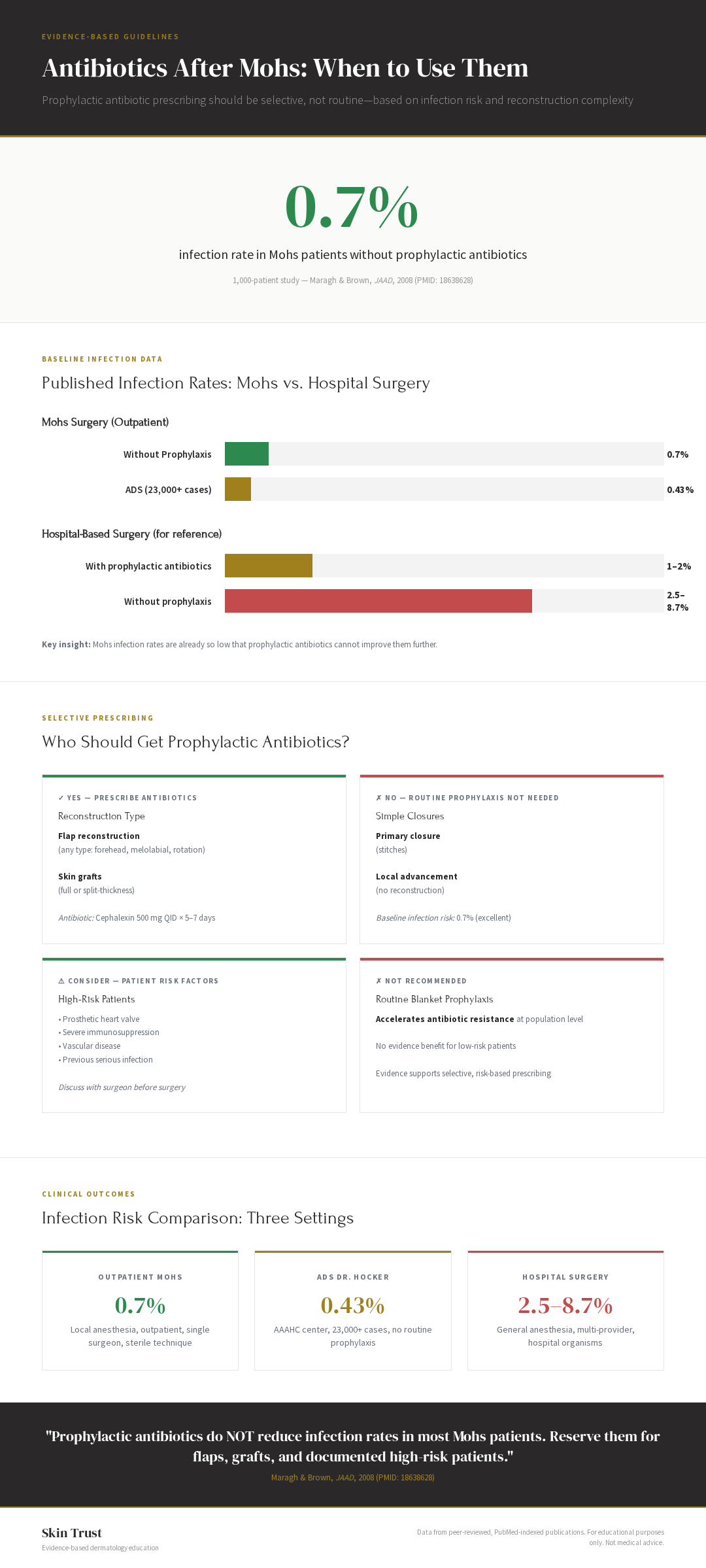
Data sourced from peer-reviewed, PubMed-indexed publications
Why Dr. Hocker gives antibiotics for flaps and grafts — even though he doesn't for simple closures
The recommended approach is to selectively give antibiotics for reconstructions that carry higher complexity and infection consequences: flaps and skin grafts. Simple closures (primary closure, local advancement) do not require routine antibiotics.
This selective approach is evidence-based. Here is the reasoning:
Flaps and grafts are higher-complexity procedures:
- They involve more tissue manipulation and longer operative time
- Flap survival depends on intact blood supply; infection threatens viability
- Graft take (adhesion to the wound bed) is jeopardized by infection
- If a flap or graft fails due to infection, the patient needs reoperation — a much bigger consequence than a simple closure infection
Simple closures are lower-complexity procedures:
- Shorter operative time, less tissue manipulation
- Local blood supply is not at risk
- If wound infection develops, local wound care typically resolves it without reoperation
- The baseline infection rate for simple closures is already 0.7%, which is excellent
The mnemonic is simple: "Flaps and grafts get antibiotics. Simple closures generally do not."
When antibiotics ARE indicated
Antibiotics (prophylactically) are given in these situations:
1. Flap reconstruction (any type)
- Paramedian forehead flap
- Melolabial flap
- Rotation or advancement flap
- Any interpolated flap
Antibiotic: Typically cephalexin 500 mg four times daily × 5–7 days
2. Full-thickness skin graft
- Any free skin graft (split-thickness or full-thickness)
Antibiotic: Typically cephalexin 500 mg four times daily × 5–7 days
3. Patient factors that warrant consideration of prophylaxis
Even for simple closures, prophylactic antibiotics may be indicated if you have:
- Prosthetic heart valve (endocarditis risk — see AHA guidelines below)
- History of endocarditis (even if valve now normal)
- Advanced immunosuppression (active chemotherapy, CD4 < 200, advanced HIV)
- Severe vascular disease with very poor circulation to the surgical site
- Liver cirrhosis (impaired immune function)
- End-stage renal disease (impaired immune function)
- Diabetes with vascular disease (impaired wound healing; antibiotic benefit more likely)
- Previous serious wound infection at the surgical site or nearby
These are exceptions, not the rule. Most Mohs patients do not have any of these risk factors.
Does endocarditis prophylaxis apply to Mohs surgery?
The American Heart Association recommends endocarditis prophylaxis for patients with specific cardiac conditions — but NOT for routine dermatologic procedures in most patients, including Mohs surgery.
Who needs endocarditis prophylaxis?
According to the AHA (2007 guidelines), endocarditis prophylaxis is recommended for patients with the following conditions and undergoing high-risk procedures:
Cardiac conditions requiring prophylaxis:
- Prosthetic valve
- Complex cyanotic heart disease
- Patent ductus arteriosus or surgically repaired with residual defect
- Ventricular septal defect or surgically repaired with residual defect
- Previous bacterial endocarditis
- Certain congenital heart lesions
Procedures requiring prophylaxis (if cardiac condition present):
- Dental procedures (extraction, periodontal, orthodontic)
- Respiratory tract procedures (endotracheal intubation, etc.)
- Genitourinary tract procedures
Dermatologic procedures (including Mohs surgery): NOT on the list of high-risk procedures requiring prophylaxis
Bottom line on endocarditis:
You do NOT need routine endocarditis prophylaxis for Mohs surgery unless you have one of the specific cardiac conditions listed above. If you have prosthetic valve disease, previous endocarditis, or complex cyanotic heart disease, inform your surgeon before surgery and discuss prophylaxis.
High-risk anatomic sites: Does location matter?
Certain anatomic sites (nose, ear, groin, lower extremity) have published infection rates that are slightly higher than the baseline, but published evidence does not justify routine antibiotic prophylaxis even at these sites. However, these are sites where infection consequences may be more significant.
Anatomic site infection rates from published literature
| Site | Infection Rate (Range) | Why Higher? | Prophylaxis Routine? |
|---|---|---|---|
| Nose | 0.7–1.7% | Concave surface, proximity to airway | No (baseline-to-slightly-elevated) |
| Ear | 0.7–1.5% | Cartilage; infection can involve perichondritis | No |
| Groin | 1.2–3.0% | High moisture, friction, bacterial flora | Consider; discuss with surgeon |
| Lower extremity | 1.5–2.5% | Poor circulation, friction, moisture | Consider; discuss with surgeon |
| Nose flap/graft | ~2.4% (Maragh & Brown data) | Higher complexity | Yes (flap/graft protocol applies) |
The critical distinction: These sites have slightly elevated infection rates, but the elevation is modest (0.7% → 1.5–2.5%). The absolute risk remains low. Many guidelines still recommend selective rather than routine prophylaxis at these sites.
Dr. Hocker's approach: For simple closures at these sites, he does not prescribe routine prophylaxis unless the patient has other risk factors (immunosuppression, vascular disease, previous infection). For flaps or grafts at these sites, he prescribes antibiotics as part of the standard reconstruction protocol.
The antibiotic resistance argument: Why blanket prescribing creates real harm
Every antibiotic prescription contributes to the development of antibiotic-resistant bacteria at the population level. Routine prophylactic antibiotics in situations where the baseline infection rate is already excellent (0.7%) create resistance without improving individual outcomes — a net harm to society.
This is a critical ethical consideration that often gets overlooked in individual patient discussions.
The resistance problem in perspective
Selective antibiotic use (only when indicated):
- Reduces resistance development
- Preserves antibiotic effectiveness for future patients
- Patients who truly need antibiotics will have drugs that work
Blanket prophylactic use (everyone gets antibiotics):
- Accelerates resistance development
- Reduces future antibiotic effectiveness
- Patients who develop resistant infections have fewer options
- Healthcare system burden increases (resistant organisms require stronger, more toxic drugs)
Leading dermatologic researchers have published this concern explicitly: "Dermatologists should adopt a cautious approach to the use of prophylactic antibiotics in dermatological surgery to help prevent the development and spread of antimicrobial resistance," (Lee & Paver, 2016).
The bottom line is uncomfortable but clear: routine prophylactic antibiotics in low-risk Mohs surgery patients creates more societal harm than benefit.
"Antibiotic resistance is not a future problem — it is a current crisis. Every single prophylactic antibiotic we prescribe when it is not medically indicated is a vote for resistance. We have an obligation to our patients and to society to prescribe antibiotics only when the evidence supports it. In Mohs surgery, that means flaps, grafts, and selected high-risk patients. Not everyone."
— Thomas L.H. Hocker, M.D., M.Phil.
If you develop infection after surgery: Signs and treatment
It is important to distinguish between prophylaxis (antibiotics given before or immediately after surgery to prevent infection) and treatment (antibiotics given when infection has developed).
Treatment of established infection is absolutely indicated. If you develop signs of infection, contact your surgeon immediately and do not wait.
Signs of wound infection (call your surgeon immediately)
- Fever ≥ 101°F (38.3°C), especially with chills
- Spreading redness beyond the original defect margin (expanding > 0.5 cm per day)
- Foul or putrid odor from the wound
- Green or thick purulent drainage (pus)
- Severe pain that worsens rather than improves
- Lymph node swelling in the neck or elsewhere
- Red streaking extending from the wound (sign of systemic lymphangitis)
How established infections are treated
If infection develops, your surgeon will typically:
Evaluate the wound — culture may be taken if drainage is significant
Start empiric antibiotics — without waiting for culture results
Common first-line antibiotics:
- Cephalexin 500 mg four times daily × 7–10 days (first-line for non-MRSA)
- Doxycycline 100 mg twice daily × 7–10 days (alternative for penicillin allergy)
- Trimethoprim-sulfamethoxazole DS twice daily × 7–10 days (for MRSA coverage if suspected)
Close follow-up — the wound is re-examined in 24–48 hours to ensure improvement
Escalation if needed — if infection worsens or spreads, hospital admission and IV antibiotics may be necessary
Standard vs. selective antibiotic prescribing: What's the evidence?
Several systematic reviews and professional guidelines have examined this question:
| Guideline / Study | Recommendation | Evidence Strength |
|---|---|---|
| Maragh & Brown (JAAD 2008) | Prophylactic antibiotics not routine for most Mohs | Strong (1,000-patient study) |
| Messingham & Arpey (Dermatol Surg 2005) | Antibiotic use "probably not warranted" for routine skin procedures | Moderate (literature review) |
| Lee & Paver (Australas J Dermatol 2016) | Recommend "cautious use" to prevent resistance | Expert consensus |
| American Academy of Dermatology | No blanket recommendation for prophylaxis | Specialist guidance |
The consensus is clear: selective, risk-based antibiotic prescribing is supported by evidence. Blanket prophylaxis is not.
Which antibiotics are used for Mohs reconstruction?
If antibiotics are indicated (flap, graft, or high-risk patient), here are the most common choices:
First-line for non-MRSA coverage:
- Cephalexin (Keflex) 500 mg four times daily × 5–7 days
- Dosing: 500 mg PO QID (every 6 hours)
- Coverage: Excellent for Staph aureus, Streptococcus, Gram-positive organisms
- Cost: Very low; generic available
- Allergy: True cephalosporin allergy is rare (~1% cross-reactivity with penicillin)
For penicillin allergy (or allergy-prone patients):
- Doxycycline 100 mg twice daily × 5–7 days
- Dosing: 100 mg PO BID (every 12 hours); take with full glass of water to avoid esophageal irritation
- Coverage: Good for Gram-positive and some Gram-negative organisms; note that Staph aureus resistance to doxycycline is increasing
- Caution: Causes photosensitivity — strict sun avoidance required
- Cost: Low; generic available
For MRSA coverage (if MRSA is suspected or known):
- Trimethoprim-sulfamethoxazole (TMP-SMX, Bactrim DS) one tablet twice daily × 5–7 days
- Dosing: DS (double strength) = 160 mg TMP / 800 mg SMX, PO BID
- Coverage: Excellent for MRSA
- Allergy: Sulfa allergy is more common than penicillin; ask if you have this history
- Cost: Low; generic available
Considerations for all oral antibiotics after Mohs:
- Take with food (cephalexin, doxycycline — takes the stomach irritation out)
- Doxycycline specifically: drink a full glass of water with each dose; do NOT lie down for 30 minutes after taking
- Finish the full course — do not stop early, even if the wound looks good
- No alcohol during doxycycline course (reduces drug levels)
- Photosensitivity risk: Doxycycline can cause sunburn-like reactions; use SPF 30+ sunscreen and avoid sun if taking doxycycline
What about topical antibiotics (bacitracin, neomycin)?
Topical antibiotics are not necessary for most Mohs wounds. Petrolatum (Vaseline) alone is as effective as bacitracin at preventing infection, and petrolatum carries zero risk of allergy.
Topical antibiotic facts:
- Bacitracin vs. petrolatum: Equal efficacy at preventing infection; bacitracin does NOT provide superior protection despite marketing (Smack et al., 1996)
- Neomycin: Higher risk of allergy (~5–10% of population); avoid unless specifically prescribed
- Contact dermatitis: Topical antibiotics cause allergic contact dermatitis in roughly 5–10% of users, which can complicate wound healing
- Cost: Bacitracin costs more than petrolatum; petrolatum is superior on a cost-benefit basis
Bottom line: Use plain petrolatum (Vaseline) for wound care. If your surgeon prescribes antibiotic ointment, use it, but understand that plain petrolatum is equally effective and causes no allergy risk.
Frequently asked questions about antibiotics after Mohs
Will I definitely get an infection if I don't take antibiotics?
No. The baseline infection rate without prophylactic antibiotics is 0.7%, which means 99.3% of Mohs patients heal without infection even without preventive antibiotics. Your risk is very low if you have no other risk factors (immunosuppression, vascular disease, previous infection).
I got antibiotics prescribed after my Mohs. Should I take them?
Ask your surgeon why they prescribed them. If your surgeon prescribed antibiotics for one of the indicated reasons (flap reconstruction, graft reconstruction, or a specific risk factor you have), take them as directed and finish the full course. If they are uncertain about the indication, it is reasonable to ask: "Do I really need these based on my surgery type and my health history?"
What if I have a penicillin allergy?
Penicillin allergy and cephalosporin allergy are not the same. True cross-reactivity between penicillins and cephalosporins is only about 1%. Most people with reported "penicillin allergy" can safely take cephalexin. That said, inform your surgeon of your allergy, and alternatives like doxycycline or trimethoprim-sulfamethoxazole are available.
Can I use natural or herbal remedies instead of antibiotics if I get an infection?
No. If you develop signs of infection (fever, spreading redness, pus, foul odor), you need prescribed antibiotics immediately. Herbal remedies, honey, or other natural products are not substitutes for antibiotics in the context of active infection. Contact your surgeon.
My friend got prophylactic antibiotics after Mohs — why didn't I?
Different surgeons follow different protocols. Some prescribe routine prophylaxis; others prescribe selectively. The published evidence supports selective prescribing (flaps, grafts, high-risk patients), but protocols vary. If you are concerned, ask your surgeon about their antibiotic philosophy.
Will taking antibiotics now affect my immune system or future antibiotic effectiveness?
A short course of antibiotics (5–7 days) for prophylaxis or treatment does not meaningfully affect your immune system. However, every antibiotic prescription you receive — and every unnecessary prescription — contributes to antibiotic resistance at the population level. This is why selective prescribing is so important. Antibiotics you truly need will work better if they are not overused.
What's the difference between "prophylactic" and "therapeutic" antibiotics?
- Prophylactic: Given before or immediately after surgery to prevent infection (even if you don't have signs of infection yet)
- Therapeutic: Given after signs of infection have developed, to treat established infection
Both are important, but they serve different purposes. Prophylactic antibiotics should only be given when the evidence supports benefit.
If I'm on antibiotics for something else, do I need additional antibiotics for Mohs?
Inform your surgeon of any antibiotics you are currently taking. If you are already on an antibiotic that covers skin flora (like doxycycline for acne), your surgeon may not prescribe additional prophylaxis. If you are on an antibiotic for a different purpose (like amoxicillin for a dental infection), inform your surgeon so they can adjust the plan if needed.
How do I know if my wound is infected vs. just healing normally?
Normal healing signs:
- ✓ Redness (especially week 1)
- ✓ Mild drainage (weeks 1–2)
- ✓ Aching (improves daily)
- ✓ Swelling in the first few days
Infection signs:
- ✗ Fever (≥ 101°F)
- ✗ Rapidly expanding redness (> 0.5 cm per day beyond original defect)
- ✗ Green or foul-smelling drainage
- ✗ Severe pain (worsening, not improving)
- ✗ Lymph node swelling
Related articles for deeper learning
- The Complete Guide to Recovery After Mohs Surgery
- Warning Signs After Mohs Surgery: When to Call Your Surgeon
- Second Intention Healing After Mohs Surgery: When and Why
References
Maragh SL, Brown MD. Prophylactic antibiotics for dermatologic surgery. Journal of the American Academy of Dermatology. 2008;59(3):464-474. PMID: 18638628
Messingham MJ, Arpey CJ. Update on the use of antibiotics in cutaneous surgery. Dermatologic Surgery. 2005;31(10):1219-1233. PMID: 16042931
Lee KJ, Paver R. Prophylactic antibiotics in minor surgery and dermatology. Australasian Journal of Dermatology. 2016;57(4):254-258. PMID: 25752777
Smack DP, Harrington AC, Dunn C, Howard RS, Szklo M, Lutz DJ, Anderson LL. Infection and allergy incidence in ambulatory surgery patients using white petrolatum vs bacitracin ointment. JAMA. 1996;276(12):972-977. PMID: 8805732
Medical Disclaimer
This article is for educational purposes only and does not constitute medical advice. Treatment recommendations vary based on individual patient factors, surgery type, medical history, and risk factors for infection.
Always consult a qualified dermatologic surgeon before making decisions about antibiotic use, prophylaxis, or treatment. If you have a prosthetic heart valve, history of endocarditis, severe immunosuppression, or other cardiac or systemic conditions, inform your surgeon before surgery so an appropriate antibiotic plan can be made.
If you develop signs of infection after surgery (fever, spreading redness, pus, foul odor, severe pain), seek immediate medical attention.
