
- Mild warmth, redness, and swelling for the first 48–72 hours are normal — this is inflammation, not infection — swelling and redness should peak at day 3 and then begin improving
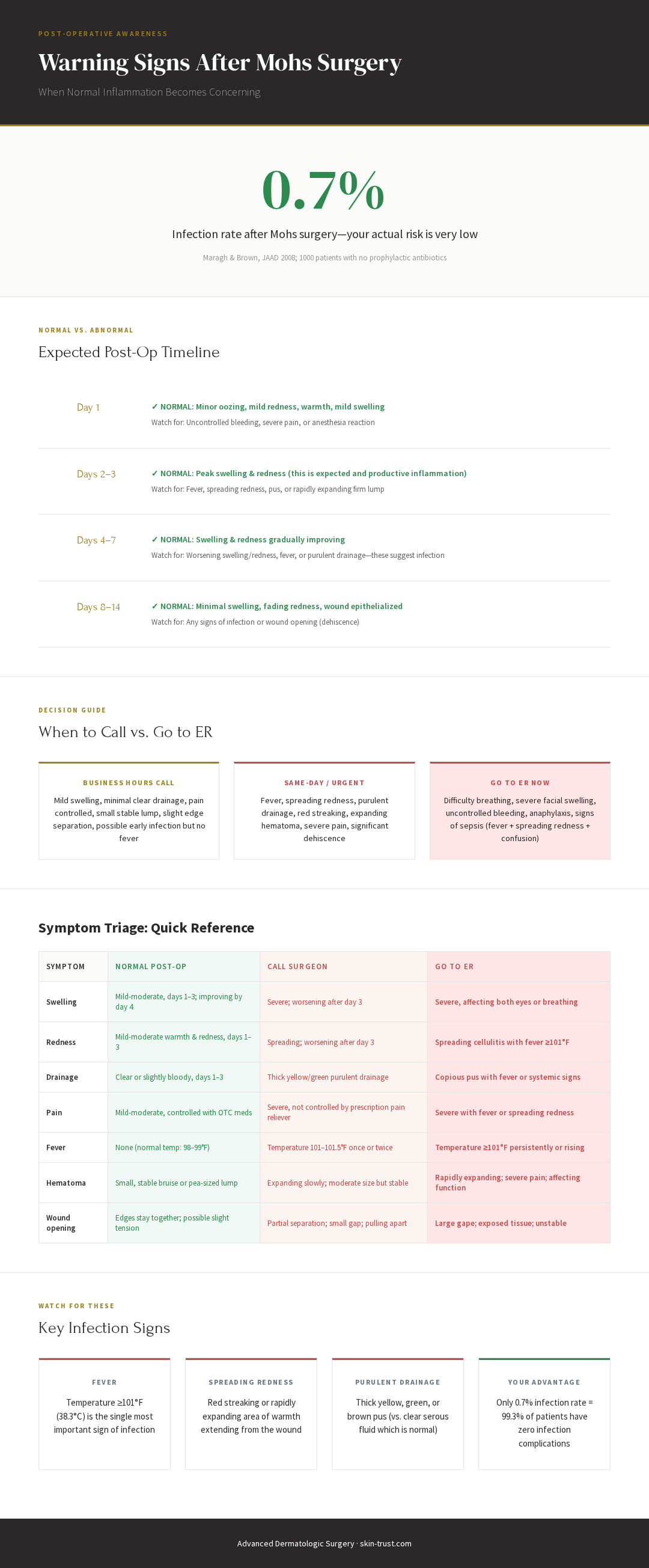
- Infection rate after Mohs surgery is only 0.7% — this means your risk is very low with proper wound care; most patients never develop infection
- Call your surgeon if redness or swelling worsens after day 3 — wounds should improve after the peak inflammation period; progressive worsening suggests infection
- Fever (≥101°F / 38.3°C), pus, or foul-smelling drainage require immediate evaluation — these are definite signs of infection requiring antibiotic treatment
- Red streaking extending from the wound upward toward the heart indicates lymphangitis — this is serious and requires urgent attention — do not wait for an office appointment; call immediately or go to the ER
- Severe uncontrolled pain, rapid swelling, or wound opening (dehiscence) may indicate hematoma or other complications — call your surgeon rather than waiting; early intervention prevents larger problems
What's normal inflammation vs. what's infection?
The first 2–3 days after surgery involve inflammation — this is your body's healing response, and it is normal and necessary. Inflammation and infection are not the same thing. Inflammation is controlled and productive; infection is progressive and harmful.
Your body's response to surgical trauma follows a predictable timeline:
- Hours 0–24: Minimal inflammation; possible oozing; mild warmth and redness at the wound edge
- Hours 24–72: Peak inflammation; noticeable warmth, redness, and swelling; this is normal and expected
- Days 3–7: Inflammation gradually subsiding; redness and swelling should plateau and then slowly improve
- Days 7–14: Continued improvement; wounds should appear progressively less red and less swollen
Infection, by contrast, is a breach of this normal timeline: progressive worsening after day 3, systemic signs (fever), purulent drainage, or spreading redness.
Normal post-operative symptoms (days 1–3):
- Mild to moderate swelling (edema) around the wound
- Redness of the wound and surrounding skin
- Warmth to the touch at the wound site
- Minimal serous (clear) drainage
- Mild throbbing or aching pain (well-controlled with acetaminophen or ibuprofen)
- Small amount of crust or scab formation
Abnormal symptoms (call your surgeon):
- Worsening redness or swelling after day 3 — swelling and redness should be improving, not worsening
- Thick yellow, green, or foul-smelling drainage — clear serous drainage is normal; purulent (pus-like) drainage is not
- Fever (temperature ≥101°F / 38.3°C) — suggests systemic infection
- Red streaking extending from the wound upward (toward the heart) — this is a sign of lymphangitis (infected lymph vessels) and requires immediate attention
- Rapidly expanding firm lump at or near the wound — may indicate hematoma (blood collection); if expanding, call surgeon
- Wound opening (dehiscence) with exposed tissue — may require re-closure or additional dressing
- Severe pain not controlled by acetaminophen, ibuprofen, or prescribed pain medication — may suggest hematoma, infection, or nerve involvement
- Signs of allergic reaction: hives, severe itching beyond the immediate wound, difficulty breathing (rare but requires emergency evaluation)
Understanding infection rates: Your risk is low
The fear of infection is one of the most common concerns after surgery, but the data should reassure you: the infection rate after Mohs surgery is only 0.7% (Maragh & Brown, Journal of the American Academy of Dermatology, 2008).
This landmark study examined 1,000 patients undergoing Mohs surgery who received no prophylactic antibiotics. The researchers found only 8 infections among 1,115 tumors treated, for an overall infection rate of 0.7%. Infection rates varied slightly by location: nose 1.7%, flaps 2.4%, and other sites 0–1.3% (Maragh & Brown, 2008).
For comprehensive post-operative wound care guidance, see: How to Care for Your Wound After Mohs Surgery.
What does 0.7% mean for you? Out of 100 patients, only 1 would develop an infection. This is exceptionally low — comparable to or lower than many common outpatient surgical procedures and dramatically lower than hospital-based surgery (2.5–8.7%).
Why is the infection rate so low?
Mohs surgery is performed in an outpatient setting with several factors that reduce infection risk:
- Local anesthesia, no general anesthesia — avoids the immunosuppression and longer operative times of general anesthesia
- Smaller defects — Mohs removes only tissue containing cancer, leaving smaller wounds that heal faster
- Same-day closure — wounds are closed immediately rather than left open overnight or referred to another facility
- Clean outpatient environment — no hospital-acquired organisms (like MRSA or Clostridioides difficile)
- Experienced surgeons — surgeons who perform hundreds of these procedures annually develop meticulous surgical technique and infection prevention
The bottom line: Infection after Mohs surgery is rare. If you follow proper wound care (moist healing, daily dressing changes, hand hygiene), your risk is even lower.
"I want patients to understand that the fear of infection is often worse than the actual risk. We track our infection rates meticulously, and across more than 23,000 Mohs cases in my practice, we maintain an infection rate of 0.43% — lower than the published literature. This is achieved through adherence to evidence-based wound care principles and careful patient selection and post-operative surveillance. The combination of low inherent risk plus proper wound care means infection is very uncommon."
— Thomas L.H. Hocker, M.D., M.Phil.
Timeline of what to watch for
Day 1 (the immediate post-operative period)
What's expected:
- Mild bleeding or oozing (should stop with gentle pressure and a dressing)
- Redness at the incision line
- Mild swelling
- Pain or discomfort at the site
- Possible bruising if you are on aspirin or other blood thinners
When to call:
- Bleeding that does not stop after 10 minutes of gentle pressure
- Severe pain disproportionate to what you'd expect (may indicate hematoma)
- Signs of anesthesia reaction (difficulty breathing, severe nausea, chest pain — rare; go to ER)
Days 2–3 (peak inflammation)
What's expected:
- Maximum swelling and redness (this is normal)
- Wound may feel warm to the touch
- Possible clear or slightly bloody drainage on dressing
- Pain may be moderate but should improve with over-the-counter pain relievers
When to call:
- Swelling is severe and affecting ability to see, eat, or breathe (this is rare and suggests a significant hematoma or allergy)
- Fever develops (may indicate early infection)
- Redness is spreading rapidly or is accompanied by warmth extending beyond 2 cm of the wound edge
- Pain is not controlled by over-the-counter medications
- Pus or thick drainage develops
Days 4–7 (inflammation improving)
What's expected:
- Gradual decrease in swelling
- Redness beginning to fade
- Minimal drainage (if any)
- Pain significantly reduced
- Possible scab or crust at the wound edge (do not pick)
When to call:
- Swelling or redness is worsening (should be improving by day 4)
- Fever develops
- Thick or foul-smelling drainage appears
- Red streaking from the wound toward the heart
- Severe pain returns or worsens
- Sutures become loose or the wound begins to open
Days 8–14 (healing phase)
What's expected:
- Minimal swelling
- Redness fading (though still pink or red; this is normal for a healing scar)
- Wound epithelialized (no open tissue or oozing)
- Pain minimal or absent
- Sutures intact until removal (timing depends on location)
When to call:
- Any signs of infection (fever, purulent drainage, spreading erythema)
- Wound opening or dehiscence after it seemed to be healing
- Allergic reaction to suture material (rare; causes itching and hives in a specific pattern)
- Suture abscess (a small pustule forming at a suture site)
After suture removal (day 7–14 depending on location)
What's expected:
- Wound remains closed
- Redness continues to fade
- Possible slight indent where stitches were (this fills in over months)
- No drainage
When to call:
- Wound reopens after suture removal
- Signs of infection appear
- Severe itching suggests possible suture material allergy (rare)
Specific warning signs: When to call your surgeon vs. go to the ER
Call your surgeon during business hours (or wait until office opens Monday morning):
- Mild increase in swelling or redness that is not severe
- Minimal clear drainage (serous fluid)
- Pain controlled with over-the-counter medications
- Small firm lump at the wound site that is not rapidly expanding
- Wound is pulling apart slightly at the edges (slight dehiscence) but not gaping open
- Possible early infection signs: warmth, very mild pus, but no fever and redness not spreading
- Questions about medications, activity, or wound care
- Suture concerns (loose stitch, stitch causing irritation)
- Allergic reaction suspect (localized itching and rash at specific spot, but no swelling of face/throat)
Call your surgeon urgently (same-day appointment or after-hours line):
- Fever ≥101°F (38.3°C)
- Purulent (thick, yellow/green) drainage from the wound
- Redness visibly spreading, or expanding area of warmth
- Red streaking extending from the wound
- Worsening swelling or redness after day 3
- Severe pain not controlled by prescribed or over-the-counter pain relievers
- Large or rapidly expanding firm lump (hematoma)
- Significant wound opening (gaping dehiscence) with exposed tissue
- Allergic reaction suspect (spreading itching or rash, or localized swelling near the wound)
- Signs of wound infection (odor, purulence, fever, spreading erythema)
Go to the ER immediately:
- Difficulty breathing or swallowing (suggests severe facial/throat swelling or allergy)
- Severe facial swelling affecting both eyes or preventing you from opening your eyes
- Chest pain or shortness of breath (may indicate systemic reaction)
- Loss of consciousness or severe dizziness
- Uncontrolled bleeding (bleeding lasting >15 minutes of direct pressure)
- Signs of serious infection spreading from the surgical site: fever + severe spreading redness + confusion or severe malaise (sepsis — rare but serious)
- Allergic reaction with systemic signs: hives beyond the surgical site, difficulty breathing, swelling of lips or throat (anaphylaxis — rare)
Specific post-operative complications explained
Infection
What it is: Bacterial colonization of the wound leading to spreading inflammation, purulent drainage, fever, and systemic symptoms.
Timeline: Typically appears 3–7 days after surgery (can appear earlier if the bacteria are very virulent, but this is rare).
Signs:
- Fever (temperature ≥101°F / 38.3°C)
- Thick yellow, green, or brown purulent drainage
- Spreading erythema (redness) extending beyond 2 cm of the wound edge
- Warmth extending beyond the immediate wound area
- Possible red streaking from the wound toward the regional lymph nodes
- Pain and swelling worsening after day 3 (should be improving)
- Possible odor or fluctuance (fluid-filled pocket) at the wound site
What to do:
- Call your surgeon immediately
- Do NOT wait until morning if this occurs in the afternoon/evening — call the after-hours line
- Your surgeon will likely prescribe antibiotics
- May need wound culture to identify the organism and guide antibiotic choice
- Increased wound care frequency or return visit may be needed
Prevention:
- Follow proper wound care (moist dressing, daily cleansing)
- Keep the wound protected from dirty environments
- Avoid touching the wound with unwashed hands
- Do not soak or submerge the wound until epithelialized
- Continue all blood thinners (do not stop for fear of bleeding)
Hematoma (blood collection)
What it is: A collection of blood under the skin, appearing as a firm lump or bruise.
Timeline: Can develop immediately or within the first few days; may expand over the first 24–48 hours.
Signs:
- Firm, expanding lump at or near the surgical site
- Visible bruising (ecchymosis) around the lump
- Possible pressure sensation or tightness if the hematoma is large
- Pain or tenderness at the site
- Swelling that is disproportionate to expected post-operative swelling
What to do:
- Small hematomas (pea-sized or smaller) are self-limited and will reabsorb over 2–4 weeks; no treatment needed
- Larger hematomas: apply ice for the first 24–48 hours to reduce bleeding, then warm compresses
- Elevate the head to reduce swelling
- If the hematoma is expanding rapidly, causing severe pain, or affecting function (like blocking an eye), call your surgeon urgently — may need drainage
- Most hematomas resolve without intervention; your body gradually reabsorbs the blood
For a comprehensive recovery timeline, see: Complete Guide to Recovery After Mohs Surgery.
When to worry:
- If the lump is rapidly expanding, especially in the first 24 hours
- If it is causing severe pain or is pressing on an eyelid or other structure
- If it is accompanied by fever or signs of infection (suggests infection within the hematoma)
Prevention:
- Do not take extra doses of blood thinners to "prevent clots" — your regular medications are sufficient
- Avoid strenuous activity or high blood pressure for the first week (elevates bleeding risk)
- Apply pressure if you notice bleeding during the immediate post-operative period
Wound dehiscence (opening)
What it is: The wound edges separate, partially or completely, instead of staying closed.
Timeline: Can occur at any time but is most common in the first 2 weeks if stitches break or tissue fails to heal.
Signs:
- Visible gap between wound edges
- Separation may be complete (wound gaping open) or partial (edges pulling apart slightly)
- Possible drainage from the gap
- Red or white tissue visible in the gap (granulation tissue or underlying structures)
Causes:
- Stitches breaking due to excess tension or movement
- Infection weakening tissue
- Patient pulling or trauma to the wound
- Tissue fragility (in elderly patients or those on certain medications)
- Poor wound care or inadequate support
What to do:
- Small partial separations: increase dressing frequency, ensure proper moist wound healing, and call your surgeon
- Large gaps: call your surgeon immediately; may need re-closure with sutures or special dressing
- Do not assume the wound will "just heal" if it is gaping — this requires evaluation
- Your surgeon may re-dress, re-suture, or apply special closure strips
Prevention:
- Keep dressings secure so stitches are not stressed
- Avoid facial movement that creates tension on the wound (grimacing, chewing vigorously)
- Keep the wound moist (moist tissue is stronger than dry)
- Follow all post-operative restrictions on activity
Allergic reactions (rare)
What it is: Allergic reaction to suture material (typically nylon or absorbable sutures), topical medications, dressing materials, or tape.
Signs:
- Itching that is out of proportion to normal wound healing itch
- Localized rash (urticaria) in a pattern matching the sutures or dressing
- Mild to moderate swelling, but usually localized to the immediate wound area
- May see a pattern of hives in a line where sutures are placed
Timeline: Usually appears within 24–48 hours of suture placement, but can occur later.
Severe allergic reactions (rare but go to ER):
- Severe itching and rash spreading beyond the wound
- Swelling of the lips, tongue, or throat
- Difficulty breathing
- Hives all over the body
What to do:
- Mild localized reaction: call your surgeon; may need to change dressing materials or remove sutures earlier
- Your surgeon can switch to hypoallergenic suture material
- Topical antihistamine (hydrocortisone cream 1%) may help with itching while awaiting follow-up
- Oral antihistamine (diphenhydramine or cetirizine) may help
- Do NOT apply topical antihistamine or other products without talking to your surgeon first
Prevention:
- Notify your surgeon before surgery if you have known allergies to topical agents, tapes, or suture materials
- Use hypoallergenic tape or dressing materials
Excessive bleeding (oozing)
What it is: Continued bleeding or oozing from the wound beyond what is expected.
Timeline: Should stop within 24 hours; ongoing oozing after this suggests inadequate pressure or a bleeding disorder.
Signs:
- Continuous seeping or dripping blood from the wound
- Dressing soaked with blood within an hour of changing
- Possible increase in oozing if on blood thinners or if blood pressure is elevated
What to do:
- Apply gentle, sustained direct pressure with clean gauze for 10–15 minutes
- If bleeding stops, change to your normal dressing and continue wound care
- If bleeding continues after 15 minutes of pressure: call your surgeon
- Elevate the head to reduce blood pressure in the head
- Continue all blood thinners (do not stop; stopping carries greater risk than minor oozing)
- If bleeding is brisk and does not stop after 15–20 minutes of pressure, go to the ER
When to worry:
- Bright red blood pouring from the wound (vs. oozing) — call surgeon urgently or go to ER
- Bleeding accompanied by dizziness or feeling faint — go to ER
Prevention:
- Avoid strenuous activity and high blood pressure for the first week
- Do not pick at scabs or crusts
- Gentle dressing changes; do not disturb healing tissue
Symptom triage table: Normal vs. Call office vs. Go to ER
| Symptom | Normal Post-Op | Call Surgeon Same-Day | Go to ER |
|---|---|---|---|
| Swelling | Mild to moderate on days 1–3, gradually improving | Severe (affecting eyes, breathing, or function); worsening after day 3 | Severe swelling affecting both eyes or causing breathing difficulty |
| Redness | Mild to moderate warmth and redness for 48–72 hours | Spreading redness, or worsening after day 3; red streaking | Spreading cellulitis with fever ≥101°F; severe spreading erythema |
| Drainage | Clear or slightly bloody for first few days | Thick yellow/green purulent drainage | Copious purulent drainage with fever or systemic signs |
| Pain | Mild to moderate, controlled with OTC pain relievers | Severe pain not controlled by prescribed pain medication; severe throbbing | Severe pain with systemic signs (fever, spreading erythema); possible nerve involvement |
| Fever | None (normal temperature varies 98–99°F) | Temperature 101–101.5°F once or twice, resolving | Temperature ≥101°F persistently, or rising temperatures; fever with spreading redness |
| Hematoma | Small bruising or firm lump that is stable | Lump expanding slowly; moderate size but stable | Large hematoma expanding rapidly; severe pain; affecting function |
| Wound opening | Edges staying together; possibly some tension lines | Partial separation (edges pulling apart slightly); small gap | Large gape; edges separated significantly; exposed tissue; unstable separation |
| Bleeding | Minor oozing stopping within 1–2 minutes of pressure | Oozing continuing >15 min of pressure; soaked dressing repeatedly | Brisk bleeding; active bleeding from wound; bleeding with dizziness |
| Activity tolerance | Mild fatigue; able to rest comfortably; able to eat/drink | Significant malaise; difficulty with basic activities | Severe illness; unable to sit up; confusion; severe weakness (possible sepsis) |
Data sourced from peer-reviewed, PubMed-indexed publications
Factors that lead to low infection rates
The recommended protocol is to we maintain an infection rate of 0.43% across 23,000+ cases — lower than the published literature benchmark of 0.7% (Maragh & Brown, JAAD 2008). This is achieved through:
- Meticulous surgical technique — three board-certified specialties (dermatology, dermatopathology, MSDO) ensure tissue-sparing precision and wound closure expertise
- Evidence-based wound care protocols — proper post-operative care emphasizes moist wound healing, appropriate dressing selection, and clear post-operative instructions
- Experienced surgeon reconstruction — the same surgeon who removes the cancer also performs the reconstruction, ensuring optimal tissue handling and tension management
- Close post-operative surveillance — scheduled follow-up visits allow early detection of any complications
| Dimension | Average Mohs Practice | |
|---|---|---|
| Board Certifications | 3 (Dermatology, Dermatopathology, MSDO — all through ABD/ABMS) | 1–2 |
| Surgeon Reads Own Pathology | Yes (board-certified dermatopathologist) | Rarely |
| Surgeon Performs Own Reconstruction | Yes (ACMS Iron Surgeon Lecturer) | Sometimes — often refers to plastic surgery |
| Infection Rate | 0.43% (23,000+ cases) | 2.5–8.7% (published literature) |
| Recurrence Rate | 0.32% (10-year follow-up) | ~1% (published benchmark) |
| Melanoma Mohs Capability | Yes (~300/year with MART-1) | Limited or none |
| Training | Harvard Medical School, Mayo Clinic | Varies |
Frequently Asked Questions
For specific post-operative medication and symptom management details, see: Opioid-Sparing Pain Control After Mohs Surgery.
How will I know if I have an infection vs. normal swelling?
Normal swelling peaks on days 1–3 and then gradually improves. Infection causes progressive worsening after day 3, is accompanied by fever or pus, and may show red streaking. If swelling is improving and there is no fever or purulent drainage, you likely have normal post-operative swelling.
Should I take antibiotics to prevent infection?
No. Research shows that prophylactic antibiotics do not reduce infection rates for Mohs surgery (Maragh & Brown study of 1000 patients with zero prophylactic antibiotics had a 0.7% infection rate). Proper wound care is far more important than antibiotics. Your surgeon will prescribe antibiotics if an actual infection develops.
Is a little bit of swelling and redness on day 1 normal?
Yes, absolutely. Some inflammation is expected immediately after surgery. The concern arises only if redness or swelling is worsening on days 3–7 (when they should be improving).
My wound looks puffy. Is that an infection or just normal swelling?
Normal swelling is diffuse, soft, and gradually improves. If the swelling is very localized (confined to one spot), firm, rapidly expanding, and causing pain, it may be a hematoma. If accompanied by fever, pus, or spreading redness, it may be infection. Call your surgeon to be sure.
What if I see a little bit of yellow drainage on my dressing?
Clear or slightly bloody drainage is normal. Thick, yellow, or green purulent drainage is not. If you see truly purulent drainage (thick pus), call your surgeon. A small amount of color in clear drainage is often just serous fluid with some hemoglobin and is usually fine.
I have a fever. Do I definitely have an infection?
Not necessarily. Fever can occur with significant inflammation, anesthesia reactions, or other post-operative stress. However, fever + spreading redness + purulent drainage = likely infection. Fever alone warrants a call to your surgeon, especially if accompanied by other symptoms.
How long will my wound look red and swollen?
Peak swelling is at 48–72 hours, then gradually improves. By day 10, most swelling is gone. Redness persists longer — typically 2–6 weeks for a healing scar. The scar remains pink for 3–6 months before fading to pale.
What does a hematoma feel like?
A hematoma is a firm or sometimes rubbery lump. It may feel hard like a pea or marble under the skin. It may be accompanied by visible bruising. Small hematomas are common and reabsorb on their own over weeks.
Is a small bruise normal?
Yes, especially if you are on aspirin or other blood thinners. Small bruises (ecchymosis) are expected and resolve over 1–2 weeks.
When should I worry about a bruise or hematoma?
If it is stable (not growing), not painful, and not affecting function, it is fine. If it is rapidly expanding, very painful, or pressing on an eyelid or airway, call your surgeon.
Can I exercise if I notice a small hematoma?
Exercise will increase blood pressure and may enlarge the hematoma. Avoid strenuous activity for at least the first week. Once stable, gentle activity is fine.
My suture site is very itchy. Is this normal?
Mild itching during healing is normal. Excessive itching or a rash in a pattern matching the sutures may suggest a suture allergy (rare). Call your surgeon if itching is severe.
What if my wound suddenly opens after it seemed to be healing?
This is dehiscence and requires evaluation. Call your surgeon the same day. Do not assume it will heal on its own — it needs assessment and possibly re-closure.
How do I know if I'm developing a suture abscess (a small pustule at a stitch)?
A suture abscess appears as a small, red, pustular bump at a suture site. It is usually sterile (not truly infected) and resolves when the suture is removed. If you notice this, mention it at your follow-up visit.
I feel faint or dizzy after my surgery. Is this normal?
Mild dizziness can occur due to anesthesia or blood loss in the immediate post-operative period. Sit down and drink water. If dizziness persists or is accompanied by chest pain, difficulty breathing, or bleeding, go to the ER or call 911.
When can I stop worrying about infection?
Infection risk is highest in the first 2 weeks. After 2 weeks with no signs of infection, your risk is extremely low. However, late infections are rare and possible if the wound is traumatized or exposed to bacteria.
My surgeon said to watch for signs of infection. What exactly am I watching for?
Watch for: fever, purulent drainage, spreading redness, red streaking, increasing warmth, pain worsening after day 3, or foul odor. Any of these warrant a call to your surgeon.
References
Maragh SL, Brown MD. Prospective evaluation of surgical site infections in dermatologic surgery patients not receiving prophylactic antibiotics. J Am Acad Dermatol. 2008;59(2):275–278. PMID: 18638628
Smack DP, Harrington AC, Dugan S, et al. Infection and allergy incidence in ambulatory surgery patients using white petrolatum vs bacitracin ointment. A randomized controlled trial. JAMA. 1996;276(12):972–977. PMID: 8805732
Medical Disclaimer
This article is educational and does not constitute medical advice. The information provided reflects evidence-based practices and general guidelines for post-operative symptom recognition. Individual experiences may vary based on the specific type of surgery performed, your medical history, current medications, healing capacity, and other factors. This article is not intended to diagnose infection or other complications — diagnosis requires evaluation by a physician. If you experience any concerning symptoms after surgery, contact your surgeon or seek medical evaluation. Do not delay seeking care based on the information in this article.
