
- Moist wound healing (petrolatum + non-stick dressing) accelerates healing and reduces scarring — wounds heal 2× faster when kept moist, with significantly better cosmetic outcomes
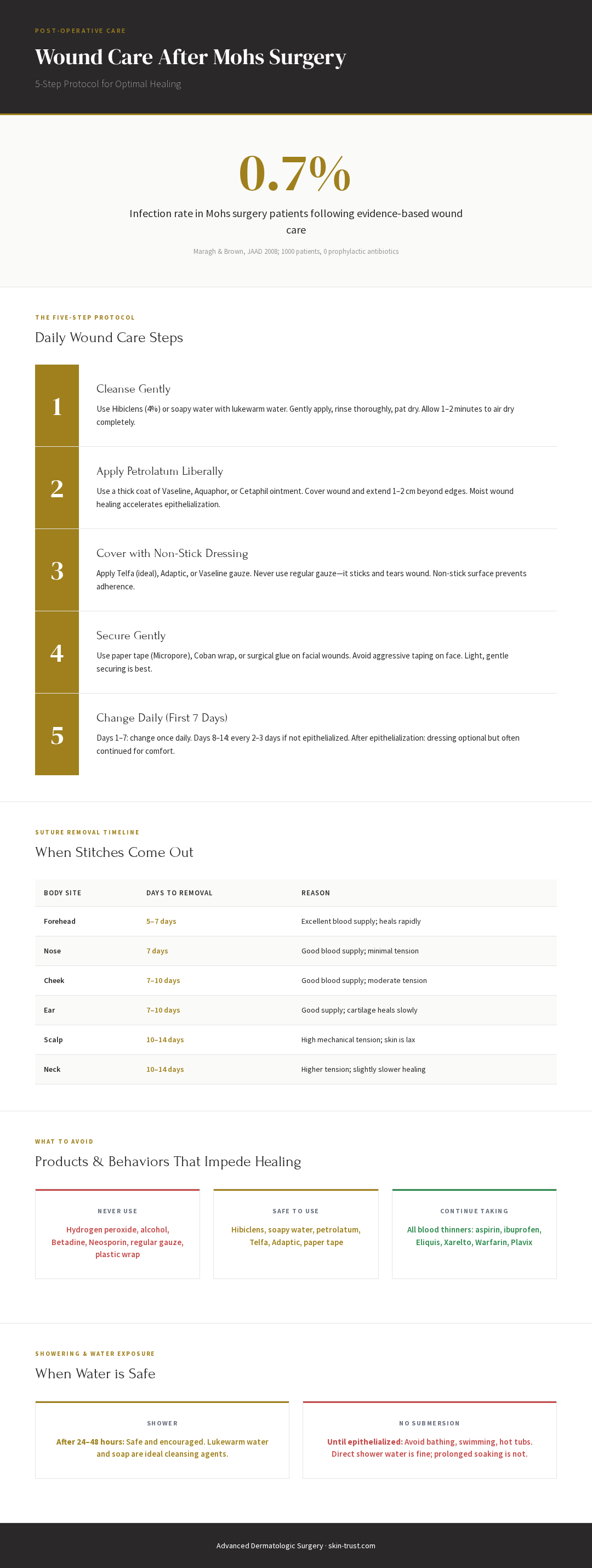
- Daily wound care: cleanse with Hibiclens or soapy water, apply generous petrolatum, cover with Telfa dressing — this simple protocol is superior to antibiotic ointments and has zero allergy risk
- Never use hydrogen peroxide or alcohol on healing wounds — these damage healthy tissue and impede healing; use saline or soap and water instead
- Showering is safe after 24–48 hours — pat the wound dry afterward and don't let water stream directly on the fresh incision; baths and swimming are off-limits until the wound is fully closed
- Continue all blood thinners (aspirin, ibuprofen, warfarin, Eliquis, Xarelto, Plavix) — do not stop them without approval from your cardiologist or primary care doctor; managed bleeding is safer than stroke/clot risk
- Suture removal timing depends on location — face 5–7 days, nose 7 days, cheek/ear 7–10 days, neck/trunk 10–14 days, lower extremity 14–21 days
What is moist wound healing and why does it matter after Mohs surgery?
Moist wound healing is the principle that wounds heal faster and with better cosmetic outcomes when the wound bed remains moist — not wet, not dry, but moist. This is the opposite of the old "let it air out to heal" advice. Decades of research shows that moist wound healing accelerates epithelialization, reduces inflammation, and produces softer, flatter scars.
After Mohs surgery, your wound is a site of active tissue repair. Epithelial cells (skin cells) are migrating across the wound surface to close the defect. If the wound dries out, these cells dry out too — they stop migrating, and healing slows dramatically. A dry wound can take twice as long to heal as a moist one, and the inflammation prolonged by dry-wound conditions can lead to worse scarring.
Moist wound healing works by maintaining an optimal wound microenvironment: enough moisture to let cells migrate, enough air circulation to prevent bacterial overgrowth, and a protective barrier against contamination. This is achieved with occlusive or semi-occlusive dressings over a thin layer of petrolatum.
The evidence for moist wound healing in dermatologic surgery is overwhelming. Studies consistently show that wounds dressed with moist dressings heal faster, with less pain and better cosmetic outcomes, compared to wounds left open to air.
"The biggest mistake I see patients make after surgery is that they're afraid of getting the wound wet or dirty, so they avoid dressing it or change their dressing too infrequently. Or worse, they think 'air is good,' and they leave the wound open. Both of these approaches slow healing and increase scarring. Moist wound healing is not folklore — it's evidence-based, and the research has been clear on this for 30 years."
— Thomas L.H. Hocker, M.D., M.Phil.
The 5-step daily wound care protocol
This is an evidence-based wound care approach that prioritizes moist wound healing, minimizes infection risk, and produces optimal cosmetic outcomes.
Step 1: Cleanse the wound (morning and evening)
Use one of the following to gently cleanse the wound:
- Hibiclens (chlorhexidine 4%) — the preferred agent; provides antimicrobial coverage without skin toxicity
- Soapy water — regular soap and lukewarm water work well; no special soap needed
Technique:
- Wet a gauze or clean cloth with Hibiclens or soapy water
- Gently apply to the wound surface and surrounding skin
- Rinse thoroughly with clean water
- Pat dry with a clean, dry gauze — do not rub
- Allow 1–2 minutes to air dry completely before applying petrolatum
What NOT to use:
- Hydrogen peroxide — it damages healthy tissue and impedes healing
- Alcohol or Betadine — too harsh; damages healing tissue
- Antibacterial soaps (Dial, Hibiclens on intact skin is OK, but plain soap works just as well)
Step 2: Apply petrolatum liberally (the "big gob" rule)
After the wound is clean and dry, apply a thick coat of one of these:
- Petrolatum (plain Vaseline)
- Aquaphor
- Cetaphil ointment
The amount matters. Use enough that it covers the entire wound and extends 1–2 cm beyond the wound edges. Think "generous coating," not a thin layer.
Why petrolatum and not antibiotic ointment? Extensive research, including a landmark 1996 study by Smack and colleagues in JAMA comparing petrolatum to bacitracin ointment in 922 dermatologic surgery patients, found no difference in infection rates between plain petrolatum and antibiotic ointments. The Smack study found infection rates of 1.5% overall, with 2.0% in the petrolatum group and 0.9% in the bacitracin group — a difference that was not statistically significant (Smack et al., 1996).
More importantly, petrolatum has zero risk of contact allergy, while bacitracin and neomycin cause allergic contact dermatitis in 1–2% of users. This means if you use Neosporin and develop a rash, you cannot tell whether it's a normal post-surgical reaction or an allergic reaction to the antibiotic ointment itself.
Plain petrolatum eliminates this problem entirely. It moisturizes, it occludes, and it has no allergy risk.
Step 3: Cover with non-stick dressing
Once the petrolatum is applied, cover the wound with a non-stick dressing:
- Telfa (non-stick pad) — ideal; prevents sticking to the ointment
- Adaptic (non-stick gauze) — also excellent
- Vaseline gauze — acceptable alternative
- Plain gauze soaked in petrolatum — acceptable if other options unavailable
Do not use:
- Regular gauze (will stick to petrolatum and tear the wound when removed)
- Antibiotic-impregnated gauze (unnecessary and adds allergy risk)
- Saran wrap or plastic (does not allow air circulation; increases infection risk)
The non-stick dressing creates a barrier that keeps the wound moist while allowing some air circulation, and it prevents the dressing from adhering to the wound bed.
Step 4: Secure the dressing (if needed)
If the dressing is on a body part where it might shift (scalp, neck, trunk), secure it with:
- Paper tape (Micropore or Nexcare)
- Gentle compression wrap (Coban)
- Surgical tape or bandage strips
Avoid aggressive taping on facial wounds — gentle, light tape is best. If tape irritates the surrounding skin, use surgical glue (Dermabond) to secure a small dressing, or just change it frequently enough that it stays in place without tape.
Step 5: Change the dressing once daily (for 7 days)
Timing matters:
- Days 1–7: Change the dressing once daily, preferably in the evening (after showering if you've had one)
- Days 8–14: Change every 2–3 days if the wound is not yet fully epithelialized
- After epithelialization: Once the wound is completely closed (no oozing or exposed tissue), dressings are optional — though many patients find continued dressing comfortable as it provides protection and keeps the area moist
How to change a dressing:
- Gently remove the old dressing — if it sticks, dampen it with Hibiclens or soapy water first
- Cleanse as in Step 1
- Apply fresh petrolatum as in Step 2
- Apply fresh non-stick dressing as in Step 3
- Secure as in Step 4
Showering and water exposure after Mohs surgery
When can I shower?
After 24–48 hours, showering is safe and encouraged. In fact, showering is the ideal way to cleanse the wound because lukewarm water is gentle, and soap is an effective cleanser. Once you begin showering, you can incorporate shower cleansing into your daily dressing change routine.
How to shower with a fresh surgical wound:
- Wrap the wound loosely if it is on the lower body and will be submerged, or if you are uncomfortable with water directly on it (though direct water is fine)
- Let warm water run over the wound — this is part of your cleansing step
- Use Hibiclens or soapy water to gently wash the wound and surrounding skin
- Exit the shower and proceed with dressing change (Steps 1–5 above)
You do not need to wait until the wound is completely sealed before showering. The wound is already open to the environment, and clean water is actually beneficial.
When can I soak or submerge the wound?
Do not submerge the wound (bathing, swimming, soaking in a hot tub) until it is fully epithelialized — that is, until there is no more oozing and the wound is completely closed with new skin.
Timing depends on wound type:
- Linear closure (stitches): Typically 10–14 days before full epithelialization and suture removal
- Local flap: 14–21 days before full epithelialization
- Full-thickness skin graft: Minimum 10 days after bolster removal (see graft care section below)
- Second intention (letting it heal on its own): 2–4 weeks depending on wound size
The reason for avoiding submersion is that prolonged water exposure can macerate (soften and break down) new epithelial tissue and create an environment for bacterial overgrowth.
Wound care by reconstruction type
Wound care principles remain the same across all reconstruction types, but timing and specific considerations vary:
Linear closure (simple stitched wound)
- Days 1–7: Daily dressing changes with petrolatum and non-stick gauze
- Showering: Safe after 24–48 hours; can wash gently but do not soak
- Suture removal: 5–7 days (forehead), 7 days (nose, cheek), 10–14 days (neck/trunk)
- After suture removal: Continue dressing for another 3–5 days if the wound is not yet epithelialized, then transition to simple petrolatum + dressing as needed, or leave open to air if completely closed
Local flap reconstruction
- Days 1–7: Daily dressing changes; flap tissue is particularly sensitive to drying out, so vigilant moist wound healing is critical
- Showering: Safe after 48 hours; avoid direct pressure on the flap
- Suture removal: 7–10 days (forehead, nose, cheek); 10–14 days (scalp, ear, neck)
- After suture removal: Continue dressing for 5–7 days; flap incision lines remain fragile and benefit from protected, moist healing
- Return to normal activity: Full wound healing takes 3–4 weeks; during this time, avoid trauma and strenuous activity that increases blood flow to the face
Full-thickness skin graft (FTSG)
A skin graft is a "take-and-place" repair: tissue is harvested from one location (usually the neck, ear, or behind the ear) and sutured or secured to the defect site. The graft must remain immobilized and moist for the first 7–10 days while it develops a blood supply from the recipient bed.
- Days 1–7 (graft immobilization — "bolster" phase): The graft is typically secured with sutures and/or a bolster (a pressure dressing that keeps the graft flat against the wound bed). During this time, the graft site should not be disturbed, and the bolster should not be changed unless instructed by your surgeon. The bolster is typically removed at day 7–10.
- After bolster removal (Days 8–14): The graft has typically "taken" (established a blood supply), and you can begin gentle dressing changes as described in the 5-step protocol. Use petrolatum and non-stick gauze. Do not soak the graft.
- Donor site care (where the graft was harvested): The donor site is a linear wound. Treat it exactly like a linear closure: cleanse, apply petrolatum, apply non-stick dressing, change daily. Suture removal is usually 10–14 days.
- Return to normal activity: Avoid the sun on the graft for 6–12 months (it may not tan as readily, making it more visible) and use SPF 30+ sunscreen. Grafts are fragile during the first month; avoid trauma and excessive movement of the graft area.
For detailed graft care, see our comprehensive guide: Skin Graft Care After Mohs Surgery.
Second intention (healing by secondary intent)
Some wounds are allowed to heal from the inside out without formal closure — this is called second intention healing. The wound is cleansed and dressed daily, and epithelial tissue gradually fills in the defect over weeks to months. This approach is used for very large wounds or when reconstruction would leave worse scars than second intention.
- Days 1–7: Daily cleansing and dressing changes, exactly as in the 5-step protocol
- Weeks 2–4: Continue daily dressing changes; wounds typically form a pink, granular tissue bed and gradually epithelialized from the edges inward
- Weeks 4–8: As the wound shrinks, dressing changes may decrease to every 2–3 days
- Timeline: Complete healing takes 2–4 months depending on wound size
- Return to normal activity: Avoid submersion in water until fully healed; sun exposure should be protected
For detailed information, see: Complete Guide to Recovery After Mohs Surgery.
Interpolation flap (staged repair)
An interpolation flap is a two-stage reconstruction where tissue from an adjacent area (often the forehead or cheek) is transferred to another site (often the nose or lip). The flap remains attached at one end ("pedicle") for 2–3 weeks to maintain blood supply, then is divided in a second procedure.
- Stage 1 (Days 1–14): Daily moist dressing changes at both the recipient site (where the defect was) and the donor site (where tissue was transferred from). The flap itself is very fragile and should not be disturbed except for gentle wound cleansing. Do not allow the flap to dry out.
- Stage 2 (Division of pedicle, typically 2–3 weeks after Stage 1): After the flap has developed enough blood supply from the recipient bed, the pedicle is divided and inset. Dressing changes continue as above.
- After Stage 2: Continue moist wound healing at both the inset sites for another 1–2 weeks
For detailed information, see: Complete Guide to Recovery After Mohs Surgery.
What should I avoid after Mohs surgery?
Do NOT use these products:
| Product | Why Avoid | What to Use Instead |
|---|---|---|
| Hydrogen peroxide | Damages healthy granulation tissue; impedes healing; causes prolonged inflammation | Water or Hibiclens |
| Rubbing alcohol | Too harsh; damages new epithelial cells | Water or Hibiclens |
| Betadine (povidone-iodine) | Causes contact sensitization; damages healthy tissue | Water or Hibiclens |
| Neomycin/bacitracin (Neosporin) | No better than petrolatum for infection prevention; 1–2% contact allergy risk | Plain petrolatum or Aquaphor |
| Regular gauze (as primary dressing) | Adheres to wound; tears tissue when removed | Telfa or Adaptic non-stick dressing |
| Saran wrap or plastic occlusive | Prevents air circulation; increases infection risk | Telfa or gauze with appropriate air exchange |
| Dry dressings | Slow healing and increase pain | Moist petrolatum-based dressings |
Behavioral precautions:
- Do not submerge the wound until epithelialized (see showering section)
- Do not expose the wound to dirty water (ponds, lakes, ocean) — chlorinated swimming pools are safer, but best to wait until epithelialized
- Do not apply makeup to the wound area until it is fully closed and epithelialized (at least 2 weeks)
- Do not soak or scrub the wound — gentle cleansing only
- Do not pick at scabs or crusts — let them fall off naturally
- Do not expose the wound to the sun without protection for at least 6–12 months (UV exposure can cause permanent discoloration of healing scars)
- Do not wear occlusive clothing over the wound until epithelialized (allow air circulation)
Data sourced from peer-reviewed, PubMed-indexed publications
Blood thinners and wound healing after Mohs surgery
A common concern is whether to stop blood thinners after surgery. The answer is clear: CONTINUE all blood thinners unless your primary care physician or cardiologist instructs you otherwise.
Blood thinners include:
- Aspirin
- Ibuprofen and other NSAIDs
- Warfarin (Coumadin)
- Apixaban (Eliquis)
- Rivaroxaban (Xarelto)
- Clopidogrel (Plavix)
Why continue them? Stopping blood thinners carries a significant risk of blood clots, stroke, or cardiac events — risks that far outweigh any theoretical benefit of reduced bleeding during the healing phase. Mohs surgery is a low-bleeding procedure, and any oozing that occurs is easily controlled with pressure and moist dressings.
The bottom line: Do not stop your blood thinners. If you have specific concerns about your medications, discuss them with your primary care physician or cardiologist — not just your surgeon.
When do sutures come out? Timing by body site
Suture removal timing is determined by the strength of healing at the wound edges. Different body sites heal at different rates due to blood supply and mechanical factors.
| Body Site | Days to Suture Removal | Reason |
|---|---|---|
| Forehead | 5–7 days | Excellent blood supply; heals rapidly |
| Nose | 7 days | Good blood supply; minimal tension on closure |
| Cheek | 7–10 days | Good blood supply; moderate tension |
| Ear | 7–10 days | Good blood supply but cartilage heals more slowly |
| Lip | 5–7 days | Excellent blood supply; tension varies |
| Scalp | 10–14 days | Good blood supply but high mechanical tension |
| Neck | 10–14 days | Higher tension; skin is more lax, healing slightly slower |
| Lower extremity | 14–21 days | Poorest blood supply; much slower healing |
These are guidelines based on anatomic considerations. Your surgeon will determine the exact timing based on the appearance of your wound at follow-up.
After suture removal: If the wound is not yet completely epithelialized (still showing oozing or red exposed tissue), continue dressing changes for another 3–7 days. Once fully closed, petrolatum and dressing are optional but often continue to protect and keep the area comfortable.
Frequently Asked Questions (FAQs)
Can I shower the day after surgery?
Showering after 24–48 hours is safe and recommended. You can let warm water run over the wound and gently cleanse with Hibiclens or soapy water. Do not submerge (soak) the wound — showering with water running over it is fine. After showering, proceed with your dressing change.
My wound is seeping clear fluid. Is this normal?
Yes, normal. Seeping (serous drainage) is expected for the first few days to 1–2 weeks, especially after local flap or graft procedures. This is the body's inflammatory response and is part of healing. Change your dressing as needed if it becomes soaked, but do not be alarmed by modest seeping. If the drainage becomes thick, yellow, or purulent (pus-like), that is a sign of infection — call your surgeon.
Can I use Neosporin instead of plain petrolatum?
You can, but there is no advantage to it. Neosporin (bacitracin + neomycin) offers no infection prevention benefit over plain petrolatum, according to the landmark Smack study (1996). However, neomycin carries a 1–2% risk of allergic contact dermatitis. If you develop a rash after using Neosporin, you cannot tell whether it is a normal post-surgical reaction or an allergy to the antibiotic. Plain petrolatum avoids this problem entirely.
Is hydrogen peroxide safe to use on my wound?
No. Hydrogen peroxide damages healthy tissue and impedes healing by disrupting granulation tissue formation. Use water or Hibiclens instead.
How often should I change my dressing?
For the first 7 days, change your dressing once daily, preferably in the evening (after any showering). After 7 days, if the wound is not yet fully epithelialized, change every 2–3 days. Once fully closed (no oozing, no exposed tissue), dressings are optional.
Can I apply makeup to my wound after surgery?
No, not until the wound is fully epithelialized (closed with new skin) and the sutures are removed. This typically takes 2 weeks. Makeup can introduce bacteria and impede healing. Once epithelialized, you can apply makeup, but be gentle around the still-healing scar.
My wound looks red and swollen a week after surgery. Is this normal?
Some redness and swelling is normal for the first 1–2 weeks. However, if the redness is spreading, the swelling is worsening after day 3, the area is warm to the touch, there is pus, or you have a fever, this suggests infection — call your surgeon immediately.
Can I use vitamin E oil or scar creams during the healing phase?
There is no evidence that vitamin E oil or commercial scar creams accelerate healing during the first 2 weeks. Stick to the simple protocol: cleanse, apply petrolatum, apply non-stick dressing. Once the wound is fully epithelialized (after suture removal and complete closure), you may use scar-minimizing products if desired, though the evidence for their benefit is modest.
How long will my scar look red or pink?
Scars typically remain pink or red for 3–6 months as new blood vessels form and the scar tissue remodels. By 6–12 months, most scars fade to a pale, flat appearance. Factors that influence scar appearance include wound tension, location on the body, age, skin tone, and how well you protected the scar from sun exposure.
When can I exercise or return to normal activity?
Low-impact activity (walking) is fine immediately. For high-impact activity (running, weightlifting) or activity with a risk of facial trauma, wait until sutures are removed and the wound is fully epithelialized — typically 1–2 weeks. Avoid strenuous activity that increases blood pressure or facial flushing during the first 2 weeks, as this can increase oozing and swelling.
Can I drink alcohol after Mohs surgery?
Yes, but with caution. Alcohol is a blood thinner and can increase oozing, so modest consumption is fine, but avoid excessive alcohol for the first week. Also, alcohol can impair judgment — avoid activities with injury risk while recovering.
My wound has a foul smell. Is this normal?
A mild odor is common due to bacteria colonization of the moist wound environment. However, a strong foul smell suggests bacterial overgrowth or early infection. If odor is accompanied by increasing redness, warmth, pus, or a fever, call your surgeon.
Can I apply a sunblock to my healing wound?
Once the wound is fully epithelialized and sutures are removed, sunblock (SPF 30+) is recommended — sun exposure during the healing phase can cause permanent discoloration of scars. During active healing (before epithelialization), physical sun protection (hat, bandage) is better than topical sunblock, as topical products may irritate the wound.
How much does wound care cost?
Proper wound care requires only inexpensive, over-the-counter supplies: petrolatum, non-stick gauze, Hibiclens, and gauze pads. Total cost is typically $15–30. Prescription antibiotics, expensive creams, and special dressings are not necessary and may impede healing.
References
Smack DP, Harrington AC, Dugan S, et al. Infection and allergy incidence in ambulatory surgery patients using white petrolatum vs bacitracin ointment. A randomized controlled trial. JAMA. 1996;276(12):972–977. PMID: 8805732
Sniezek PJ, Brodland DG, Zitelli JA. A randomized controlled trial comparing acetaminophen, acetaminophen plus ibuprofen, and acetaminophen plus codeine for postoperative pain in dermatologic surgery patients. Dermatol Surg. 2011;37(7):1007–1013. PMID: 21561527
Maragh SL, Brown MD. Prospective evaluation of surgical site infections in dermatologic surgery patients not receiving prophylactic antibiotics. J Am Acad Dermatol. 2008;59(2):275–278. PMID: 18638628
Medical Disclaimer
This article is educational and does not constitute medical advice. The information provided reflects evidence-based practices and general guidelines. Individual wound care may vary based on the specific type of surgery, your medical history, current medications, and other factors. Always follow the post-operative instructions provided by your surgeon. If you experience signs of infection, excessive bleeding, or other concerning symptoms, contact your surgeon or seek immediate medical attention.
