
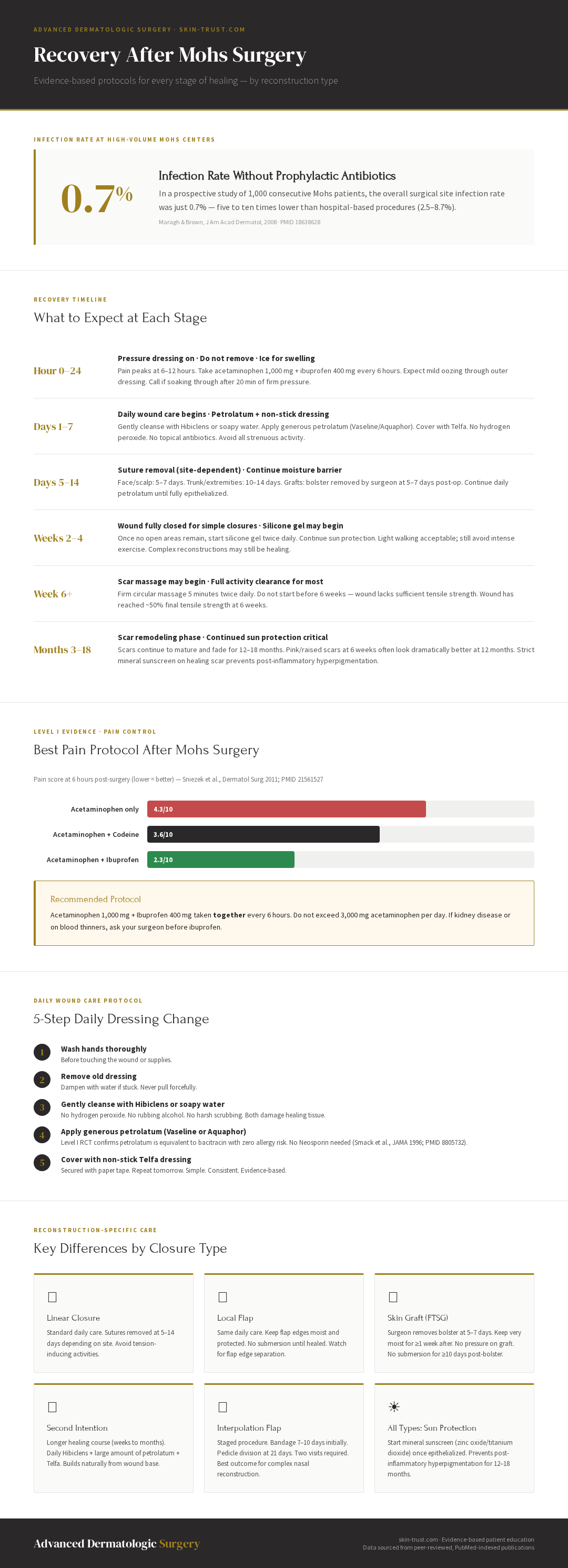
- First 24 hours: leave the pressure dressing in place, use ice for swelling, take acetaminophen + ibuprofen for pain — minor bleeding and oozing are normal; only remove the dressing early if bright red blood continues after 20 minutes of pressure
- Days 1–7: daily wound care with cleansing, petrolatum, and non-stick dressing is the complete protocol — infection rates below 1% at high-volume centers prove this simple approach works
- Wound tensile strength is only 5–15% at day 7 and 20–30% at day 14 — strenuous activity during this window increases bleeding, dehiscence (opening), and hematoma risk
- Stitches come out in 5–21 days depending on body location — facial wounds heal faster; scalp and extremities take longer due to lower blood flow and higher mechanical stress
- Serious complications (infection, major bleeding, dehiscence) occur in <2% at high-volume practices — excellent outcomes are achievable through good technique, moist wound healing, and activity restriction
- Different reconstruction types have specific protocols — linear closures follow standard care; flaps and grafts require longer restrictions; second-intention healing has a different timeline
What should I expect during the first 24 hours after Mohs surgery?
The first 24 hours are about controlling bleeding, managing discomfort, and keeping the wound undisturbed. Most patients experience mild to moderate pain and some oozing through the dressing — both are normal.
Leave the post-surgical pressure dressing in place for the first 24 hours unless your surgeon instructs otherwise. The pressure dressing controls bleeding and begins the healing process. Do not remove it to check the wound.
Pain peaks in the first 6–12 hours and typically diminishes significantly by 24–48 hours. A randomized controlled trial by Sniezek, Brodland, and Zitelli — conducted specifically in Mohs surgery patients — found that the combination of acetaminophen 1,000 mg plus ibuprofen 400 mg taken together every 6 hours produced lower pain scores at every postoperative time interval than acetaminophen alone or acetaminophen with codeine (Sniezek et al., 2011). Unless your surgeon has specified otherwise, this combination is the evidence-based first choice.
Bleeding is the most common first-day issue. Minor seeping through the bandage is normal. If bright red blood soaks through and continues after 20 minutes of firm, uninterrupted pressure with a clean cloth, call the office.
Ice applied to the outer dressing (never directly to the wound) can reduce swelling on the face and scalp during the first 24 hours. Apply for 20 minutes on, 20 minutes off while awake.
"The most common mistake I see in the first 24 hours is patients removing the pressure dressing too early to check the wound. Leave it alone. The pressure is doing critical work. The only reason to remove it before 24 hours is if you are having a significant bleed that does not respond to pressure — and in that case, call us."
— Thomas L.H. Hocker, M.D., M.Phil.
What is normal in the first 24 hours
| Finding | Normal | Call the Office |
|---|---|---|
| Pain | Mild to moderate (3–6/10) | Severe (8–10/10), or not responding to medication |
| Bleeding | Light seeping on outer dressing | Soaking through after 20 minutes of firm pressure |
| Swelling | Mild, especially on face | Rapidly expanding, firm, or causing visual changes |
| Numbness | Local area around wound | Spreading numbness or weakness |
| Oozing | Small amount of clear/blood-tinged fluid | Pus, foul odor, or thick discharge |
How do I care for my wound during the first week?
Daily wound care during the first week is straightforward: gentle cleansing, petrolatum-based moisture barrier, and a non-stick dressing. This moist wound environment is the single most important factor in reducing infection risk, minimizing scarring, and accelerating healing.
Starting the day after surgery (or after 24–48 hours per your surgeon's instruction), begin the daily wound care routine:
- Wash your hands thoroughly before touching the wound or dressing
- Remove the old dressing — if it is stuck, dampen it gently with clean water before removing
- Gently cleanse the wound with mild soapy water (Hibiclens or gentle soap) — no hydrogen peroxide, no rubbing alcohol, no harsh scrubbing. Both hydrogen peroxide and alcohol damage healing tissue
- Pat dry with a clean cloth or gauze
- Apply a generous amount of white petrolatum (Vaseline) or petrolatum-based ointment (Aquaphor) — this is your moisture barrier
- Cover with a non-stick dressing (Telfa or non-adherent pad) secured with paper tape or gentle adhesive
The petrolatum is not optional. It is the most important element of the daily routine. A landmark randomized controlled trial of 922 ambulatory surgery patients found that white petrolatum produced equivalent infection rates to bacitracin ointment — 2.0% vs. 0.9%, statistically non-significant — while producing zero cases of allergic contact dermatitis, compared to four allergic reactions in the bacitracin group (Smack et al., 1996). Topical antibiotic ointments (Neosporin, bacitracin) provide no infection benefit and carry unnecessary allergy risk. Use petrolatum.
"We recommend Hibiclens or plain soap and water — nothing harsh. Then a big gob of Vaseline or Aquaphor. When I say a big gob, I mean it. People are afraid to put too much on. You cannot put too much on. Then cover it. Repeat tomorrow. That is the entirety of the wound care protocol for most patients."
— Thomas L.H. Hocker, M.D., M.Phil.
Daily wound care by reconstruction type
Different reconstruction types have specific protocols. See the dedicated guides for detailed instructions:
| Reconstruction Type | Key Differences from Standard Care | Dedicated Guide |
|---|---|---|
| Linear closure | Standard daily care; may have more tension | Wound Care After Mohs Surgery |
| Local advancement/rotation flap | Same daily care; flap edges are critical; no submersion | Wound Care After Mohs Surgery |
| Full-thickness skin graft (FTSG) | Bolster removed by surgeon at 5–7 days; keep very moist for ≥1 week after; no pressure | Caring for a Skin Graft After Mohs Surgery |
| Second intention healing (SIH) | Daily Hibiclens + large amount of petrolatum; larger dressings; longer healing course | Second Intention Healing After Mohs Surgery |
| Staged interpolation flap | Specific protocol; pedicle division at 21 days; keep dressing 7–10 days initially | Wound Care After Mohs Surgery |
Data sourced from peer-reviewed, PubMed-indexed publications
What activity restrictions apply after Mohs surgery?
Current evidence — based on wound healing physiology — supports avoiding strenuous activity (exercise, heavy lifting, anything that raises blood pressure or causes sweating) for two weeks after most Mohs reconstructions. Swimming and submersion should be avoided until the wound is fully epithelialized.
There are no published randomized controlled trials directly testing activity restriction in cutaneous surgery. The recommendations are based on wound healing physiology, and the reasoning is solid.
Surgical wounds gain only 5–10% of their final tensile strength in the first week of healing. At the end of six weeks, they have recovered approximately 50% of the original skin strength, which continues to increase over 12–18 months. During this early period, activities that raise blood pressure, stretch wound edges, or cause sweating create real risks: bleeding, wound separation (dehiscence), and delayed healing.
The practical implications:
- Week 1–2: No exercise, heavy lifting (>10 lbs), yard work, sexual activity, or any strenuous exertion. Rest is appropriate and healing.
- Week 2–4: Light walking is generally acceptable. Resume normal activity as tolerated, listening to the wound — any pulling, bleeding, or pain signals to slow down.
- Week 4–6: Most activities can resume unless the wound is in a high-tension area. Ask your surgeon before returning to intense exercise.
- Swimming and submersion: Do not submerge in pools, lakes, hot tubs, or bathtubs until the wound is fully healed (epithelialized). For skin grafts, this means a minimum of 10 days after the bolster is removed, and often longer. Showering is generally acceptable after 24–48 hours; no pressure should be directed at the wound.
For a detailed breakdown with site-specific guidance, see Activity Restrictions After Mohs Surgery.
"I tell patients: if it makes you sweat, makes your heart pound, or makes you strain, it is too much for the first two weeks. A gentle walk is fine. Your spin class is not. Your garden beds can wait two weeks."
— Thomas L.H. Hocker, M.D., M.Phil.
What are the warning signs that require calling the office or going to the emergency room?
Most Mohs wounds heal without complications. The infection rate at high-volume Mohs practices is under 1% (Maragh & Brown, 2008). But knowing what to watch for — and when to escalate — is essential.
Call the office (during business hours)
- Increasing redness, warmth, or swelling beyond the first 48 hours
- Yellow or green drainage with odor
- Fever below 101.5°F
- Wound edges separating (wound opening up)
- Sutures that appear loose or have fallen out early
- A firm, expanding lump under the wound (possible hematoma)
- Pain worsening after 48 hours rather than improving
- Questions about your wound care routine
Go to the emergency room or call 911
- Bleeding that soaks through multiple dressings and does not stop with 20 minutes of firm pressure
- Fever above 102°F with wound site pain
- Rapidly spreading redness (red streaks, rapidly expanding warmth) — possible cellulitis
- Wound on or near the eye with sudden vision changes
- Signs of systemic infection: shaking chills, confusion, low blood pressure, rapid heart rate
For a complete symptom guide with photos and triage criteria, see Warning Signs After Mohs Surgery: Is This Normal?
How do I optimize my scar after Mohs surgery?
Scar optimization is a timeline-dependent process. The right interventions at the right times make a meaningful difference. Starting too early — particularly scar massage or silicone — before the wound has epithelialized causes harm rather than help.
The scar optimization timeline:
Immediately (day 1 onward): Moist wound healing. Petrolatum is scar-protective — it prevents scab formation, which inhibits normal epithelialization and creates a thicker, more irregular scar.
When sutures are removed (typically 5–14 days): Continue petrolatum until the wound is fully closed. No silicone gel until fully epithelialized.
When fully epithelialized (no open areas): Start silicone gel. Apply twice daily. Generic silicone gel performs equivalently to branded products like Kelo-cote. Evidence does not support Mederma (onion extract alone) — it has not demonstrated benefit in controlled trials.
Six weeks post-surgery: Scar massage may begin. Firm circular massage for 5 minutes, twice daily. Do not start massage before six weeks — the wound lacks sufficient tensile strength and massage disrupts healing collagen.
Three months onward: Sun protection becomes critical. UV exposure on a healing scar causes post-inflammatory hyperpigmentation (darkening) that can persist for years. Use mineral sunscreen — zinc oxide or titanium dioxide — which physically blocks UV without converting it to heat. Chemical sunscreens convert UV to heat energy, which drives PIH in healing tissue.
Twelve to eighteen months: The remodeling phase continues. Scars that look imperfect at three months often improve significantly by eighteen months. Avoid making revision decisions before this time.
For the complete evidence-based scar timeline, see How to Minimize Scarring After Mohs Surgery and How to Minimize Scarring After Skin Surgery.
What should I know about antibiotics after Mohs surgery?
Prophylactic (preventive) antibiotics are not routinely recommended after Mohs surgery for most patients. The evidence — and ADS protocol — reserve antibiotic use for specific high-risk situations.
Routine prophylactic antibiotics have not been shown to reduce infection rates in Mohs surgery in the published evidence. The overall infection rate without prophylactic antibiotics in a published prospective study of 1,000 consecutive patients was 0.7% (Maragh & Brown, 2008). Blanket antibiotic prescribing does not improve on this rate and contributes to antibiotic resistance.
The recommended protocol is to prescribe antibiotics for flap and graft reconstructions, where tissue disruption is greatest and the consequences of infection are most significant to the cosmetic outcome.
If you develop signs of infection (worsening redness, warmth, swelling, purulent discharge, fever), contact the office promptly. Established infections require treatment.
For the complete antibiotics discussion, see Antibiotics After Mohs Surgery: When You Need Them.
When do I need sun protection, and what kind?
Sun protection of the healing wound should begin as soon as the wound is epithelialized — typically within 2–4 weeks for simple closures. A mineral sunscreen (zinc oxide or titanium dioxide) SPF 30 or higher is preferred for post-surgical wounds.
Direct UV exposure on a healing scar has two significant consequences: it slows healing and it triggers post-inflammatory hyperpigmentation (PIH) — a darkening of the scar that can persist for 1–2 years. The mechanism matters. Chemical sunscreens (avobenzone, oxybenzone) absorb UV radiation and convert it to heat — and heat drives PIH in healing tissue. Mineral sunscreens (zinc oxide, titanium dioxide) physically reflect UV without generating heat, making them the better choice for post-surgical wounds.
Tinted mineral sunscreens with iron oxides provide additional protection against visible light, which also contributes to PIH.
For the complete sun protection guide after Mohs surgery, see Sun Protection After Mohs Surgery.
What surveillance do I need after Mohs surgery for skin cancer?
Follow-up surveillance after Mohs surgery depends on the type of skin cancer removed. Basal cell carcinoma, squamous cell carcinoma, melanoma, Merkel cell carcinoma, and rarer cancers each have different surveillance intervals based on NCCN and AAD guidelines.
Mohs surgery treats the primary tumor with the highest cure rate of any treatment for skin cancer. But surveillance remains essential because patients who have had one skin cancer are at significantly increased lifetime risk for additional skin cancers at other sites, and for local recurrence of the treated cancer.
Summary of surveillance by cancer type:
| Cancer Type | Year 1 Follow-Up | Years 2–5 | Long-Term |
|---|---|---|---|
| Low-risk BCC | Every 6–12 months | Annually | Annually |
| High-risk BCC | Every 3–6 months | Every 6–12 months | Annually |
| Low-risk cSCC | Every 3–6 months | Annually | Annually |
| High-risk cSCC | Every 3 months | Every 6 months | Annually |
| Melanoma Stage I | Every 3–6 months × 2 years | Annually × 3 years | Annually |
| Melanoma Stage II/III | Every 3 months × 2 years | Every 3–6 months | Annually |
| Merkel Cell Carcinoma | Every 3 months × 2 years | Every 6 months × 3 years | Annually |
Guidelines per NCCN and AAD — see Kim et al., 2018 for cSCC and Swetter et al., 2019 for melanoma.
For the complete surveillance guide by cancer type, see Skin Cancer Surveillance After Mohs Surgery.
Frequently asked questions about Mohs surgery recovery
How long does recovery from Mohs surgery take?
For a simple linear closure on the trunk, most patients feel well within 1–2 weeks, and the wound is fully healed in 4–6 weeks. Complex reconstructions — flaps, grafts, second intention healing on the nose or scalp — take longer: the wound may close in 4–8 weeks, but scar remodeling continues for 12–18 months. The visible appearance of any scar improves significantly over the first year.
Can I shower after Mohs surgery?
Yes — after 24–48 hours, gentle showering is generally permitted. Do not direct the shower spray at the wound, and avoid submersion (bathtubs, pools, lakes, hot tubs) until the wound is fully epithelialized. For skin grafts, the surgeon removes the bolster at 5–7 days; do not submerge until at least 10 days after bolster removal, or as directed.
When can I exercise after Mohs surgery?
Avoid all strenuous exercise for the first two weeks. This includes gym workouts, running, cycling, swimming, heavy lifting, yard work, and any activity that significantly elevates your heart rate or blood pressure. Light walking is acceptable from day 2–3. Ask your surgeon before resuming intense exercise after two weeks, particularly if your wound is in a high-tension or functionally critical area.
Should I use Neosporin or Vaseline on my wound?
Vaseline (white petrolatum) is the evidence-based first choice. A randomized controlled trial of 922 patients found petrolatum produced equivalent infection rates to bacitracin with zero risk of allergic contact dermatitis (Smack et al., 1996). Neosporin (triple antibiotic) carries a meaningful risk of allergic reaction and provides no infection benefit over petrolatum in outpatient wounds. Use petrolatum.
What pain medication is best after Mohs surgery?
The combination of acetaminophen 1,000 mg plus ibuprofen 400 mg taken together every 6 hours is supported by Level I evidence specifically from Mohs surgery patients. This combination produced the lowest pain scores at every time interval compared to acetaminophen alone or acetaminophen with codeine (Sniezek et al., 2011). Do not exceed 3,000 mg of acetaminophen per day. If you have kidney disease or are on blood thinners, ask your surgeon before taking ibuprofen. See Managing Pain After Mohs Surgery for the complete guide.
Do I need to stop my blood thinners before or after Mohs surgery?
No. Continue aspirin, ibuprofen, fish oil, and all prescription anticoagulants (warfarin, Eliquis, Xarelto, Plavix) unless your prescribing physician or cardiologist has specifically directed you to stop. The risk of stopping these medications (blood clots, cardiac events) significantly outweighs the manageable risk of increased intraoperative bleeding, which can be controlled surgically.
When should I be worried about infection?
The infection rate in Mohs surgery without prophylactic antibiotics is approximately 0.7% in prospective data (Maragh & Brown, 2008). Signs of infection include worsening redness beyond 48–72 hours, increasing warmth and swelling, yellow-green drainage with odor, and fever. Some redness and warmth in the first 48 hours is normal inflammatory healing — not infection. Infection that develops later (day 4–10) and worsens rather than improves needs evaluation. See Warning Signs After Mohs Surgery for the complete triage guide.
Will my scar fade?
Yes — significantly. The scar remodeling phase lasts 12–18 months after surgery. What looks like a pink, raised, or irregular scar at 6 weeks typically fades, flattens, and softens substantially by 12–18 months. You should not evaluate the final cosmetic outcome until at least 12 months post-surgery. During this period, sun protection, silicone gel, and scar massage (after 6 weeks) all contribute to a better final outcome.
What is second intention healing and when is it used?
Second intention healing (wound healing by granulation, without surgical closure) is chosen when it produces a better cosmetic outcome than suture closure — particularly on concave surfaces like the inner corner of the eye (medial canthus), ear conchal bowl, temple, and scalp. The wound fills in from the bottom with new tissue and closes over weeks. See Second Intention Healing After Mohs Surgery for the complete protocol.
My surgeon removed more tissue than I expected. Is that normal?
Yes. Mohs micrographic surgery maps the precise cancer margins before closing — it does not guess. Additional "stages" (tissue removal passes) are taken when the microscopic examination shows residual cancer. Every additional stage is a good thing: it means the cancer was found and removed rather than left behind. The defect reflects the true extent of the cancer, not surgeon error.
References
Sniezek PJ, Brodland DG, Zitelli JA. A randomized controlled trial comparing acetaminophen, acetaminophen and ibuprofen, and acetaminophen and codeine for postoperative pain relief after Mohs surgery and cutaneous reconstruction. Dermatol Surg. 2011;37(7):1007-1013. PMID: 21561527
Smack DP, Harrington AC, Dunn C, et al. Infection and allergy incidence in ambulatory surgery patients using white petrolatum vs bacitracin ointment. A randomized controlled trial. JAMA. 1996;276(12):972-977. PMID: 8805732
Maragh SL, Brown MD. Prospective evaluation of surgical site infection rate among patients with Mohs micrographic surgery without the use of prophylactic antibiotics. J Am Acad Dermatol. 2008;59(2):275-278. PMID: 18638628
Kim JYS, Kozlow JH, Mittal B, Moyer J, Olenecki T, Rodgers P. Guidelines of care for the management of cutaneous squamous cell carcinoma. J Am Acad Dermatol. 2018;78(3):560-578. PMID: 29331386
Swetter SM, Tsao H, Bichakjian CK, et al. Guidelines of care for the management of primary cutaneous melanoma. J Am Acad Dermatol. 2019;80(1):208-250. PMID: 30392755
About the author: Thomas L.H. Hocker, M.D., M.Phil., is a triple board-certified dermatologist, dermatopathologist, and Mohs micrographic surgeon. He trained at Harvard Medical School and completed his Mohs fellowship at Mayo Clinic. He serves as founding division chief of dermatologic surgery at the University of Missouri-Kansas City.
This content is provided for educational purposes only. It does not constitute medical advice and should not replace the individualized instructions provided by your surgical team. Always follow your surgeon's specific post-operative instructions.
