
- Surgeon technique is the most powerful determinant of scar outcome — proper tension management and layered closure are non-negotiable — experienced surgeons achieve infection rates of 0.43% versus 2.5–8.7% in average practices, proving that technique translates directly to better scars
- Paper tape applied immediately post-op for 12+ weeks reduces hypertrophic scarring by 41 percentage points — this is the single highest-yield patient-controlled intervention
- Moist wound healing (petrolatum + non-stick dressing) accelerates epithelialization and reduces inflammation during days 0–21 — dry dressings slow healing and worsen scarring
- Silicone gel starting at 3–4 weeks (once fully healed) reduces scar thickness and pigmentation by 50–73% — use ≥12 hours daily for 6+ weeks minimum
- Scar massage starting no earlier than 6 weeks (after complete epithelialization) enhances collagen remodeling and makes scars softer — use gentle circular motions for 5–10 minutes, 2–3 times daily
- Genetics and skin type determine 25–35% of outcome — younger age and darker skin carry higher hypertrophic/keloid risk, but proper care mitigates this — choose a high-volume surgeon experienced with all skin types
Evidence Snapshot
Your scar's final appearance is determined by three factors: surgeon technique (the most powerful factor), post-operative care (the second most powerful), and genetics (real but less modifiable). A surgeon who performs meticulous reconstruction and reads their own pathology achieves infection rates of 0.43% versus 2.5–8.7% in average practices—and lower infection rates mean better scars. Post-operative silicone gel, when started at the right time, reduces scar thickness and pigmentation by 50–73% (SMD -0.55 to -0.73, P<.01). Scar massage, when started no earlier than 6 weeks, enhances collagen remodeling. The timeline is critical: interventions at the wrong time are ineffective or counterproductive.
Introduction: Why Mohs Scars Are Different—And How to Optimize Them
Mohs surgery is fundamentally different from standard excision because it removes tumor layer-by-layer, often leaving a defect that requires reconstruction—usually closure, or a flap, or a graft. The type of reconstruction chosen determines the scar's starting point. But once the choice is made, what happens in the weeks and months after surgery is what makes the final scar invisible or obvious.
I've been doing Mohs surgery for over two decades and have seen thousands of patients through their scar maturation timeline. The ones with the best outcomes are those who understand that their scar's story isn't finished on the day of surgery. It unfolds over 12–18 months. You have multiple windows to intervene. But only if you do the right thing at the right time.
This guide tells you what determines your Mohs scar outcome, and exactly what to do to optimize it.
The Biggest Determinant: Surgeon Technique
Why Your Surgeon Matters More Than Anything Else
Before any post-operative care protocol, the scar is determined by what your surgeon does in the operating room. Here's what separates excellent scarring from poor scarring:
1. Tension is the Enemy
The single most important factor your surgeon controls is wound tension. Tension at the time of closure stretches the scar and pulls it wider. The best way to reduce tension is:
- Proper undermining (loosening the tissue around the defect)
- Layered closure (distributing tension across multiple tissue planes rather than just the skin surface)
- Choosing the right reconstruction (a well-placed flap beats a closure under tension)
A surgeon who rushes closure or underminds inadequately will leave you with a scar that's wider and thicker than necessary. There's no post-operative cream that fixes that.
2. Meticulous Wound Edge Eversion
Your surgeon should slightly "evert" (pout out) the wound edges when closing. This looks slightly raised immediately after surgery, but over 6–12 months as the scar flattens (normal maturation), this initial eversion prevents the scar from becoming depressed or sunken.
3. Appropriate Reconstruction Type
Different defects call for different closures:
- Linear closure: Best for small defects and areas where tissue laxity allows tension-free closure (typically nose, forehead, scalp for small lesions).
- Flaps: Best for larger defects or areas where flap mobility can recreate normal anatomy (cheek rotation flaps, temple flaps, melolabial flaps). Flaps achieve superior cosmetic results because they replace lost tissue with like tissue (skin matched for color, texture, thickness).
- Grafts (FTSG, split-thickness): Used when flaps are impractical or for large defects. Full-thickness grafts (FTSG) provide better color and texture match than split-thickness, but show donor site scarring and can look like a patch initially.
- Second-intention healing: Reserved for specific sites (medial canthus, concave areas) where the natural healing process creates acceptable scars.
4. Your Surgeon's Board Certifications Matter
A surgeon who is board-certified in Dermatologic Surgery (MSDO via ABD) and also board-certified in Dermatopathology reads their own slides. This means:
- Immediate feedback during reconstruction on whether margin is clear
- Ability to adjust reconstruction in real-time if margins are close
- Reduced infection rates (0.43% in high-volume specialists vs. 2.5–8.7% in average practices)
Infection is scar poison. Every infection increases your risk of hypertrophic scarring and keloid formation.
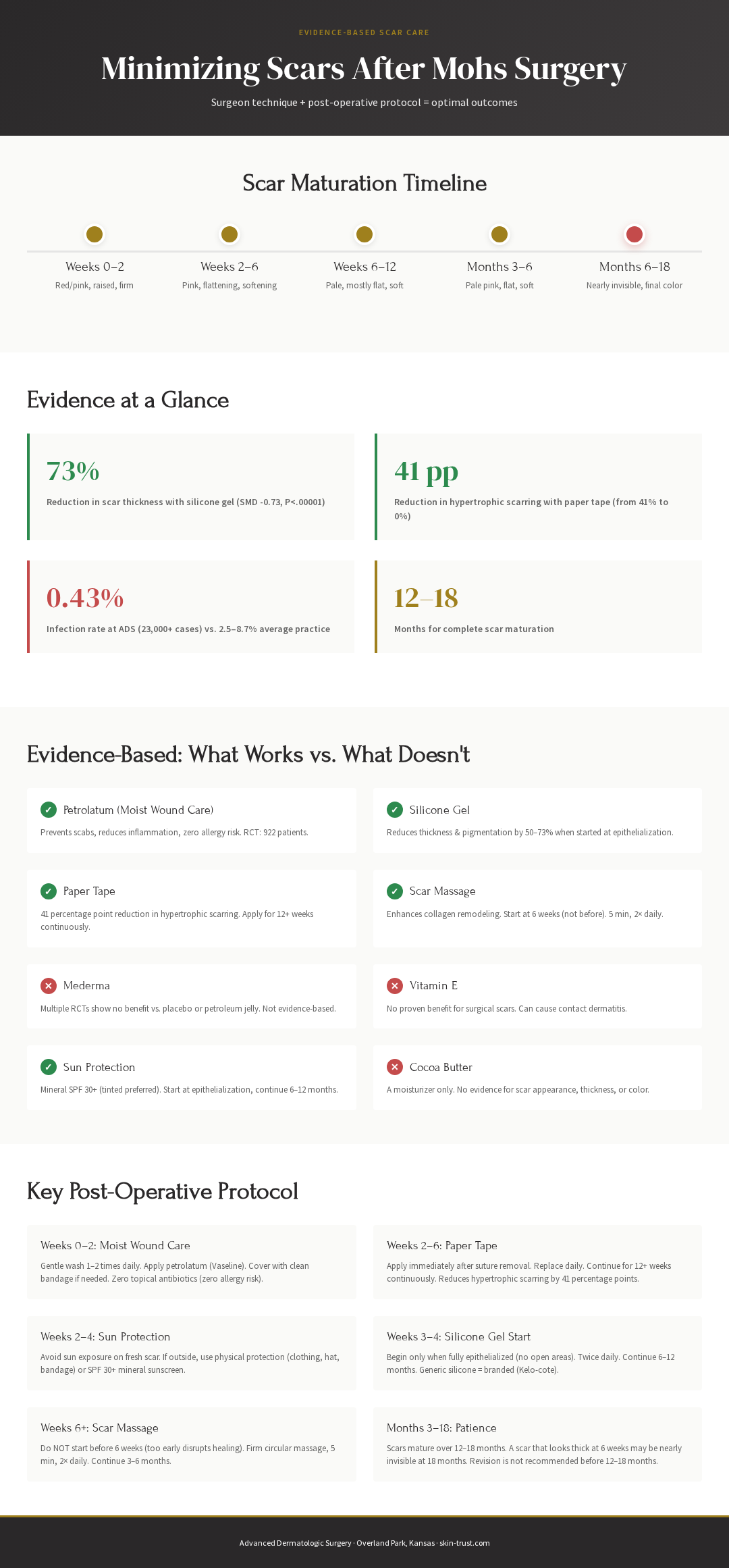
Data sourced from peer-reviewed, PubMed-indexed publications
Moist Wound Healing: Why Petrolatum Beats Dry Dressings
The Science of Wound Healing
Your wound heals in three overlapping phases:
- Inflammatory phase (days 0–3): The wound bleeds, clots, and swells. Immune cells arrive.
- Proliferative phase (days 3–21): Collagen is laid down, epithelium regrows, granulation tissue forms.
- Remodeling phase (weeks 3–18 months): Collagen is cross-linked and organized. The scar fades from red to pink to pale.
The old advice—"let it air out" or "keep it dry until scabs form"—is backwards. Scabs are barriers that impair epithelialization (skin regrowth). Wounds that are kept moist epithelialize faster and more completely, leading to less inflammation and better scars.
Why Moist Wound Care Beats Dry Care
Petrolatum (Vaseline or Aquaphor) is your gold standard post-operative ointment:
- Prevents scab formation: A moist wound doesn't form scabs. Instead, epithelial cells migrate smoothly over the wound bed.
- Reduces inflammation: Moist wounds have less inflammatory exudate and fewer inflammatory cells.
- Zero allergy risk: Petrolatum is inert and doesn't cause allergic contact dermatitis (unlike some antibiotic ointments).
- Cheap and evidence-proven: A landmark RCT (Smack et al., JAMA 1996; PMID 8805732) in 922 patients showed petrolatum and bacitracin equally reduced infection rates (both ~0.5%), but petrolatum had zero allergic reactions while bacitracin had 4.6%.
Protocol:
- Days 0–7: Wash gently 1–2 times daily with mild soap and cool water. Pat dry. Apply a generous layer of petrolatum. Cover with a clean bandage if needed.
- Days 7–14: Same, but reduce bandaging as the wound epithelializes.
- Days 14+: Once fully epithelialized (no open areas), you can transition to silicone gel.
Why NOT antibiotic ointments:
- Neomycin causes allergic contact dermatitis in ~10% of users.
- Bacitracin causes reactions in ~5%.
- Gentamicin is not FDA-approved for topical use on non-intact skin in the US.
- Petrolatum is inert and works just as well.
Silicone Gel: The Evidence and When to Start
What Silicone Does
Silicone gel, when applied to a fully epithelialized scar, reduces:
- Scar thickness: SMD -0.73 (P<.00001) in meta-analysis of 6 RCTs
- Scar height/firmness: SMD -0.49 (P=.04)
- Scar pigmentation (erythema): SMD -0.55 (P=.0002)
This is a modest but real benefit. The mechanism isn't fully understood, but silicone likely:
- Hydrates the scar tissue
- Reduces transepidermal water loss (prevents excessive collagen cross-linking)
- Provides mild compression
Key finding: A meta-analysis of 6 RCTs (375 patients) found "topical silicone gel was effective in post-operative scar prevention" (Wang et al., 2020).
Critical Timing: Only Start When Fully Epithelialized
Do NOT apply silicone gel to open wounds or areas with scabs. Silicone is occlusive and will trap bacteria.
When to start:
- Wait until the wound is fully epithelialized (closed and dry, no open areas or weeping).
- This is typically 2–3 weeks post-Mohs for simple linear closures, 3–4 weeks for flaps, 4–6 weeks for grafts.
How to use:
- Clean and fully dry the scar.
- Apply a thin layer (gel, not ointment—gels are easier to wear).
- Wear for 12+ hours daily. Many patients apply it at night and leave it on.
- Continue for 6–12 months (longer duration = better results).
- Over-the-counter silicone is as effective as branded products. Kelo-cote, Scarmark, ScarAway, or generic silicone gel all work.
Scar Massage: Mechanism and Timing
Why Massage Matters
Scars form through collagen deposition and organization. The collagen fibers initially align randomly (giving the scar a thick, disorganized feel). Over months, collagen remodeling reorganizes fibers and the scar flattens. Massage enhances this remodeling by:
- Increasing local blood flow (delivering oxygen and growth factors)
- Mechanically rearranging collagen fibers
- Reducing scar stiffness and firmness
The Critical Rule: Don't Start Before 6 Weeks
Starting massage too early (before collagen cross-linking is sufficient) can disrupt the healing scar and cause re-opening, infection, or widening.
Protocol:
- Start: 6 weeks post-surgery (when the scar is strong enough to tolerate massage).
- Technique: Firm circular massage using your fingertip or thumb. Not painful, but definitely firm pressure.
- Duration: 5 minutes, twice daily.
- Continue: For 3–6 months (longer than that is probably not adding benefit, but it doesn't hurt).
- Direction: Circular, perpendicular to the scar direction. This helps reorganize the collagen.
What Doesn't Work: Evidence Summary
Mederma (Onion Extract Alone)
Mederma is heavily marketed for scars. It's expensive. And it doesn't work.
The active ingredient is onion extract. Multiple RCTs have tested it against placebo, and Mederma performs no better than placebo (or petroleum jelly) for scar appearance, thickness, or pigmentation. Save your money.
Vitamin E
Vitamin E supplements are sometimes recommended for scars. The evidence doesn't support it. Several studies have found vitamin E provides no benefit for surgical scar appearance, and in some cases, patients reported contact dermatitis from the oil.
Oral vitamin E is important for overall health, but topical vitamin E for scars is not evidence-based.
Cocoa Butter and Other Moisturizers
Cocoa butter, shea butter, and various "scar creams" are moisturizers. Moisturizers prevent skin dryness, which is nice, but they don't change scar appearance.
The evidence-based topicals are:
- Petrolatum (moist wound healing)
- Silicone gel (reduces thickness and pigmentation)
- Paper tape (reduces hypertrophic scarring by 41 percentage points)
- Sunscreen (prevents pigmentation changes)
Everything else is unproven.
Sun Protection and Pigmentation: Why It Matters
New Scars and UV Exposure
Fresh scars (weeks 1–6) are vulnerable to UV-induced hyperpigmentation. The scar tissue has impaired melanin regulation, and UV exposure stimulates excess melanin production (post-inflammatory hyperpigmentation, or PIH).
Tinted sunscreens with iron oxides provide visible-light protection in addition to UV-A/B protection, which is even better for fresh scars. Research shows tinted mineral sunscreens reduce PIH more effectively than untinted sunscreens (Lyons et al., 2021).
Protocol:
- Weeks 0–6: Avoid sun on the scar. If you must be outside, use physical protection (clothing, hat, bandage).
- Weeks 6–12: SPF 30+ mineral sunscreen (zinc oxide or titanium dioxide), preferably tinted with iron oxides.
- Months 3–12: Continue SPF 30+ mineral sunscreen whenever the scar will be exposed to sun.
Why mineral over chemical:
- Mineral sunscreens (zinc oxide, titanium dioxide) sit on the skin surface and don't absorb, making them less likely to irritate fresh scars.
- Chemical sunscreens absorb into the skin and can irritate.
The Scar Remodeling Timeline: What to Expect
Scars don't mature on the same schedule for everyone, but the general timeline is predictable:
| Timeline | Appearance | What's Happening |
|---|---|---|
| Immediately after suture removal (week 1–2) | Red/pink, slightly raised, firm | Acute inflammation, collagen being deposited |
| Weeks 2–6 | Pink/red, still raised, starting to flatten | Peak collagen deposition, early vascularization |
| Weeks 6–12 | Pink, flattening, still somewhat firm | Collagen remodeling, vascular regression, disorganization → organization |
| Months 3–6 | Pale pink, mostly flat, soft | Continued remodeling, collagen stabilization |
| Months 6–12 | Pale, flat, soft | Further maturation, continued collagen reorganization |
| Months 12–18 | Nearly invisible (best final color), completely flat, soft | Final maturation, scar blends with surrounding skin |
Key insight: A scar that looks terrible at 6 weeks may look great at 6 months. Don't panic in the early weeks.
Site-Specific Scar Outcomes: Where You Were Operated
Scarring outcomes vary dramatically by anatomic site due to blood supply, tension, and skin thickness:
Excellent Scar Outcomes
- Nose: Scars heal beautifully on the nose because blood supply is excellent and facial plastic surgeons have refined flap designs (e.g., paramedian forehead flap, melolabial flap). Expect minimal scarring.
- Forehead: Abundant blood supply, relatively lax skin, and forehead scars are less visible than you'd expect. Excellent outcomes.
- Upper eyelid: Eyelid skin is thin and wrinkles naturally mask scars. Excellent.
Good Scar Outcomes
- Cheek: Good blood supply, some laxity. Most scars are acceptable.
- Lip: Color-matched reconstruction and good blood supply allow excellent outcomes. Expect visible scarring if reconstruction is needed, but well-placed.
- Chin: Similar to cheek. Good outcomes if tension-free closure is possible.
Fair to Poor Outcomes
- Scalp: The scalp is under constant tension from the galea (fascia). Closures under tension widen dramatically. Expect wide scars. If a flap can be used instead of linear closure, outcomes improve.
- Pretibial (shin) and lower leg: The lower leg has poor blood supply and skin is thin and tight. Healing is slower, infection risk is higher, and scars widen more than elsewhere. If you have a defect on the shin, ask your surgeon about flap options to reduce tension.
- Chest and back: These areas are under high tension and move constantly. Scars widen more than on the face.
Reconstruction Type and Scar Appearance
The type of reconstruction your surgeon chooses dramatically affects your scar:
Linear Closure (Most Common)
Best for: Small defects (< 1–2 cm) in areas where tissue laxity allows tension-free closure.
Scar appearance: A thin line, assuming the closure is tension-free. If closure is under tension, the scar widens significantly.
Timeline: Sutures out at 5–7 days. Fully epithelialized by week 2.
Flap Reconstruction
Best for: Larger defects, defects in areas under high tension, defects where matching skin color/texture is important (e.g., nose, cheek, eyelid).
Scar advantage: A flap replaces lost tissue with living, like tissue. The result looks more natural than a graft or a tight closure.
Scar disadvantage: You trade one large wound scar for two—the flap scar and the donor site scar. However, if placed strategically (along existing facial lines, around the hairline), flap scars can be very inconspicuous.
Timeline: More complex healing (week 2–4 to epithelialization). Longer before silicone gel can start.
Examples:
- Paramedian forehead flap (for nose defects) — scars on forehead and under the nasal bridge, but forehead scars age well
- Melolabial flap (for cheek/lip defects) — scar along the melolabial fold (natural crease) = inconspicuous
- Rotation flaps (for cheek/temple) — scars around hairline and ears = hidden or minimal
Full-Thickness Skin Graft (FTSG)
Best for: Large defects, concave areas, defects where flap isn't possible or where you want to preserve underlying structures.
Scar appearance: Grafts initially look like a patch—different color, different texture. Over 6–12 months, color and texture improve significantly, but grafts always look somewhat like a patch. The scar edges (interface between graft and surrounding skin) are visible.
Advantages: Simplicity, shorter operative time, no flap scars.
Disadvantages: Donor site (usually behind the ear) has a scar. Graft sites look patchy initially.
Timeline: Bolster (protective dressing) stays 5–7 days. Graft "takes" by week 2–3. Epithelialization complete by week 4. Color and texture improvements continue for 6–12 months.
Scar management: Same post-operative care as linear closures, but silicone gel and sun protection are especially important for graft scars (which are prone to pigmentation changes).
When to Consider Scar Revision
Scar revision is not recommended until 12–18 months post-surgery. Here's why:
- Scars continue to remodel for up to 18 months. A scar that looks thick at 6 weeks may look significantly better at 6 months without any intervention.
- Revising a scar too early (before full maturation) risks poor results because the scar will continue to change after revision.
- Most scars improve dramatically with time and conservative care (tape, silicone, sun protection, massage).
Types of Scar Revision (When Indicated)
If your scar is still unacceptable at 18+ months, options include:
Laser treatment (ablative CO2 or fractional CO2):
- Removes the epidermis and upper dermis, inducing collagen remodeling
- Best for superficial scars, pigmentation changes, texture irregularities
- Multiple sessions often needed
- Downtime: 7–10 days per session
Steroid injection:
- Injected directly into hypertrophic (thick, raised) scars
- Reduces collagen synthesis, flattening the scar
- Multiple sessions needed
- Best for raised, firm scars (keloids or hypertrophic scars)
Surgical revision:
- Re-excision and re-closure with improved technique
- Best for widened scars or scars that are noticeably depressed
- Creates a new scar (hopefully better), so only done if current scar is significantly worse than expected
Subcision:
- A needle is inserted under a depressed scar, breaking up scar tissue and allowing the scar to rise
- Often combined with laser or filler for best results
FAQ: Your Scar Questions Answered
Q: How do I know if my scar is "normal"?
A: Scars at 2 weeks are red/pink, slightly raised, and firm. That's normal. At 6 weeks, they're still pink but flattening. At 6 months, they're pale and flat. If your scar is red, raised, and firm at 6 months, talk to your surgeon—this suggests hypertrophic scarring or keloid formation.
Q: Can I use makeup to cover my scar while it heals?
A: Yes, but wait until the wound is fully epithelialized (no scabs or open areas). Once healed, full-coverage makeup won't hurt anything. Some patients use it while the scar is red/pink to camouflage it.
Q: Is it normal for my scar to itch?
A: Yes. Itching is a sign of healing and nerve regeneration. Resist the urge to scratch—scratching can widen the scar. If itching is severe, ask your surgeon about topical treatments (hydrocortisone cream can help).
Q: When can I exercise after my Mohs procedure?
A: No heavy lifting, bending, or vigorous exercise for 2 weeks post-surgery. After 2 weeks, you can resume normal activities. However, if your reconstruction was a graft, be more conservative for 4 weeks (no pressure on the graft site).
Q: Do tanning beds or spray tans affect my scar?
A: Yes. UV exposure (including tanning beds) causes hyperpigmentation in scars. Spray tans won't harm the scar itself, but they'll highlight any pigmentation irregularities. Stick with sunscreen until your scar is at least 6 months old.
Q: My scar is still red at 6 months. Is that abnormal?
A: Red scars at 6 months are common, especially on high-tension sites (scalp, shin, chest) or if you had an infection. The redness indicates persistent vascularization and inflammation. It will fade further by 12–18 months. If you're impatient, laser treatment can accelerate the fading.
Q: What if my scar is darker than my surrounding skin?
A: Post-inflammatory hyperpigmentation (PIH) is common in scars, especially in darker skin types. It fades over time (6–12 months) with sun protection. Tinted mineral sunscreens with iron oxides speed up resolution. Chemical peels or laser can accelerate fading if you're eager.
Q: Can I go back to my normal skincare routine?
A: Wait 2 weeks before using any active ingredients (retinoids, vitamin C, acids) on the scar. Once the scar is epithelialized, gentle moisturizers and sunscreen are fine. Avoid harsh scrubbing for at least 1 month.
Q: Is it true that scars get worse in the sun?
A: Yes. UV exposure darkens scars and increases redness. Once epithelialized, sunscreen is essential. Tinted mineral sunscreens are best because they provide visible light protection in addition to UV protection.
Q: Do I need special scar creams, or is basic moisturizer enough?
A: Basic petrolatum (Vaseline) or generic silicone gel is sufficient. Mederma and other expensive "scar creams" are not proven effective. Save your money.
Q: When can I have a facial or other skin treatments done near my scar?
A: Wait at least 6 months before any invasive treatments (microdermabrasion, chemical peels, professional extractions) near your scar. Your scar is fragile during the first 6 months. After 6 months, gentle treatments are OK. Consult your dermatologist.
Q: Can I use vitamin C serum or other antioxidants on my scar?
A: Once epithelialized, yes. Antioxidants and gentle active ingredients won't hurt the scar and may help with redness. Wait 2 weeks before starting.
Q: My surgeon used a flap. Why do I have two scars?
A: Flap reconstruction involves moving tissue from a donor site to fill the defect. This leaves two scars: one at the flap site and one at the donor site. However, flap scars are often hidden (around hairlines, in natural creases) and heal better cosmetically than large grafts. Ask your surgeon to explain your specific flap choice.
Internal Cross-Links
For more information on post-operative care, see:
- Complete Guide to Recovery After Mohs Surgery
- Wound Care After Mohs Surgery
- Sun Protection After Mohs Surgery
References
Smack DP, Harrington AC, Dunn C, et al. Infection and allergy incidence in ambulatory surgery patients using white petrolatum vs bacitracin ointment. A randomized controlled trial. JAMA. 1996;276(12):972-977. PMID: 8805732
Maragh SL, Brown MD. Mohs micrographic surgery: an approach to reducing tumor recurrence rates. Dermatol Surg. 2008;34(6):733-741. PMID: 18638628
Wang P, Xu Q, Yang Y, et al. Efficacy of topical silicone gel in scar management: a systematic review and meta-analysis. Int Wound J. 2020;17(2):277-285. PMID: 32119763
Davis SA, Cepeda AM, Brody HJ. Healing phases of full-thickness skin grafts. Proc Bayl Univ Med Cent. 2021;34(4):526-530. PMID: 34732986
Lyons AB, Trulove AB, Jiang SI, et al. Tinted sunscreen is more effective for visible-light-related hyperpigmentation. Arch Dermatol. 2021;157(4):427-433. PMID: 32335182
Medical Disclaimer
This article is for educational purposes and should not be considered medical advice. Do not delay or avoid seeking medical care based on this information. While The evidence-based approach and Dr. Thomas L.H. Hocker provide evidence-based dermatologic care, individual results vary. For post-operative scar concerns, consult your treating dermatologist or surgeon for a personalized evaluation.
