
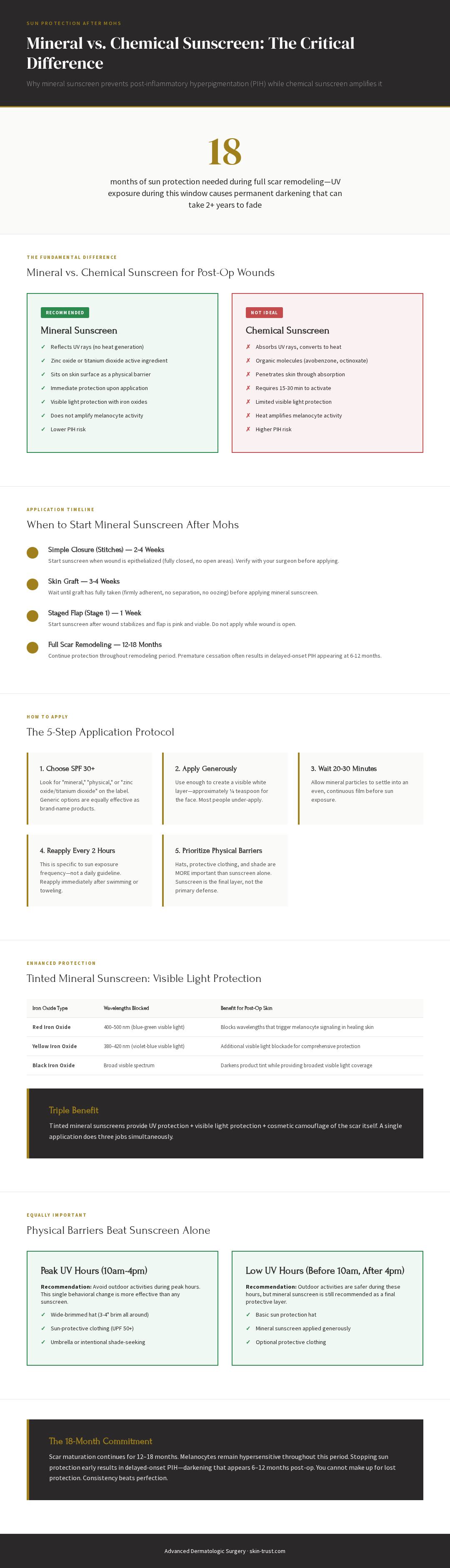
- Mineral sunscreen (zinc oxide or titanium dioxide) is mandatory for healing surgical scars — these physically reflect UV rays without generating heat, whereas chemical sunscreens convert UV to heat that amplifies melanin production
- Post-inflammatory hyperpigmentation (darkening) can persist 12–18 months if sun is not blocked — healing skin is hypersensitive to UV and visible light; prevention is far easier than treatment later
- Start mineral sunscreen once the wound is epithelialized (2–4 weeks post-op) — apply SPF 30+ daily, reapply every 2 hours with sun exposure, and continue for at least 12 months
- Physical barriers (hats, protective clothing, shade) are superior to sunscreen alone — they block both UV and visible light without heat generation
- Tinted mineral sunscreens with iron oxides provide additional protection against visible light — visible light (particularly blue wavelengths) also triggers excessive melanin production in healing skin
- Avoid tanning beds and spray tans — these create excess UV exposure or unknown irritants on vulnerable healing skin
Why is sun protection so critical after Mohs surgery?
Sun exposure after Mohs surgery is not like sun exposure on normal skin. Fresh surgical wounds are hypersensitive to UV radiation and visible light, triggering excessive melanin production in healing melanocytes—a process called post-inflammatory hyperpigmentation (PIH). This darkening can persist for 12–18 months if not prevented.
After Mohs surgery, the healing skin undergoes a dramatic process. Inflammatory cells flood the wound, growth factors redirect collagen deposition, and melanocytes (pigment-producing cells) become hyperactive. This hyperactivity is the source of PIH. When UV radiation or visible light hits healing skin, it amplifies melanocyte signaling and triggers the production of far more melanin than normal skin would produce in response to the same UV dose.
The result is a surgical scar that becomes progressively darker over the first few weeks to months—a phenomenon that can be devastating for patients, particularly on the face, where the scar is constantly visible.
The critical insight is this: PIH is preventable. It requires a different approach than sunscreen for normal skin, and the timing of sunscreen initiation matters significantly.
"One of the most common complaints I hear from patients at the 3-month mark is that their scar looks darker than it did at 6 weeks. That darkening is almost always post-inflammatory hyperpigmentation—and it is almost always preventable. The patients who carefully use mineral sunscreen starting at 2 weeks and stick with it throughout the remodeling period almost never develop significant PIH. Those who skip sunscreen or use the wrong type of sunscreen often end up with a dark scar that takes 18–24 months to fade."
— Thomas L.H. Hocker, M.D., M.Phil.
What is post-inflammatory hyperpigmentation (PIH) and why does it happen?
Post-inflammatory hyperpigmentation is excess melanin deposition in healing skin triggered by UV radiation and visible light hitting inflammatory tissue. The mechanism involves melanocyte overstimulation by inflammatory cytokines (IL-1, TNF-alpha) combined with UV/visible light exposure. This combination creates a "perfect storm" for pigment overproduction.
PIH is fundamentally different from a scar's intrinsic appearance. A surgical scar has a different texture and structure than normal skin—that structural difference is permanent and cannot be prevented. But the darkness of that scar is determined by melanin content, and melanin content is exquisitely sensitive to light exposure during the healing window.
Here is the biological mechanism:
Surgical trauma triggers inflammation. Immediately after Mohs surgery, the wound is flooded with inflammatory mediators—interleukins, tumor necrosis factor (TNF), and other cytokines. These are essential for wound healing.
Inflammatory mediators hyperstimulate melanocytes. IL-1 and TNF-alpha directly activate melanocytes to produce more melanin. This is a normal part of wound healing in darker skin types and those with higher baseline melanin production.
UV and visible light amplify the signal. When UV-B rays (280–320 nm) or visible light (particularly blue wavelengths 380–500 nm) hit healing skin, they further amplify melanocyte signaling. The combination of inflammation + UV/visible light = massive melanin overproduction.
Melanin is deposited in the healing epidermis and dermis. Unlike normal hyperpigmentation which is confined to the epidermis, PIH can involve dermal melanin deposition, making it slower to fade.
The darkening peaks at 3–6 months and gradually fades over 12–18 months. As the wound heals and inflammation resolves, melanocytes return to baseline. But the excessive melanin takes many months to be shed or resorbed.
Evidence for UV-triggered PIH
The connection between sun exposure and PIH in healing skin is well established. Lyons and colleagues examined this mechanism in a 2021 study, finding that tinted mineral sunscreens with iron oxides provided superior protection against post-inflammatory hyperpigmentation compared to untinted mineral sunscreens or chemical sunscreens (Lyons et al., 2021). Iron oxides protect against both UV radiation and visible light, making them especially valuable for healing surgical wounds where visible light is also a trigger.
Mineral sunscreen vs. chemical sunscreen: why the choice matters
The fundamental difference between mineral and chemical sunscreen is how they interact with UV radiation. Chemical sunscreens absorb UV rays and convert that energy to heat. Mineral sunscreens reflect UV rays without generating heat. For post-operative skin, this distinction is critical because heat amplifies PIH, while reflection prevents it.
This is not a marketing distinction. It is a mechanistic one with direct implications for surgical outcomes.
How chemical sunscreens work (and why they're problematic for post-op wounds)
Chemical sunscreens contain organic molecules—oxybenzone, avobenzone, octinoxate, homosalate, etc. These molecules absorb UV photons and re-emit that energy as heat. The process is efficient for sun protection, but the heat is the problem.
When UV rays are converted to heat on healing skin, that heat does two things:
- It increases local skin temperature, which enhances melanin production through thermal stimulation of melanocytes.
- It promotes vasodilation and increased blood flow, which delivers more inflammatory mediators and growth factors to the healing wound—amplifying the inflammatory response that is already triggering excessive melanin production.
For patients with a fresh surgical scar, this is counterproductive. You are trying to suppress melanocyte activity, not amplify it.
How mineral sunscreens work (and why they're ideal for post-op wounds)
Mineral sunscreens contain inorganic particles—zinc oxide (ZnO) or titanium dioxide (TiO₂). These particles physically reflect and scatter UV rays rather than absorbing them. No absorption = no heat generation.
For healing skin, this is the ideal mechanism because:
- UV rays are reflected before they penetrate the skin, so melanocytes see less UV stimulation.
- No heat is generated, so local skin temperature remains stable and melanocyte activity is not thermally amplified.
- The particle layer sits on the surface, providing a physical barrier without chemical conversion.
Mineral sunscreen sits on the skin like a physical shield. That shield is simple, elegant, and highly effective for the specific problem of PIH prevention.
| Feature | Mineral Sunscreen (Zinc Oxide / Titanium Dioxide) | Chemical Sunscreen (Avobenzone, Octinoxate, etc.) |
|---|---|---|
| Mechanism | Reflects UV rays | Absorbs UV rays, converts to heat |
| Heat generation | Minimal | Significant |
| Best for post-op wounds | Yes — prevents heat-driven PIH | No — heat amplifies PIH |
| Particle size | Larger particles (sit on surface) | Molecular absorption (penetrates skin) |
| Time to protection | Immediate upon application | 15–30 min (requires absorption) |
| PIH risk with post-op skin | Low | High |
| Visible light protection | Enhanced with iron oxides | Limited |
Data sourced from peer-reviewed, PubMed-indexed publications
When to start sunscreen after Mohs surgery
Start mineral sunscreen when the wound is completely epithelialized—meaning the wound has closed and all open areas have re-covered with new skin. For simple closures (stitched wounds), this typically occurs 2–4 weeks after surgery. For skin grafts, wait until the graft has fully taken (3–4 weeks). For staged flap repairs, start after the final stage is complete and the wound is closed.
The timing of sunscreen initiation is critical. Starting too early is problematic. An open or incompletely epithelialized wound should not be covered with sunscreen because:
- Sunscreen can trap bacteria and delay epithelialization.
- Mineral particles can physically obstruct new skin formation.
- The risk of infection outweighs any PIH prevention benefit while the wound is still open.
Starting too late is also problematic. If you delay sunscreen application until 6–8 weeks post-op, you have already missed the critical early inflammatory window when melanocytes are most hyperactive.
Practical timeline
| Wound Type | Time to Epithelialization | When to Start Sunscreen | Verification |
|---|---|---|---|
| Simple closure (stitches) | 2–4 weeks | 2 weeks post-op (or when your surgeon removes stitches) | Wound completely closed, no scabs, new skin visible |
| Skin graft | 3–4 weeks | 3–4 weeks post-op (when graft has taken) | Graft is firmly adherent, no separation, no oozing |
| Staged flap repair (Stage 1) | Variable (5–7 days to 1 week) | 1 week post-op (after wound stabilizes) | Flap is pink and viable, no blanching |
| Staged flap repair (Stage 2/separation) | 5–7 days | Immediately after separation | Separation wound is closed, flap is independent |
"The biggest mistake I see patients make is starting sunscreen too early or too late. They either apply it while the wound is still open—which risks infection—or they wait until 6 weeks because they think 'the wound is closed so I'm fine.' By 6 weeks, the critical inflammatory window has already passed and PIH is well underway. The sweet spot is right at epithelialization: the wound is closed and protected, but we are still catching the tail end of the inflammatory phase when sunscreen will have the most impact."
— Thomas L.H. Hocker, M.D., M.Phil.
How to apply mineral sunscreen correctly
Apply mineral sunscreen generously at least 20–30 minutes before sun exposure (to ensure an even, continuous film), reapply every 2 hours with outdoor activity, and use at least SPF 30. "Generously" means covering the entire scar area and surrounding skin with a visible white layer—not a thin film that disappears immediately.
The most common sunscreen mistake is under-application. A typical sunscreen study uses 2 mg/cm² of skin—which translates to about ¼ teaspoon per face or about 1 tablespoon for the entire body. Most people apply one-tenth to one-quarter of this amount.
Proper application protocol
Choose an SPF 30+ mineral sunscreen with zinc oxide and/or titanium dioxide as the active ingredient. Look for products labeled "mineral," "physical," or "zinc oxide/titanium dioxide."
Apply generously 20–30 minutes before sun exposure. This allows the mineral particles to settle into an even, continuous film. Do not apply it right before going outside.
Cover the entire scar area and 1 inch of surrounding skin. The scar is the target, but protecting the surrounding healing skin helps reduce overall inflammation.
Reapply every 2 hours if you are outdoors. Every 2 hours—not twice a day. This is a specific recommendation based on the degradation of the mineral particle layer on skin.
Reapply immediately after swimming or toweling off. Water and friction remove the mineral layer.
Use it consistently for 12–18 months. This covers the full remodeling period of the scar. You will not need this level of vigilance forever, but during the critical first 18 months, consistency matters.
Product selection: generic mineral is fine
You do not need to buy expensive brand-name sunscreen. Generic mineral sunscreen from any pharmacy—using zinc oxide or titanium dioxide as the active ingredient—is equally effective. The active ingredient is what matters, not the brand.
Common generic options include:
- Zinc oxide 20% in a cream base
- Titanium dioxide 5–10% in a lotion base
- Combination zinc oxide + titanium dioxide products
Cost should not be a barrier to consistent sun protection.
Visible light protection and tinted mineral sunscreen
Visible light—particularly blue wavelengths (380–500 nm)—also triggers melanocyte activity in healing skin. Tinted mineral sunscreens containing iron oxides (red, yellow, and black iron oxides) provide protection against both UV and visible light, making them superior to untinted mineral sunscreens for post-operative PIH prevention.
This is a nuance that often gets overlooked in generic sun protection advice, but it is important for optimizing outcomes.
Standard mineral sunscreens (zinc oxide or titanium dioxide only) block UV radiation effectively but allow visible light to pass through. Visible light does not cause traditional sunburn, but it does trigger melanocyte signaling through a different pathway than UV.
In healing, inflamed skin with hypersensitive melanocytes, visible light exposure can contribute meaningfully to PIH development. This is why tinted mineral sunscreens—which include iron oxides to block visible light—have shown superior outcomes in the research literature.
Lyons and colleagues found that patients using tinted mineral sunscreens (with iron oxides) had significantly less post-inflammatory hyperpigmentation at 3 and 6 months compared to patients using untinted mineral sunscreen or chemical sunscreen (Lyons et al., 2021).
Iron oxides: the active ingredients for visible light protection
| Iron Oxide Type | Wavelengths Blocked | Color in Product |
|---|---|---|
| Red iron oxide (Fe₂O₃) | 400–500 nm (visible blue-green) | Imparts reddish/tan tone |
| Yellow iron oxide | 380–420 nm (violet-blue) | Imparts yellow tone |
| Black iron oxide (magnetite) | Broad visible spectrum | Imparts darker tone to product |
Tinted mineral sunscreens use combinations of these iron oxides to provide:
- A physical barrier against visible light
- A product tint that actually conceals the scar itself (bonus cosmetic benefit)
- Enhanced melanin production prevention compared to untinted options
This is not marketing hype. The mechanism is straightforward: visible light triggers melanocytes in healing skin, iron oxides block visible light, therefore iron oxides reduce PIH.
"I recommend tinted mineral sunscreen to almost every post-operative patient. It does triple duty: it protects against both UV and visible light, it provides a physical barrier, and it actually looks better cosmetically because the tint helps camouflage the scar. Patients are often surprised when they apply it and the scar immediately becomes less noticeable. That cosmetic improvement while healing is happening is a nice bonus."
— Thomas L.H. Hocker, M.D., M.Phil.
Physical barriers: more important than sunscreen alone
For fresh surgical scars in the first 3–6 months, physical barriers—hats, sun-protective clothing, umbrellas, and shade avoidance—are MORE important than sunscreen alone. Mineral sunscreen is essential, but it is not sufficient without behavioral changes that minimize sun exposure altogether.
Here is the key insight: you cannot apply sunscreen perfectly. There will be missed areas. Sunscreen degrades with friction and sweat. Reapplication is inconsistent. Physical barriers eliminate this variable.
Physical barrier strategies (ranked by effectiveness)
Avoid direct sun during peak UV hours (10 am–4 pm). UV intensity peaks at solar noon. A simple shift in daily schedule—indoor activities during midday, outdoor activities in early morning or late afternoon—dramatically reduces UV exposure to healing scars.
Use wide-brimmed hats (3–4 inch brim all around). A baseball cap protects only the forehead and nose. A wide-brimmed hat protects the forehead, nose, ears, cheeks, and the back of the neck. For scalp, temple, or ear scars, a wide-brimmed hat is non-negotiable.
Wear sun-protective clothing. UPF (ultraviolet protection factor) 50+ clothing—available from outdoor retailers—provides a physical barrier that is more reliable than sunscreen. For arm, neck, or torso scars, this is highly effective.
Use an umbrella or seek shade. UV rays reflect off surfaces (sand reflects 15–25% of UV, water reflects 10%), so shade from trees or umbrellas is not 100% protection, but it blocks 50–70% of UV exposure.
Avoid reflective surfaces. Water, sand, concrete, and snow all reflect significant UV radiation. A scar on the face heals differently if the patient is spending the summer at the beach versus spending it indoors.
The behavioral approach to sun protection
The most successful patients are those who combine three strategies:
- Behavioral avoidance: Staying indoors or in shade during peak UV hours
- Physical barriers: Hats, clothing, umbrellas for essential outdoor time
- Mineral sunscreen: Applied generously as a final layer for any remaining exposed skin
This is not about becoming a hermit. It is about being strategic during the critical first 6 months when PIH risk is highest.
Can you go outside after Mohs surgery? A realistic perspective
Yes, you can go outside after Mohs surgery. You should go outside. Staying indoors for 3–6 months is not necessary and is not what we recommend. What we recommend is being strategic: planning outdoor time during low-UV hours, using physical barriers, and applying mineral sunscreen consistently.
One of the most common patient misconceptions is that they need to avoid sun exposure entirely during the healing period. This leads some patients to isolate indoors for months, which is psychologically costly and unnecessary.
The evidence supports a much more balanced approach: calculated sun exposure is fine if you use appropriate protection.
Here is how to think about it:
- Early morning (sunrise to 10 am): Low UV intensity. Outdoor activities are generally safe even without sunscreen, but mineral sunscreen is still recommended.
- Mid-morning to mid-afternoon (10 am–4 pm): High UV intensity. If you must be outside during these hours, use maximum protection: wide-brimmed hat, sun-protective clothing, mineral sunscreen reapplied every 2 hours. Better option: plan indoor activities.
- Late afternoon and evening (4 pm onwards): Low UV intensity. Outdoor activities are safe.
- Cloudy days: UV penetrates clouds. Use sunscreen even on overcast days.
- Winter months: UV intensity is lower, but winter sun has a low angle and reflects off snow. The equation changes—winter sun might actually penetrate more deeply.
The patient who plays tennis at 7 am with a hat and sunscreen will have better outcomes than the patient who avoids the sun entirely but then gets exposed during unavoidable midday outdoor activities without protection.
Site-specific considerations: which scars need the most protection?
Facial scars require the most aggressive sun protection because the face receives the highest chronic UV exposure and facial scars are the most cosmetically visible. Ear, nose, and forehead scars are highest priority. Scalp scars under hair have lower risk. Trunk scars have intermediate risk.
Site-specific ranking (by PIH risk)
Forehead, nose, cheeks, lips, ear: Highest risk
- Constant sun exposure (difficult to cover consistently)
- Highest cosmetic sensitivity
- Tinted mineral sunscreen + hat + strict UV avoidance recommended
Eyelid, under-eye: Very high risk (especially lower eyelid)
- Extremely cosmetically sensitive
- Difficult to apply sunscreen without irritation
- Recommend sunglasses + wide-brimmed hat + tinted mineral sunscreen for surrounding skin
Neck, upper chest: High risk
- Chronic sun exposure, especially in warmer months
- Visible location
- Recommend sun-protective clothing + mineral sunscreen
Hairline, temple: Intermediate-high risk
- Partially covered by hair, but hair does not block all UV
- Recommend hat + mineral sunscreen along hairline
Scalp (under hair): Lower risk
- Hair provides significant UV blockade (though not complete)
- Less cosmetically visible
- Still recommend mineral sunscreen if scar is exposed during hair styling
Arm, hand, leg: Intermediate risk
- Visible, but scars on extremities are typically less cosmetically sensitive than facial scars
- Sun-protective clothing + mineral sunscreen recommended
Trunk (covered by clothing): Lower risk
- Clothing provides substantial UV blockade
- Lower cosmetic sensitivity
- Mineral sunscreen recommended when area is exposed
The 12–18 month commitment: why you can't stop early
Sun protection for the full 12–18 month scar remodeling period is non-negotiable. This is the timeframe during which collagen organization is still occurring and melanin is still being resorbed. Premature cessation of sun protection often results in delayed-onset PIH—darkening that appears 6–12 months post-op.
A common mistake is assuming that once the wound is fully closed (4–6 weeks), sun protection can stop. This is incorrect. Scar maturation—the process during which disorganized collagen is reorganized into mature scar tissue and excess melanin is resorbed—continues for 12–18 months.
During this entire period, the scar is at risk for PIH if sun-exposed.
The three phases of scar healing
| Phase | Timeline | What's Happening | Sun Protection Need |
|---|---|---|---|
| Inflammatory phase | 0–3 weeks | Wound closure, inflammation, initial epithelialization | Critical (inflammation + UV = PIH) |
| Proliferative phase | 3 weeks–3 months | Collagen deposition, neovascularization, extracellular matrix remodeling | High (ongoing melanocyte activity) |
| Remodeling phase | 3–18 months | Collagen reorganization, scar maturation, melanin resorption | Continued protection needed |
Many patients assume that by 3 months—when the scar starts to look better and feel less tender—they can stop sunscreen. This is a mistake. The remodeling phase extends to 18 months, and sun exposure during this phase will cause PIH that appears insidious—it looks fine for a few months, then darkening appears at 6–12 months.
This delayed-onset PIH is more psychologically frustrating than early PIH because the patient thought they "got away with it" and then darkening appears months later.
"The patients who have the best outcomes are the ones who commit to 18 months of protection and stick with it, even when the scar looks and feels good at 3–4 months. The patients who get complacent and stop at 6 months are the ones who often call with regrets at month 12 when PIH develops. You cannot make up for lost sun protection during month 8–12. Once darkening develops, it takes years to fade. It is much easier to prevent it than to treat it after the fact."
— Thomas L.H. Hocker, M.D., M.Phil.
FAQ: Sun Protection After Mohs Surgery
Q: Can I use my regular facial sunscreen after Mohs surgery? A: It depends on the type. If it is a chemical sunscreen (the typical kind used for routine sun protection), it is not ideal for post-operative skin because chemical sunscreens convert UV to heat, and heat amplifies post-inflammatory hyperpigmentation. Switch to a mineral sunscreen (zinc oxide or titanium dioxide) specifically for the healing period. Your regular sunscreen can resume after 12–18 months.
Q: Does the mineral sunscreen brand matter? A: No. Generic mineral sunscreen with zinc oxide or titanium dioxide is as effective as expensive brand-name options. The active ingredient is what matters. Look at the label, confirm "mineral," "physical," or "zinc oxide/titanium dioxide," and choose based on price and whether you prefer lotion or cream texture.
Q: Can I use a powder mineral sunscreen? A: Powder mineral sunscreens are convenient but not ideal for post-operative wounds because they do not form a continuous protective film and can migrate with sweat or friction. Use a cream or lotion mineral sunscreen during the healing period. Powder sunscreen can be used as a supplement for touch-ups, but it should not be your primary product.
Q: What if I am allergic to zinc oxide or titanium dioxide? A: True allergy to mineral sunscreen actives is rare, but sensitivity to other ingredients (preservatives, fragrance, dyes) is common. Consider using a hypoallergenic mineral sunscreen product (fragrance-free, minimal additives) or patch-test a small area of skin before applying to the scar. If you have a documented mineral sunscreen allergy, discuss alternative sun protection strategies (physical barriers primarily) with your surgeon.
Q: Do I need to use tinted mineral sunscreen, or is regular mineral sunscreen enough? A: Regular mineral sunscreen (untinted) provides excellent protection against UV radiation. Tinted mineral sunscreen (with iron oxides) provides additional protection against visible light, which also contributes to post-inflammatory hyperpigmentation. Tinted is superior, but if cost or texture is a barrier, untinted mineral sunscreen is better than no sunscreen or chemical sunscreen. Do the best you can.
Q: When should I start using SPF 30 vs. SPF 50+ sunscreen? A: SPF 30 is the minimum recommended. SPF 50+ provides marginally better protection (SPF 30 blocks ~97% of UVB, SPF 50+ blocks ~98%). For post-operative wounds, SPF 30 is acceptable if applied generously and reapplied every 2 hours. If cost is not a factor, SPF 50+ is reasonable. Do not use less than SPF 30.
Q: Can I use sunscreen on an open wound? A: No. Wait until the wound is completely epithelialized (fully closed with new skin covering). Sunscreen on an open wound risks infection and delays healing. Typical timing is 2–4 weeks after a simple closure. Your surgeon will tell you when the wound is ready.
Q: What if I forget to reapply sunscreen—how bad is it? A: One missed reapplication is not catastrophic. The goal is consistency over 12–18 months, not perfection on any single day. If you forget a 2-hour reapplication, reapply when you remember. If you go a few days without sunscreen, resume protection. The key is not to give up because of one mistake.
Q: Can I use lip balm with sunscreen, or do I need dedicated sunscreen? A: Lip balms with SPF are typically lower-SPF formulations and often contain chemical sunscreen agents. For lip scars specifically, use a mineral lip balm or apply your mineral sunscreen carefully to the lip area, or use dedicated mineral SPF 30+ lip protection. The lip is a high-visibility area, so it deserves the same level of protection as the face.
Q: How long will it take for post-inflammatory hyperpigmentation to fade if it develops? A: PIH typically appears at 3–6 weeks, peaks at 3–6 months, and then gradually fades over 12–18 months. Some cases can take 2–3 years to fully resolve. Prevention is far more effective than treatment. However, if PIH does develop, topical retinoids, vitamin C, niacinamide, and hydroquinone can accelerate fading. Laser treatment (gentle Q-switched laser) can be considered, but is typically reserved for PIH that persists beyond 12 months.
Q: Can I tan my scar intentionally to match my surrounding skin? A: Absolutely not. Deliberate sun exposure to tan a scar will worsen post-inflammatory hyperpigmentation. The scar will become darker, not more uniform with surrounding skin. The correct approach is to protect the scar (so it does not darken) while allowing surrounding skin to tan normally. As the scar matures over 12–18 months and surrounding skin tans slightly, they will naturally converge in color. Patience and protection beat intentional tanning every time.
Q: Is mineral sunscreen safe for sensitive skin? A: Mineral sunscreen is generally considered the safest type for sensitive skin because it sits on the surface rather than penetrating. However, some people react to other ingredients in sunscreen formulations (preservatives, fragrance, emulsifiers). Choose a hypoallergenic mineral sunscreen or one labeled "for sensitive skin." Patch-test before applying to the entire scar if you have known sensitivities.
References
Lyons AB, Trulove NB, Jiang SIB, et al. Visible light-induced pigmentation in patients with skin of color: In vitro and clinical evidence and effect of a protective agent. Journal of the American Academy of Dermatology. 2021;84(3):658-665. PMID: 32335182
Kim JY, Kozlow JH, Miteva M, Olbricht SM, Rigel DS. Guidelines of care for basal cell carcinoma. Journal of the American Academy of Dermatology. 2018;78(3):540-559. PMID: 29331385
Kim JYS, Kozlow JH, Miteva M, Olbricht SM, Rigel DS. Guidelines of care for cutaneous squamous cell carcinoma. Journal of the American Academy of Dermatology. 2018;78(3):560-578. PMID: 29331386
Swetter SM, Tsao H, Bichakjian CK, et al. Guidelines of care for the management of melanoma: Surveillance of patients and follow-up assessment. Journal of the American Academy of Dermatology. 2019;80(2):308-318. PMID: 30392755
Medical Disclaimer
This article is provided for educational purposes only and does not constitute medical advice. The information presented is based on peer-reviewed, published research and clinical practice guidelines from the American Academy of Dermatology and American College of Mohs Surgery. However, individual patient factors, wound characteristics, and healing responses vary significantly.
Before beginning any post-operative sun protection regimen, consult with your treating surgeon to confirm recommendations are appropriate for your specific wound and skin type. Do not discontinue or modify medical advice provided by your surgeon without explicit approval.
Individual wound characteristics vary significantly, and treatment should be tailored accordingly. Seek immediate medical attention if you notice signs of infection (increasing redness, warmth, drainage, fever) or other complications in your surgical wound.
