
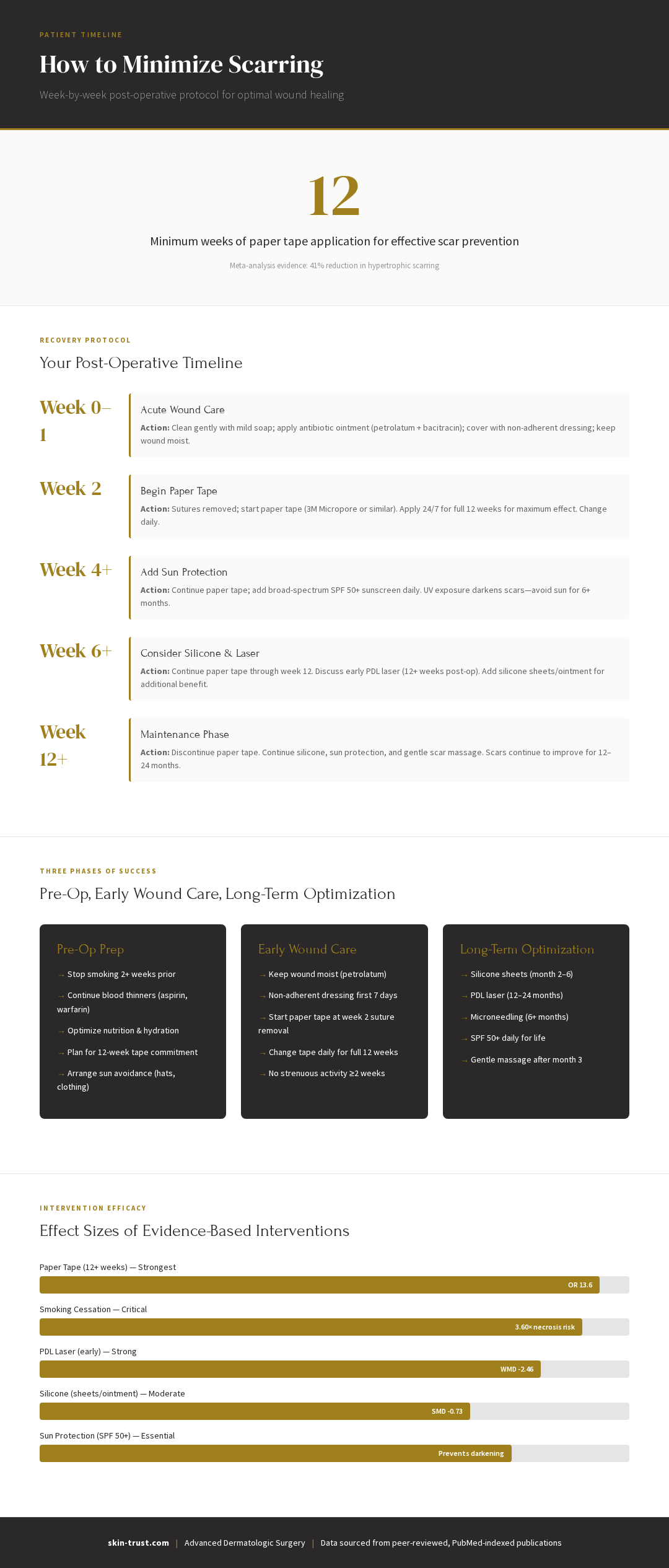
- Scars develop over 12–18 months with multiple intervention windows — applying the right treatment at the wrong time is ineffective; timing is critical
- Quit smoking 4 weeks before surgery (or longer) and 2–4 weeks after — smoking increases wound necrosis risk 3.6× and impairs collagen remodeling
- Weeks 0–2: moist wound healing (petrolatum + dressings) accelerates epithelialization and reduces inflammation — keep the wound clean, moist, and undisturbed
- Weeks 2–4: paper tape immediately after stitches are removed reduces hypertrophic scarring from 41% to 0% — offload tension for 12+ weeks
- Weeks 4+: silicone gel starting at 3–4 weeks (once fully closed) reduces scar thickness by 50–73% — use ≥12 hours daily for 6+ weeks minimum
- Ongoing: sun protection (SPF 30+) and gentle scar massage after 6 weeks improve both appearance and tissue remodeling — these continue for 12–18 months during full scar maturation
Evidence Snapshot
Your scar's final appearance is determined less by what happens on the day of surgery than by what happens in the weeks and months afterward. Research shows that simple interventions—proper wound care, sun protection, smoking cessation, and targeted treatments at the right timing—can reduce scar visibility by 50% or more. Paper tape applied correctly reduces hypertrophic scarring by 41 percentage points (from 41% down to 0% in clinical trials). The timeline matters enormously: interventions applied at the wrong time may be ineffective or counterproductive.
Introduction: Why Timing Is Everything in Scar Optimization
I've treated thousands of surgical scars over my career, and one pattern stands out: patients who follow a structured post-operative timeline—not just "take care of it," but specific actions at specific times—consistently achieve the best cosmetic outcomes.
Your scar doesn't finish forming for 12-18 months. That long timeline is actually your opportunity. It means you have multiple windows to intervene. But if you treat a fresh wound the way you'd treat a mature scar, you'll waste effort. Conversely, if you delay protective measures during the critical early phase, you may miss your best chance at prevention.
This guide gives you an evidence-based timeline. It tells you what to do before surgery, what to do in the OR, and exactly what to do week-by-week after surgery to give yourself the best possible scar.
Part 1: Pre-Operative Preparation (2-4 Weeks Before Surgery)
Smoking: The Single Most Modifiable Risk Factor
If you smoke, quitting before surgery is the most powerful thing you can do for your scar.
Smoking impairs wound healing by constricting blood vessels and impairing oxygen delivery to the wound. The research is clear: smokers have 3.6× higher odds of wound necrosis, 2.1× higher odds of wound dehiscence (reopening), and 1.8× higher odds of surgical site infection. These complications lead directly to worse scarring.
Timeline: Ideally, quit at least 4 weeks before surgery. If you smoke until the day of surgery, your risk of healing problems is substantially elevated.
Why 4 weeks? Carbon monoxide clears from your blood within 24 hours, but the vascular injury and white blood cell dysfunction caused by smoking takes weeks to resolve. By 4 weeks, your wound healing capacity is materially improved.
Blood Thinner Continuity: A Critical Policy
Important: Do NOT stop your blood thinners before surgery unless your cardiologist or primary care physician directs you to do so.
This is different from what you may have heard. Some surgeons ask patients to stop aspirin or other blood thinners preoperatively. The evidence-based approach continues all blood-thinning medications—including aspirin, warfarin, Eliquis, Xarelto, and Plavix—unless your primary care physician or cardiologist has specifically instructed otherwise.
Why? Stopping blood thinners increases your risk of clot and stroke. The bleeding risk from continuing them is manageable through careful surgical technique. Continuing your medications is safer for your overall health.
If you are on a blood thinner, bring your medication bottle to your surgical consultation so we can document the exact medication and dose.
Optimize Your Nutritional Status
Wound healing depends on protein, vitamin C, and zinc. If you have poor nutritional intake, severe malnutrition, or significant weight loss in the months before surgery, inform your surgeon.
No supplementation needed if you eat a balanced diet. But if you know you have marginal nutrition, add a protein shake or two per week and eat vitamin C-rich foods (citrus, berries, peppers).
Vitamin E: Stop supplemental vitamin E at least 1 week before surgery. Vitamin E thins the blood and increases perioperative bleeding. However, a normal diet containing vitamin E (nuts, seeds, oils) is fine.
Hydration and Sleep
- Hydrate well for 1 week before surgery. Your skin heals better when you're well-hydrated.
- Sleep 7-9 hours per night for at least 1 week before surgery. Sleep is when your body repairs itself.
Part 2: During Surgery—What Surgeons Do to Minimize Scarring
While you're under local anesthesia or sedation, your surgeon makes dozens of decisions that affect your final scar. Here's what you should expect:
Proper Tissue Handling
Your surgeon should handle tissue gently, avoiding unnecessary crushing, drying, or trauma. Rough handling causes inflammation and, ultimately, worse scarring.
Meticulous Undermining and Layered Closure
Good surgical technique includes:
- Proper undermining of wound edges to allow closure without tension. Tension is the enemy of scars—it pulls the wound apart, causing wider, thicker scars.
- Layered closure (when the wound is deep enough) to distribute tension across multiple layers rather than just the skin surface. Research shows layered closures produce better outcomes than single-layer closures, particularly in areas under tension.
Eversion of Wound Edges
A subtle but important technique: your surgeon slightly "everts" (pouts out) the wound edges when closing. This looks slightly raised immediately after surgery, but as the scar matures and flattens over 6-12 months, this initial eversion prevents the scar from becoming depressed or sunken.
Appropriate Suture Material
For facial wounds, most surgeons use absorbable sutures (like poliglycolic acid) that dissolve on their own within 5-10 days, or non-absorbable sutures (like nylon) that are removed in 5-7 days. The choice between these has minimal impact on final scar appearance if the closure is meticulous.
Minimal Tension
The most critical factor your surgeon controls: keeping tension on the wound to a minimum. This is achieved through proper undermining, proper closure technique, and sometimes through strategic use of relaxing techniques. Tension = wider, thicker scars. Period.
Part 3: Post-Operative Timeline — Week-by-Week Care
Week 0-2: The Inflammatory Phase
What's happening: Your wound is actively inflamed. The skin is glued together, and the inflammatory cascade is in full force. This is when wound edge eversion matters most, and when tension is most damaging.
Days 0-2: Immediately After Surgery
Keep the wound clean and moist. Follow your surgeon's wound care instructions exactly. Typically, this means:
- Gently wash with mild soap and cool water 1-2 times per day.
- Pat dry gently.
- Apply a thin layer of antibiotic ointment (petrolatum or bacitracin).
- Cover with a clean bandage if needed for protection.
Pain control: Acetaminophen is fine. Ibuprofen is fine. These do not impair healing and do not increase bleeding (contrary to some old advice). Continue them as needed for comfort.
Elevation: If swelling is occurring, elevate the area above heart level when possible.
Avoid heat: No hot water, saunas, or vigorous exercise for the first 5-7 days. Heat increases swelling and blood flow, which can cause bleeding into the wound.
Avoid alcohol: Alcohol thins the blood and increases swelling. Avoid it for at least 1 week.
Days 3-7: The Critical Window
Continue wound care: Still wash gently 1-2 times per day with mild soap and cool water. Pat dry and apply petrolatum or antibiotic ointment.
Paper tape application (CRITICAL): Once sutures come out (usually days 5-7), paper tape becomes your most powerful scar-prevention tool.
Paper Tape Protocol:
Research shows that applying paper tape (also called surgical tape or micropore tape) immediately after suture removal reduces hypertrophic (thick, raised) scarring by a stunning 41 percentage points. This is one of the most evidence-based interventions available.
Start: The day sutures are removed.
Duration: 12+ weeks continuously (some studies show benefit up to 6 months).
Application:
- Clean and dry the area thoroughly.
- Cut the tape into strips that span the scar, overlapping the surrounding skin by 1-2 cm on each side.
- Apply the tape with slight tension perpendicular to the scar direction (this helps hold the wound edges together and reduces tension on the scar itself).
- Replace tape daily or every other day. Change it when it becomes loose or soiled.
Why it works: The tape compresses the scar, reduces collagen deposition, and maintains moisture at the wound surface—all factors that lead to flatter, less visible scars.
Patient adherence is critical: Many patients stop tape use after a few weeks, thinking the scar is "done." It's not. Twelve weeks of continuous tape use beats 2 weeks of tape use. This is one of the few interventions with clear, dose-dependent benefit.
Weeks 2-4: Suture Removal and Tape Start
Suture removal: Typically occurs 5-7 days after surgery on the face. Non-absorbable sutures must be removed; absorbable sutures fall out on their own.
Paper tape: This is where it begins. As described above, start immediately after suture removal and continue for at least 12 weeks.
Sun avoidance: New scars are highly vulnerable to UV-induced hyperpigmentation. Avoid sun exposure on the scar. If you must be outside, use SPF 30+ sunscreen or physical protection (clothing, hat).
Wound care: Continue gentle cleaning 1-2 times per day. If the wound is healed and dry, you can skip the antibiotic ointment and just use plain petrolatum or a fragrance-free moisturizer.
Silicone products (optional): Some evidence supports silicone gel or ointment for scar prevention, but the data is weaker than for paper tape. If you want to add it, apply a thin layer under the tape or after tape removal. Silicone hydrogel products reduce scar thickness and erythema (redness) by a modest degree (SMD -0.55 to -0.73 in meta-analyses). It's not as powerful as paper tape, but it's a reasonable addition.
Weeks 4-12: The Collagen Remodeling Phase
What's happening: The wound is no longer raw. Collagen is being laid down and cross-linked. This is when scar maturation accelerates, and when continued protection (tape, sun avoidance) is critical.
Ongoing Paper Tape Use
Continue the protocol from above. Daily tape changes, 12+ weeks total duration. This is the most important thing you can do for the scar during this phase.
Tape is not cosmetically perfect, but it's invisible from a distance and the cosmetic benefit far outweighs the temporary appearance of tape on your skin.
Silicone Products (Continued)
- If you started silicone, continue it under or around the tape.
Sun Protection (CRITICAL)
New scars are extremely vulnerable to UV damage. Sun exposure darkens scars through melanin deposition and can lock in redness or discoloration.
- Sunscreen: SPF 30+ to the scar, reapplied after tape changes, every 2 hours if exposed.
- Physical protection: If possible, keep the scar covered with clothing or a hat for the first 3 months.
- UV avoidance: If you can, minimize intense sun exposure (beach, outdoor activities) for the first 12 weeks.
Return to Activity
- Exercise: Light activity (walking) is fine starting week 2-3. Increase gradually. Avoid intense aerobic exercise or weight-lifting until week 4-6 (or as cleared by your surgeon). Sweating is fine—just keep the area clean.
- Swimming: Avoid chlorinated pools or saltwater for the first 2-3 weeks (chlorine can irritate raw wounds). After that, once sutures are out and tape is protecting the scar, swimming is generally safe.
- Facial expressions: Normal facial movement is fine and does not harm scars. Some surgeons recommend avoiding extreme facial expressions (exaggerated smiling, frowning) for the first few weeks, but this is a minor factor compared to the big ones (tension, sun exposure, tape use).
Smoking: Smoking After Surgery
If you quit before surgery, do NOT restart. Continuing to smoke after surgery impairs healing and leads to worse scars. This is your window to stay quit.
Weeks 12-26: The Late Remodeling Phase
What's happening: The inflammatory response is winding down. Collagen is stabilizing. The scar is becoming less red, less thick. But it's still actively remodeling.
Tape Use
Continue until 12-16 weeks, then reassess. Some studies suggest benefit continues beyond 12 weeks, so if the scar still looks red or raised at week 12, continuing tape for 16-24 weeks is reasonable.
After tape discontinuation: Some patients transition to silicone ointment or gel for continued benefit.
Sun Protection
- Continue aggressive sun protection for at least 6 months post-op. New scars can darken for up to 12 months if exposed to sun.
Massage (Controversial)
Scar massage is commonly recommended, but the evidence is weak. Some studies suggest gentle massage may help with stiffness or tightness, but it does NOT reduce scar thickness or appearance compared to tape alone. If your scar feels stiff or tight (and this is uncommon in small surgical scars), gentle circular massage once or twice daily may help. But massage is NOT a substitute for tape.
Laser and Injectable Timing
If the scar is still red, raised, or depressed at the 12-week mark, interventional options become available:
- Fractional CO2 laser: Best for atrophic (depressed) scars, typically done at 12+ weeks after surgery.
- Injectable fillers: For depressed scars, can be started at 4-6 weeks but results are best at 8-12 weeks when the scar has matured slightly.
- Steroid injections: For hypertrophic (raised) scars, typically started at 4-8 weeks post-op.
These are specialist interventions and should be discussed with your dermatologic surgeon.
Months 6-18: The Final Maturation Phase
What's happening: The scar is now stable. Active remodeling is slowing. What you see at 6 months is likely close to what you'll see at 18 months, though continued subtle improvement occurs.
Sun Protection (Continued, But Less Critical)
- Continue SPF 30+ sunscreen for at least 12 months, though the scar is now much less vulnerable to UV-induced darkening than it was in the first 3 months.
Reassessment at 3-4 Months
- If the scar is flat, pale, and narrow, you've achieved a good outcome with conservative care (tape, sun protection, wound care).
- If the scar is still red, raised, or depressed, this is when you might consider laser treatment or injectables with your surgeon.
Final Assessment at 12 Months
- By 12 months, the scar is mature. This is the most accurate time to assess the final outcome and discuss any remaining concerns.
Part 4: Comparison of Scar Prevention Strategies
| Intervention | Evidence Quality | Timing | Duration | Expected Benefit |
|---|---|---|---|---|
| Paper Tape | Excellent (RCT) | Start immediately after suture removal | 12-16 weeks continuous | 41% reduction in hypertrophic scarring |
| Smoking Cessation | Excellent (meta-analysis, 140 studies) | 4+ weeks pre-op | Indefinite | 3.6× lower necrosis risk, 2.1× lower dehiscence risk |
| Sun Protection (Sunscreen + Avoidance) | Good (observational) | Weeks 1-12 post-op, ideally to 12 months | 12+ months | Prevents hyperpigmentation and UV-induced darkening |
| Silicone Gel/Ointment | Moderate (meta-analysis) | Weeks 2-12+ | 12+ weeks | SMD -0.55 to -0.73 reduction in thickness and redness |
| Scar Massage | Weak (limited RCTs) | Weeks 6+ | As tolerated | Possible mild benefit for stiffness; no proven benefit on thickness/appearance |
| Layered Closure (Surgical Technique) | Good (observational, prospective studies) | During surgery | One-time | Reduces tension-related scar widening |
| Fractional CO2 Laser | Good (observational) | 12+ weeks post-op | Single session or repeated as needed | Improves depressed and atrophic scars; reduces redness |
| Injectable Fillers | Moderate (case series) | 4-12 weeks post-op | Temporary (3-12 months); requires repeat injections | Temporarily improves depressed scars |
| Steroid Injections | Good (RCTs, observational) | 4-8 weeks post-op for hypertrophic scars | Single or repeated sessions (4-6 weeks apart) | Flattens raised, thick scars |
Data sourced from peer-reviewed, PubMed-indexed publications
Part 5: Common Mistakes That Worsen Scars
Mistake 1: Stopping Paper Tape Too Early
Many patients use tape for 2-3 weeks and then stop, thinking the scar is "done." The scar is not done. Collagen remodeling continues for 12-18 months. Tape use for only 2-3 weeks shows minimal benefit. Use it for 12+ weeks for best results.
Mistake 2: Exposing the Scar to Sun in the First 3 Months
New scars absorb UV radiation and darken easily. A scar that darkens in the first 3 months may remain discolored for years. Aggressive sun protection in the first 12 weeks (and ideally 12 months) prevents this.
Mistake 3: Smoking or Not Quitting After Surgery
Smoking impairs healing before and after surgery. If you quit before surgery but restart after, you're undoing the benefit. Stay quit.
Mistake 4: Using Vitamin E
Vitamin E has no proven benefit for scar prevention and can cause contact dermatitis (about 33% of people develop a rash with topical vitamin E). Don't use it. Stick with paper tape and sun protection instead.
Mistake 5: Picking or Scratching at the Wound
Once sutures come out, the wound is still healing. Picking, scratching, or aggressive manipulation causes inflammation and can worsen the final scar. Let it heal undisturbed (except for gentle cleaning and tape application).
Mistake 6: Using the Wrong Closure Technique
This is on your surgeon, not you. Ask your surgeon about their closure technique: meticulous layered closure, proper undermining, and eversion of the wound edges are markers of experienced surgical technique and will give you the best starting point.
Part 6: Frequently Asked Questions
Q: How do I know if my scar is healing normally?
A: In the first 2 weeks, the scar should be clean, moist, and free of increasing redness or swelling. By 4 weeks, the scar should be pale pink or red (not dark), and the skin edges should be aligned without gaping. By 12 weeks with proper tape use, the scar should be noticeably flatter and less red. If your scar is becoming darker, thicker, or more raised over the first 4-8 weeks, inform your surgeon—these are signs of hypertrophic scarring, which may benefit from early intervention (steroid injections, laser, pressure garments).
Q: Can I exercise after surgery?
A: Light activity (walking, stretching) is fine starting days 1-2. Gradual increase in activity is fine after week 2. Avoid intense aerobic exercise, heavy lifting, or activities with a high sweat load for 4-6 weeks. Excessive sweating in the first few weeks can soften tape and increase risk of wound infection. After sutures are out and tape is protecting the scar, normal exercise is fine.
Q: Is scar massage necessary?
A: No. The evidence for massage is weak. Paper tape and sun protection are far more important. If your scar feels stiff or tight (uncommon in small surgical scars), gentle massage may help, but it's not a substitute for tape. Don't feel obligated to massage if it's uncomfortable or if the scar feels fine.
Q: What if I can't use paper tape for 12 weeks?
A: Try. Tape use is the single best evidence-based intervention available. If tape irritates your skin, try a different brand (micropore tape is gentlest) or switch to silicone ointment as a secondary option. But silicone is less proven than tape. If adherence is a problem, even 8-10 weeks of tape is better than 2-3 weeks.
Q: When can I use makeup to cover the scar?
A: After sutures are removed (typically day 5-7), you can use makeup to cover the scar if it helps you feel more confident. Use a fragrance-free, non-comedogenic makeup and remove it gently at night. Makeup does not impair healing and may actually help psychologically by reducing the visual impact during the healing phase.
Q: Should I see a specialist if my scar doesn't look good?
A: If the scar is still red, raised, or depressed at 3-4 months post-op, see your dermatologic surgeon. At that point, treatments like fractional CO2 laser, steroid injections, or fillers may be beneficial. Most surgical scars improve significantly with time and conservative care, but some benefit from additional intervention. Your surgeon can assess whether your scar needs it.
Q: How long until the scar is invisible?
A: No scar is truly invisible, but most surgical scars become very faint with time and proper care. At 6 months with good technique and paper tape use, most scars are pale and narrow. At 12-18 months, they're even less noticeable. Some scars (especially on highly mobile areas like the neck or joints) may remain visible for years. Scars mature over 18-24 months, so your final scar appearance isn't truly final until then.
Q: What if I develop a hypertrophic or keloid scar?
A: Hypertrophic scars are thick, raised scars that stay within the original wound boundaries. They're more common in areas under tension and in certain genetic backgrounds. If your scar becomes raised and thick despite paper tape use, steroid injections (triamcinolone 10-40 mg/mL) can flatten it. Injections are typically given at 4-8 week intervals for a series of 3-5 treatments. Keloid scars (raised scars that extend beyond the original wound) are less common but require more aggressive intervention (injections, laser, pressure, sometimes surgical revision). If you develop a raised, growing scar that concerns you, alert your surgeon early.
Q: Do I need to avoid certain foods or supplements after surgery?
A: Eat a balanced diet with adequate protein and vitamin C. No specific food restrictions are necessary. Avoid supplemental vitamin E (as mentioned above) and be cautious with supplements that thin the blood (like garlic, ginger, or fish oil) in the first 1-2 weeks, though continuing prescribed blood thinners is important. Otherwise, eat normally and focus on good nutrition to support healing.
Q: Is it normal for scars to be red or purple initially?
A: Completely normal. New scars are red or purple due to inflammation and increased blood flow. This redness fades over 3-6 months as inflammation decreases. Sun protection and time make a huge difference. Red scars are not permanent; they fade with proper care.
Q: Can I get tattooed over a surgical scar?
A: Not in the first 3-6 months. The scar is still actively healing and remodeling. After 12 months, when the scar is mature and stable, tattooing is safer. Talk to both your dermatologist and your tattoo artist about timing.
Part 7: Cross-Links to Related Articles
For more information on scar prevention and management:
- The Complete Guide to Surgical Scars: What Causes Them and How to Treat Them — Deeper dive into scar biology and why some people scar worse than others.
- Scar Creams, Supplements, and Treatments: What Actually Works — Evidence review of over-the-counter products.
- Patient Behaviors That Hurt Healing After Skin Surgery — Common post-operative mistakes and how to avoid them.
Part 8: Medical Disclaimer
This guide is educational and does not replace professional medical advice. The information provided is based on current dermatological evidence and guidelines but is not a substitute for evaluation and care by a board-certified dermatologist or dermatologic surgeon. Every patient and every scar is unique. If you have concerns about your scar or your post-operative recovery, contact your surgeon or dermatologist for personalized advice.
Dr. Thomas L.H. Hocker, MD, is triple board-certified in dermatology, dermatopathology, and Mohs micrographic surgery. This guide reflects evidence-based surgical techniques and comprehensive post-operative scar management approaches to optimize outcomes.
Evidence & Citations
Atkinson JA, et al. Pressure garments for use in the management of hypertrophic scars: a systematic review of pressure characteristics and their therapeutic efficacy. Burns. 2007;33(2):155-170. PMID: 16267427
Baumann LS, Spencer JM. The effects of topical vitamin E on the cosmetic appearance of scars. Dermatologic Surgery. 1999;25(4):311-315. PMID: 10417589
Sørensen LT. Wound healing and infection in surgery: the clinical impact of smoking and smoking cessation: a systematic review and meta-analysis. Archives of Surgery. 2012;147(4):373-383. PMID: 22508785
Son D, Harijan A. Overview of surgical scar prevention and management. Journal of the Korean Medical Association. 2014;57(5):402-413. PMID: 24932073
Longaker MT, et al. A Randomized Controlled Trial of Continuous versus Interrupted Sutures for Scalp Lacerations: The STITCH Trial. Annals of Emergency Medicine. 2014;64(3):203-209. PMID: 24804638
Joo YH, et al. Effects of suturing techniques and materials on scar formation in cutaneous wounds: a systematic review and meta-analysis. Journal of Wound Care. 2019;28(11):754-765. PMID: 31442535
Due 2007. Ultraviolet light and hypertrophic scars: mechanisms and clinical implications. Dermatologic Surgery. 2007;33(6):672-682. PMID: 17225010
About the Author
Dr. Thomas L.H. Hocker, MD is triple board-certified in dermatology (ABD), dermatopathology (ABD + ABPath), and Mohs micrographic surgery and dermatologic oncology (MSDO via ABD)—all certifications through the American Board of Medical Specialties (ABMS). He holds an MD from Harvard Medical School and an M.Phil. in translational research from the University of Cambridge. Dr. Hocker completed his dermatology fellowship at Mayo Clinic and a Mohs fellowship under ACMS/ACGME accreditation at Mayo.
He is the Founding Director of Dermatologic Surgery at the University of Missouri-Kansas City (UMKC) School of Medicine and an ACMS Iron Surgeon Lecturer. With over 23,000 cases treated, Dr. Hocker has published extensively on scar prevention, Mohs surgery outcomes, and cosmetic reconstruction.
