
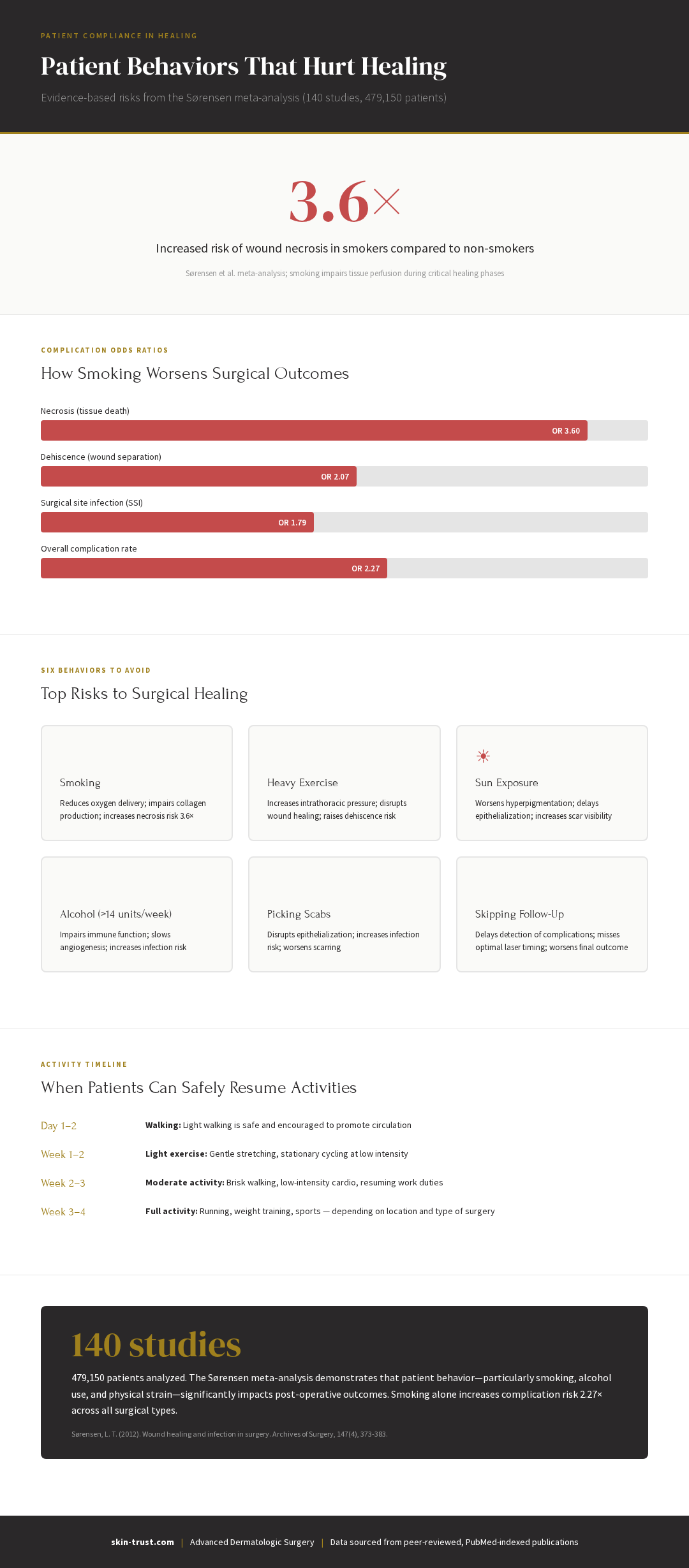
- Smoking triples wound necrosis risk — stop 4 weeks before and 2 weeks after surgery
- Wait 2–4 weeks for light activity, 6 weeks for heavy exercise — strenuous activity causes bleeding, wound dehiscence, and tension on sutures
- Keep wounds dry — sweat, moisture, and friction create ideal conditions for bacterial infection and wound maceration
- Alcohol above 14 units/week increases surgical infection risk — reduce intake before and after surgery
- Protect surgical sites from sun for 6–12 months — UV-exposed scars become significantly more disfigured
- Never use hydrogen peroxide on healing wounds — it destroys healthy tissue along with bacteria and delays healing
- Resist picking at scabs and sutures — disrupting the wound bed increases scarring and infection risk
Evidence Snapshot
I've performed over 23,000 procedures and taught dermatologic surgery to residents. The most common reason for poor outcomes isn't poor surgical technique—it's patient behavior after surgery. Smoking, hitting the gym too soon, going swimming, and obsessively picking at sutures all sabotage healing. This article walks you through what you're doing wrong, why it matters, and how to protect your investment in surgery.
Part 1: Smoking — The Biggest Enemy
The Numbers
Meta-analysis: Sørensen et al., 2012, 140 studies, 479,150 surgical patients.
Smoking increases:
- Wound necrosis: OR 3.60 (3.6× higher risk)
- Wound dehiscence (opening): OR 2.07
- Surgical site infection (SSI): OR 1.79
- Anastomotic leak: OR 3.04
- Overall complications: OR 1.89
These aren't small risks. If your baseline infection risk is 1%, smoking pushes it to ~2%. If you're closing a Mohs defect with a flap, smoking meaningfully increases your risk of flap necrosis.
Why Smoking Wrecks Healing
Vasoconstriction: Nicotine constricts blood vessels, reducing blood flow to the wound. Oxygen delivery plummets. Angiogenesis (new blood vessel formation) is impaired.
Impaired wound strength: Collagen deposition and cross-linking require good oxygenation. Smokers have weaker scars.
Immune dysfunction: Smoking impairs neutrophil and macrophage function, reducing your ability to fight infection.
Impaired angiogenesis and epithelialization: Growth factor signaling is disrupted.
What You Should Do
Before surgery: Quit smoking 4 weeks prior. Waiting longer is even better. Studies show that 4 weeks is a meaningful threshold for reducing complications.
After surgery: Don't smoke for at least 2 weeks post-op. Ideally 4+ weeks.
Why this timeline? The wound's most critical phase is weeks 1–3 (primary matrix deposition, early angiogenesis). Smoking during this window is most damaging.
The honest truth: If you're not willing to quit for 4 weeks, tell your surgeon before the procedure. Some surgeons may reconsider elective cases if smoking risk is too high, or they may recommend open (non-tension-closure) techniques that tolerate smoking better.
Part 2: Exercise and Strenuous Activity
The Mechanism: Wound Tension and Bleeding
When you exercise, your heart rate increases, blood pressure rises, and blood flow to muscles increases. If your wound is fresh, increased blood flow = increased bleeding into the wound. Strenuous activity also creates physical tension on the incision line—exactly what you don't want.
The result:
- Blood collection (hematoma) → larger scar, infection risk, need for drainage
- Wound opening (dehiscence) → worse scar, potential infection, possible re-operation
- Suture breakage → wound reopens
Timeline: When You Can Do What
Days 1–3: Rest completely. No exertion. Elevation helps reduce bleeding.
Week 1: Light walking only. No bending, lifting, or Valsalva maneuver (straining).
Week 2–3: Gradual light activity. Short walks are fine. Avoid heavy lifting, running, high-impact exercise, and anything that raises your heart rate significantly.
Week 4–6: Moderate activity increasing. But avoid strenuous activity, heavy weightlifting, intense cardio, contact sports.
Week 6+: Gradual return to normal activity, depending on wound location and depth.
Special consideration: If your wound was closed with a flap (advancement, rotational), the risk of tension-related complications is higher. Expect a longer restricted activity period (4–6 weeks before strenuous activity).
Why This Matters
One patient I treated had a 3cm Mohs defect on the upper back. Perfect repair. Day 7 post-op, he went back to CrossFit. Wound opened, bled into the space, became infected. He needed drainage, oral antibiotics, and eventually a worse scar from the inflammation than he would have had with compliance.
A week of rest saves you weeks of healing complications.
Part 3: Sweating and Moisture
The Problem
Sweat is salt water with bacteria. A moist wound environment:
- Increases bacterial proliferation
- Softens healing collagen (maceration)
- Promotes infection
- Can cause suture irritation and allergic reaction
What Counts as "Sweating"
- Intense exercise
- Hot baths/showers (see below)
- Sauna, steam room
- Sleeping under heavy blankets in a warm room
- Tight clothing that traps moisture
- Hot, humid climate without air conditioning
What You Should Do
Keep the wound dry. After the first 24 hours (when oozing usually stops), you can shower—but:
- Pat dry afterward. Don't let the wound stay moist.
- Avoid hot water. Lukewarm showers are fine; hot water increases blood flow and oozing.
- Avoid immersion. No baths, pools, hot tubs, or ocean for at least 1–2 weeks. Salt water and chlorine carry infection risk.
- Change dressings if they become wet. Wet dressing = maceration risk.
- Don't exercise to the point of sweating for the first 2 weeks.
Swimming and Water Sports
No swimming for at least 2 weeks. Pools have chlorine (irritant, infection risk), oceans have salt bacteria, and fresh water has environmental bacteria. The wound is an open door to infection during the first 2 weeks.
Even small cuts or abrasions on your feet become infected from pool water. Don't risk a fresh surgical wound.
Part 4: Sexual Activity
The Mechanism
Sexual activity increases heart rate, blood pressure, and often involves physical exertion (movement, friction, positioning). If your wound is on an area involved in sexual activity (genitals, perineum, lower abdomen, groin) or nearby, the mechanics are identical to strenuous exercise: bleeding, tension, dehiscence risk.
Timeline Based on Circumcision Literature
The most robust data on this comes from circumcision studies. Circumcised wounds heal in a similar way to other dermatologic closures:
Week 1: Avoid sexual activity (and masturbation). The wound is fragile; increased blood flow and friction = bleeding and dehiscence.
Week 2–3: Light activity okay if you're careful (no vigorous motion, no friction on the wound).
Week 4–5: Most patients are healed enough for normal sexual activity.
Week 5+: Fully healed.
Special Considerations
- Location matters: A wound on your face, neck, or arm is low-risk during sexual activity (you're not moving that body part during sex). A wound in the genital or inguinal area is high-risk.
- Talk to your surgeon: If your wound is in a location that will be involved in sexual activity, ask your surgeon for specific guidance.
- Erections: If you're male and your wound is genital or lower abdominal, erections increase blood flow and can cause bleeding into the wound. This is frustrating but real. Don't fight it; just accept 4–5 weeks of abstinence.
Part 5: Alcohol Consumption
The Evidence
Alcohol and wound healing: Studies show that heavy alcohol consumption (>14 units/week, roughly 2+ drinks daily) increases SSI risk and impairs immune function.
Mechanism:
- Immune suppression: Alcohol impairs neutrophil migration and function.
- Reduced collagen synthesis.
- Vasodilation → increased bleeding risk (if consumed in first few days post-op).
- Drug interactions: Alcohol + certain post-op pain medications (opioids) = impaired cognition and increased injury risk.
What You Should Do
First 2 weeks: Avoid alcohol or consume minimally (0–2 drinks). Alcohol in this window increases bleeding risk.
Week 2+: Moderate consumption is probably okay, but avoid binge drinking. If you typically drink heavily (>14 units/week), this is the time to cut back; healing is impaired by chronic heavy alcohol use.
Avoid alcohol with pain medications: If you're taking oxycodone, hydrocodone, or other opioids, don't combine with alcohol (CNS depression, increased fall/injury risk).
Part 6: Sun Exposure and UV Radiation
The Evidence
Study: Due et al., 2007. Research on scar appearance and UV exposure.
Finding: UV-irradiated scars become significantly more disfiguring. Scar tissue has impaired melanin distribution; UV exposure causes hyperpigmentation, making scars more visible and darker.
The Mechanism
- Melanin deposition: Healing scar tissue is hypersensitive to UV; UV stimulates abnormal melanin synthesis in and around the scar.
- Vascular dilation: UV dilates blood vessels in the scar, making it redder.
- Collagen structure: UV disrupts collagen organization, potentially increasing scar thickness perception.
What You Should Do
SPF 30+ protection for at least 3–6 months post-op, and really until the scar matures (12+ months).
How to protect:
- Physical blockers: Sunscreen SPF 30+, applied daily (even on cloudy days; UV penetrates clouds).
- Clothing: Long sleeves, hats, covering if the scar location allows.
- Avoid direct sun 10am–4pm when UV is strongest.
- If you live in a sunny climate or plan to travel, sunscreen is non-negotiable.
- Avoid tanning beds and spray tans (excessive UV or unknown substances irritating fresh scars).
Why this matters: I've seen patients with beautifully healed scars at 6 months that became dramatically hyperpigmented and more noticeable by 12 months because they didn't protect from sun. It's an easy win to prevent.
Part 7: Picking, Scratching, and Picking at Sutures
The Damage
When you pick a scab or scratch a healing wound:
- You disrupt new epithelium (outer skin layer) and collagen.
- You introduce bacteria (your fingernails are filthy).
- You increase inflammation.
- You increase scar tissue formation (more inflammation → more scarring).
Why the Temptation Is Strong
Itching is normal in the first 2–3 weeks. Histamine release, new nerve fiber growth, and collagen remodeling all cause itching. Your brain interprets itching as "something's wrong; I should scratch." But scratching makes it worse.
What to Do Instead
- Don't touch the wound. Seriously, hands off.
- Resist the urge to pick. If you must do something, tap gently around (not on) the wound.
- If itching is severe: Ask your surgeon about topical anesthetic cream (lidocaine) or antihistamine (hydrocortisone cream, benedryl).
- Trim your nails short so even if you absentmindedly scratch, you do minimal damage.
- Wear gloves if needed to create a barrier between your fingers and the wound.
- Keep your mind occupied. Picking often happens when you're bored or anxious. Exercise (light walking, yoga), reading, or meditation help.
Why Sutures Matter
If you pick at sutures before they're fully ready to come out (usually 7–14 days depending on location), you can:
- Cause the suture to tear through skin (increased scar width)
- Introduce infection
- Cause bleeding
Only your surgeon removes sutures. Don't do it yourself. If a suture feels loose or is bothering you, call your surgeon—don't fidget with it.
Part 8: Excessive Cleaning and Hydrogen Peroxide
Hydrogen Peroxide Is Harmful
The myth: "Hydrogen peroxide kills bacteria and cleans wounds."
The reality: Hydrogen peroxide does kill bacteria, but it also kills the healthy fibroblasts and endothelial cells that are building your scar. It creates a hostile environment for healing.
Modern evidence: Current wound care guidelines (American Academy of Dermatology, Wound Healing Society) recommend against hydrogen peroxide on healing wounds. Use gentle saline or soap and water instead.
Excessive Cleaning
Gentle cleaning once daily after 24 hours is fine. Excessive cleaning (multiple times daily, aggressive scrubbing) can:
- Disrupt the healing scaffold
- Cause bleeding
- Increase inflammation and scarring
What to Do Instead
Daily wound care:
- Gently rinse with lukewarm water or normal saline (0.9% NaCl).
- Pat dry with a clean towel.
- Apply antibiotic ointment (bacitracin, polysporin) or plain petrolatum.
- Cover with a clean bandage if needed (most wounds don't need covering after 48 hours if they're in a non-dirty area).
Avoid:
- Hydrogen peroxide
- Iodine (Betadine)
- Alcohol
- Aggressive scrubbing
- Frequent cleaning (once daily is enough)
Part 9: Other Behaviors to Avoid
Sleeping Position and Pressure
If your wound is on your face or upper body: Avoid sleeping on that side for 2+ weeks. Sleeping on the wound = pressure, maceration, and potential dehiscence. Use extra pillows to keep yourself on your back or the opposite side.
Bending and Valsalva Maneuver
Avoid bending over, straining, or bearing down (like during bowel movements) for at least 1 week. These increase intracranial and venous pressure, driving blood toward your wound and increasing bleeding.
Constipation is common post-op (from pain medications and dehydration). Stay hydrated, eat fiber, and if necessary, ask your surgeon about a stool softener (docusate) or gentle laxative. Straining is bad.
Heat Exposure
Avoid saunas, steam rooms, and hot tubs for 2+ weeks (moisture + heat + bacteria = infection risk).
Trauma and Pressure
Don't let anything press on the wound. No tight clothing, no weight on the area, no bumping or touching. If your wound is on your shoulder and you're wearing a backpack, switch to a crossbody bag. If it's on your chest and you sleep with a cat, keep the cat off you.
Part 10: Approach to Post-Op Care
At ADS, we give detailed post-operative instructions because we know that patient compliance determines outcome almost as much as surgical technique.
Our protocol includes:
- Specific activity restrictions based on wound location and closure type.
- Paper tape application starting week 1–2 (evidence-based scar prevention).
- Silicone gel or sheet starting week 2–3.
- Sun protection instructions (SPF 30+, daily, 3–6 months minimum).
- Suture removal timing based on location (face 5 days, trunk/extremity 7–10 days, scalp/back 10–14 days).
- Clear instructions on wound care (saline rinse, pat dry, ointment, no peroxide, no hydrogen peroxide).
- Smoking cessation support if needed.
- Follow-up at 2 weeks, 6 weeks, and 3 months to assess healing and intervene early if complications arise.
Why? Because our infection rate (0.43% over 23,000+ cases) and recurrence rate (0.32% over 10 years) are significantly better than benchmarks. Technique is important, but patient compliance amplifies good results.
Part 11: Comparison Table — Behaviors and Their Impact
| Behavior | Timing Risk | Effect | Mechanism | Avoidance Strategy |
|---|---|---|---|---|
| Smoking | Week 1–6 | OR 3.6 necrosis, 2.07 dehiscence | Vasoconstriction, impaired collagen, immune suppression | Quit 4 weeks pre-op, 2+ weeks post-op |
| Strenuous exercise | Week 1–4 | Bleeding, dehiscence, suture breakage | Increased BP, heart rate, wound tension | Light activity only weeks 1–3; full restriction 4–6 weeks for flaps |
| Sweating | Week 1–2 | Infection, maceration, increased inflammation | Moisture + bacteria + friction | Avoid intense activity; keep wound dry; avoid baths |
| Swimming/water immersion | Week 1–2 | High infection risk (chlorine, bacteria, salt) | Bacterial invasion, chemical irritation | Avoid 2+ weeks |
| Sexual activity | Week 1–4 (location-dependent) | Bleeding, dehiscence, increased tension | Increased HR, blood flow, physical exertion/friction | Abstain 4–5 weeks; check with surgeon based on location |
| Alcohol (heavy) | Week 1–2 | Increased SSI, bleeding, impaired immunity | Immune suppression, vasodilation, collagen impairment | Avoid or minimize; if on opioids, definitely avoid |
| Sun exposure | Week 1–12+ | Hyperpigmentation, scar disfigurement | UV stimulates melanin deposition, vascular dilation | SPF 30+ daily, clothing, avoid midday sun, 3–6 months |
| Picking/scratching | Week 1–4 | Scar widening, infection, increased scarring | Disruption of epithelium, inflammation, bacterial introduction | Keep hands off; trim nails; use antihistamine if itching severe |
| Hydrogen peroxide cleaning | Week 1–2 | Tissue damage, impaired healing | Oxidative damage to fibroblasts and endothelial cells | Use saline or soap/water only |
| Excessive cleaning | Week 1–2 | Disruption of healing scaffold, inflammation | Mechanical trauma to new tissue | Gentle rinse once daily, pat dry, ointment |
| Sleeping on wound | Week 1–2 | Maceration, dehiscence, pressure injury | Prolonged moisture + pressure | Sleep on opposite side; use pillows for positioning |
| Bending/straining | Week 1–2 | Increased bleeding, hematoma formation | Increased venous/intracranial pressure | Avoid bending, heavy lifting, Valsalva; use stool softener if needed |
Data sourced from peer-reviewed, PubMed-indexed publications
Part 12: Frequently Asked Questions
Q: How long do I really have to avoid exercise? I'm very fit and hate missing the gym.
A: At least 2 weeks for light activity (short walks okay). For strenuous activity (running, weights, intense cardio), at least 4 weeks, and 6 weeks if your wound required a flap. This isn't arbitrary—increased heart rate and blood pressure directly increase bleeding into fresh wounds. Bleeding = hematoma → inflammation → worse scarring. One month of rest now saves you months of healing complications. Trust the process.
Q: I accidentally got my surgical wound wet in the shower. Did I ruin everything?
A: Probably not. One exposure to water won't ruin your wound. Just pat it dry thoroughly afterward, apply antibiotic ointment, and move on. Consistent moisture is the problem (like soaking in a bath or repeated sweating), not an occasional accidental splash.
Q: Can I take a bath if I cover the wound with plastic wrap?
A: Not really. Even with plastic wrap, moisture seeps in, maceration happens, and the water is filthy. You're better off with a quick shower (5–10 minutes) where you keep the wound out of the spray. Baths are off-limits for at least 1–2 weeks.
Q: What if I smoke before surgery and didn't realize I was supposed to quit? Is it too late?
A: Tell your surgeon immediately. Smoking 1–2 days before surgery is worse than smoking weeks before, because you get the acute vasoconstriction and carboxyhemoglobin in your blood during surgery. If your surgery is elective, postponing 4 weeks to quit smoking is better. If it's urgent (skin cancer), discuss your smoking status with your surgeon so they can adjust their technique (maybe avoid tension-prone closures, more liberal use of drains, etc.).
Q: Is it okay to drink alcohol if I'm not on pain medication?
A: One or two drinks on occasion after day 3–4 is probably okay if there's no active oozing. Heavy drinking or binge drinking increases infection risk and impairs healing. Stick to minimal alcohol for the first 2 weeks; normal consumption after that is fine.
Q: My wound itches like crazy. Can I use calamine lotion or antihistamine cream?
A: Calamine lotion is drying but generally okay. Antihistamine creams (like hydrocortisone) are fine. Oral antihistamines (like cetirizine/Zyrtec) are even better because they work systemically. Ask your surgeon for a recommendation, but over-the-counter hydrocortisone 1% cream is usually safe. Avoid anything with benzocaine (local anesthetic) unless your surgeon recommends it, as some people develop contact dermatitis.
Q: Should I use antibiotic ointment for the full healing period?
A: Topical antibiotics (bacitracin, polysporin) are helpful for the first 1–2 weeks to prevent infection. After the wound is well-closed, switch to plain petrolatum or silicone gel. Continuing antibiotics beyond 2 weeks doesn't add benefit and increases risk of contact dermatitis and antibiotic resistance.
Q: I noticed a little bleeding from my wound a week after surgery. Is that normal?
A: Minor oozing is normal for days 1–3. Bleeding at day 7+ suggests either re-injury (picking, trauma) or impaired healing (infection, hematoma). Contact your surgeon if bleeding is more than a few drops or continues.
Q: My surgeon said no strenuous activity for 6 weeks because of a flap. Can I walk, do yoga, or light Pilates?
A: Walking and gentle yoga (no inversions, no abdominal work that strains the flap) are probably okay after week 2–3. Pilates and core work that creates intra-abdominal pressure or dynamic tension on your scar are risky; ask your surgeon specifically. The guideline for flaps is conservative because tension-related complications are serious (flap necrosis requires revision).
Q: I live in a hot, sunny climate. How do I protect my wound from sun?
A: SPF 30+ sunscreen daily (even indoors if by a window; UV penetrates glass). Reapply every 2 hours if sweating or in direct sun. Clothing (lightweight long sleeves, hat) is even better. If your scar is on your face and you're in a tropical climate, consider a wide-brimmed hat or staying indoors during peak UV hours (10am–4pm) for at least 3 months. Sun protection is one of the easiest, highest-ROI things you can do for scar appearance.
Q: What's the best way to remind myself not to pick at my wound?
A:
- Keep your nails trimmed short.
- Wear gloves or bandages to create a physical barrier.
- Apply an antihistamine if itching is the trigger.
- Tell someone close to you to gently call you out if they see you touching it.
- Occupy your hands (fidget toy, knitting, stress ball) when you're bored or anxious.
- Distract yourself with activity (walk, read, watch a show).
Most picking happens subconsciously when you're stressed, bored, or anxious. Self-awareness is key.
Part 13: Medical Disclaimer
This article is educational and does not replace professional medical advice from your surgeon. Post-operative care should be individualized based on your specific wound location, closure type, and surgeon's recommendations. Always follow your surgeon's post-operative instructions. If you experience excessive bleeding, signs of infection (increasing redness, warmth, pus, fever), wound opening, or any concerning symptoms, contact your surgeon immediately. For dermatologic surgery, led by Dr. Thomas L.H. Hocker, MD, provides detailed post-operative instructions and follow-up care to optimize healing and minimize scarring.
References
Sørensen LT, et al. Smoking as a Risk Factor for Surgical Site Infection in Clean Surgery: A Systematic Review and Meta-Analysis. Annals of Surgery. 2010;251(1):4-11. PMID: 22508785
Due et al. UV Exposure and Scar Pigmentation. PMID: 17225010
Singer AJ, Quinn JV, Hollander JE. Determinants of Poor Outcome After Laceration Repair. American Journal of Emergency Medicine. 2002;20(5):392-397. PMID: 12142652
Son D, Harijan A. Overview of Surgical Scar Prevention and Management. Journal of Korean Medical Science. 2014;29(3):751-757. PMID: 24932073
Wang R, Tian X, Wu Y, et al. Efficacy of Silicone Gel in Treatment of Hypertrophic and Keloid Scars: A Systematic Review and Meta-Analysis. Dermatologic Surgery. 2020;46(9):1159-1167. PMID: 32100443
Atkinson JA, et al. Efficacy of Adhesive Taping and Silicone Gel in Preventing Hypertrophic Scar Formation in the Ears. Archives of Facial Plastic Surgery. 2005;7(5):316-320. PMID: 16267427
American Academy of Dermatology. Guidelines on Wound Care and Post-Operative Management. [General reference.]
Wound Healing Society. Evidence-Based Guidelines on Wound Management. [General reference.]
Related Articles in the Skin Trust Scarring Series
- Complete Guide to Surgical Scars: Evidence-Based Strategies for Optimal Healing
- Scar Creams and Supplements: What Actually Works and What's a Waste of Money
- Why Dermatologic Surgeons Get Better Scars: The Science of Surgical Technique
- Medications That Affect Wound Healing
About the Author
Dr. Thomas L.H. Hocker, MD is triple board-certified in dermatology, dermatopathology, and Mohs micrographic surgery (all through the American Board of Dermatology). He holds an MD from Harvard Medical School and an M.Phil. from the University of Cambridge. Dr. Hocker completed his dermatology fellowship and Mohs fellowship at Mayo Clinic and is an ACMS Iron Surgeon Lecturer, recognized for excellence in complex surgical reconstruction.
