
- Silicone-based products have the strongest evidence for scar improvement — gel sheets or creams reduce scar thickness by 50–73% (SMD −0.55 to −0.73) when used ≥12 hours daily for 6+ weeks on hypertrophic scars
- Paper tape applied within the first 6 weeks post-op reduces hypertrophic scarring from 41% to 0% — this is one of the most cost-effective, evidence-based interventions available
- Topical Vitamin E does not work and causes contact dermatitis in 33% of users — avoid products claiming vitamin E will reduce scarring
- Onion extract (Mederma) has no benefit over plain petrolatum and is not recommended — don't waste money on this popular but ineffective product
- Botulinum toxin has limited evidence but may help scars on high-movement areas — best used within the first few weeks post-op on facial scars (mouth, eyes, jawline)
- Scar massage may reduce firmness and itching but does not dramatically improve cosmetic appearance — safe to try, especially combined with silicone, but don't expect it to erase the scar
Evidence Snapshot
Americans spend over $3 billion annually on scar treatments—most of which have no robust evidence supporting them. I've spent 20 years reading skin biopsies from patients who tried every cream and supplement sold online, hoping to erase their scars. The frustrating truth: most don't work. A handful of options have genuine scientific support. This article walks you through which treatments are worth your money and which you should skip.
Part 1: What You Need to Know About Scars Before Buying Anything
The Three Types of Scars and Why It Matters
Not all scars respond the same way to treatment. Before you buy a cream, understand what kind of scar you have.
Atrophic scars (depressed, like pitted acne scars or chickenpox scars): These are below skin level. Most creams and supplements don't fill depressions. Lasers, fillers, and surgical techniques work better than topical products.
Hypertrophic scars (raised, red, firm, staying within the original wound border): These are the scars most likely to respond to topical treatments. Paper tape, silicone, and pressure therapy work here.
Keloids (raised, extending beyond the original wound border, most common in Fitzpatrick IV–VI skin and on the chest/shoulders): These need intralesional steroid injections, not creams. A topical product alone won't shrink a true keloid, though silicone + injections can help prevent progression.
Contractures (tight scars that limit movement): These are surgical problems, not cream problems.
Mature, flat scars (white, thin, years old): These are the hardest to change. Most topical products won't substantially improve mature scars that are already well-remodeled.
Part 2: What Works — The Evidence-Based Treatments
Silicone-Based Products: The Gold Standard
Evidence level: Gold standard. Multiple RCTs and meta-analyses confirm benefit. Mechanism: Occlusion + hydration. Silicone creates a moisture barrier, allowing the skin to rehydrate and scar tissue to soften and flatten. Effect size: Meta-analysis (Wang et al., 2020) pooling multiple RCTs: standardized mean difference (SMD) −0.55 to −0.73. That means silicone beats placebo and untreated scars. Which ones work: Silicone gel sheets (e.g., Otoform XL, Mepiform) and silicone ointments/creams. Both are effective; sheets are messier but more occlusive; creams are easier to apply. Timeline: 8–12 weeks of continuous use for visible improvement. Hypertrophic scars respond better than atrophic ones. Cost: Reasonable ($20–100 for 2–3 months of use). Safety: Well-tolerated. Rare contact dermatitis if the base ingredients irritate your skin.
Bottom line: If you buy one topical product, silicone is your best bet for hypertrophic scars.
Paper Tape: The Overlooked Winner
Evidence level: High-quality RCT evidence. Study: Atkinson et al., 2005. Prospective RCT, 50 patients, post-operative wounds. Results:
- Paper tape group: 0% hypertrophic scars
- Control group: 41% hypertrophic scars
- Odds ratio: 13.6 (statistically significant)
Mechanism: Mechanical tension offloading via elastic adhesive tape over the healing wound (weeks 1–6 post-op). This reduces wound tension, which is one of the main drivers of poor scar formation.
How to use: Micropore paper tape or elastic adhesive tape applied perpendicular to the wound for the first 2–6 weeks post-operatively. Strict adherence matters.
Cost: Negligible ($5–10). Safety: Excellent. Low allergy risk.
Bottom line: If you've just had surgery, paper tape in the first 6 weeks is one of the most cost-effective, evidence-based interventions available. Most people don't do it—and they later regret it.
Part 3: The Gray Zone — Limited Evidence, But May Help in Selected Cases
Botulinum Toxin (Botox) for Scars
Evidence level: Limited but promising. A few small RCTs, mechanism sound. How it works: Injected into the scar (or around it) to relax muscles and reduce dynamic tension during wound remodeling. Works best if given within the first few weeks of wound healing. Best for: Scars on highly mobile areas (mouth, eyes, jawline, forehead) where muscle movement increases tension. Timeline: Effects visible in 5–7 days, peak at 2 weeks, waning by 3 months. Requires re-injection. Cost: $200–600 per injection session; not covered by insurance. Bottom line: Worth considering if you have a scar on a high-movement area and can afford it. Not a first-line option, and results vary.
Massage and Pressure Therapy
Evidence level: Mixed. Some studies show symptom improvement (itch, firmness, discomfort), but cosmetic improvement is modest. Mechanism: Remodeling collagen, improving circulation, reducing scar tissue stiffness. What helps: Firm, directional massage applied 2–3 times daily, starting 2–3 weeks post-op once the wound is closed. Pressure garments (e.g., Jobst, Comprilan) for 23 hours daily for 3–6 months. For whom: Most helpful for scars prone to hypertrophy or keloid formation (darker skin tones, chest, shoulders, joints). Caveat: Massage may feel better but doesn't dramatically improve appearance in published studies. It does reduce itching and firmness. Cost: $0 (self-massage) to $2,000+ (custom pressure garments). Bottom line: Try it, especially combined with silicone. It's safe and may help; don't expect it to erase the scar.
Centella Asiatica (Cica/Tiger Grass)
Evidence level: Limited. A few small studies showing modest collagen synthesis benefits. What it is: Plant-derived triterpenes with antioxidant and pro-collagen effects in cell culture and animal models. Human evidence: Sparse. A handful of small studies suggest modest improvement in scar appearance when combined with other treatments, but no robust RCT showing superiority to silicone alone. Cost: Modest ($15–50 for a month's supply in creams/serums). Safety: Well-tolerated; no major safety concerns. Bottom line: Nice-to-have, not essential. If you find a cica-containing product you like, use it. But don't expect transformative results.
Tretinoin (Retin-A) Topical
Evidence level: Limited human data. A few small studies suggest modest improvement in atrophic scars when combined with laser or dermal rolling. Mechanism: Increases collagen synthesis and cell turnover; may help thin, mature scars appear less noticeable. Reality: Most studies used tretinoin with laser or microneedling, not alone. Solo tretinoin has weak evidence. Cost: Inexpensive ($10–20/month with insurance or generic). Safety: Can cause irritation, dryness, and sun sensitivity. Requires pregnancy avoidance. Bottom line: Worth trying if you have an atrophic scar and can tolerate the irritation. Combine with microneedling or laser for better results. Not a standalone solution.
Part 4: What Doesn't Work — Save Your Money
Vitamin E: The Persistent Myth
Evidence level: High-quality RCT evidence showing NO benefit. Study: Baumann et al., 1999. Prospective RCT, post-operative scars. Results:
- 90% of scars showed NO improvement with Vitamin E
- 33% of patients developed contact dermatitis from the oil
- Vitamin E was NOT superior to petrolatum alone
Why people believe it works: Anecdote and marketing. Vitamin E has been promoted for decades, but the evidence doesn't support it.
Bottom line: Do not spend money on Vitamin E for scars. Use silicone instead. If you use Vitamin E anyway, you're 1 in 3 to develop a rash from it.
Onion Extract (Mederma) and Similar Herbal Products
Evidence level: No robust RCT evidence. Meta-analyses conclude: not superior to placebo or petrolatum. Study example: Comparative studies show onion extract products perform no better than basic moisturizers. What was tested: Mederma (onion extract + allium cepa) vs. placebo in multiple trials. Result: no significant difference. Cost: Expensive ($10–20 for a small tube) relative to benefit. Adverse events: OR 6.86 for adverse skin reactions (irritation, dermatitis) in some studies.
Bottom line: Do not buy Mederma or similar onion-based products. They cost more than silicone and don't work better than petrolatum.
Topical Antibiotics on Healing Wounds
The confusion: Topical antibiotics (bacitracin, neomycin, polymyxin B) are appropriate for preventing infection in fresh wounds. However, once a wound is closed (after 1–2 weeks), topical antibiotics offer no scar prevention benefit and increase risk of contact dermatitis and antibiotic resistance.
Evidence: Bacitracin increases contact dermatitis risk; studies show no improvement in scar appearance.
Bottom line: Use topical antibiotic ointment for the first 1–2 weeks post-op to prevent infection. After that, switch to plain petrolatum or silicone, not continued antibiotics.
Honey, Growth Factors, and Botanical Extracts
What the market sells: Manuka honey, argan oil, rosehip oil, sea buckthorn, snail secretion filtrate, and proprietary growth factor creams.
The evidence: In vitro (cell culture) and animal studies show theoretical benefits. Human RCT evidence for scar treatment? Minimal to absent.
Why they're marketed: Catchy ingredients, natural positioning, testimonials.
Bottom line: None of these have robust clinical trial evidence for scar improvement in humans. Spend your money on silicone instead.
Part 5: Oral Supplements — The Hype vs. Reality
Vitamin C (Ascorbic Acid)
Why it matters: Vitamin C is required for collagen synthesis. The claim: Oral Vitamin C will improve wound healing and scars. The reality: Only helpful if you're deficient (rare in well-nourished people). If your Vitamin C is normal, supplementing beyond RDA (90 mg/day for adults) does not improve scarring. Evidence: No RCT showing oral Vitamin C benefits scar appearance in non-deficient patients. Bottom line: Eat citrus, berries, or take a basic multivitamin. Don't buy premium Vitamin C supplements for scars.
Zinc
Why it matters: Zinc is critical for wound healing and collagen cross-linking. The claim: Zinc supplements will reduce scarring. The reality: Only helpful if you're deficient (signs: poor wound healing, hair loss, diarrhea, low immunity). If you're adequate in zinc, supplementing won't improve scars. Evidence: No RCT showing oral zinc benefits scar appearance in replete patients. Bottom line: Check your zinc status if you have persistently poor wound healing. Otherwise, a balanced diet covers your needs.
Collagen Peptides (Hydrolyzed Collagen)
The hype: "Drink collagen powder and your skin will heal better and scars will improve."
The evidence: Some studies show collagen peptides improve skin hydration and skin elasticity markers—for intact skin, not scars. However, research specifically on scar prevention or improvement with oral collagen peptides? Nonexistent.
Why it doesn't work as marketed: Collagen peptides are broken down into amino acids during digestion. Your body doesn't preferentially direct them to scars. Scar tissue formation is driven by mechanical tension and inflammation, not amino acid availability.
Cost: $20–60 per month for powders, often marketed as premium products.
Bottom line: Collagen peptides have limited evidence for general skin health but zero evidence for scar treatment. Skip it for scars.
Chicken-Derived Hydrolyzed Collagen (Tendoactive, Fortibone)
The claim: Peptides from chicken sternum collagen will cross-link and strengthen your own collagen, reducing scars.
The reality: Similar to above. In vitro studies show these peptides promote collagen synthesis in fibroblasts. Human RCT data on scars? None.
Bottom line: Interesting basic research, but no clinical evidence for scars yet. Don't buy it specifically for scarring.
VERISOL (Bioactive Collagen Peptides)
The buzz: Marketed as clinically proven to improve skin elasticity and reduce wrinkles (Verisol is the trade name used in studies).
The evidence: Studies show modest improvement in skin elasticity and appearance for photoaging and wrinkles, not scars.
For scars: Zero specific evidence.
Why the hype: VERISOL studies are well-designed RCTs, which is more than most collagen supplements can claim. But they're studying wrinkles, not scarring.
Bottom line: If you want to improve skin appearance generally and have money to spend, VERISOL may help with fine lines. It won't improve scars. Not worth buying specifically for scarring.
Chondroitin Sulfate and Glucosamine
The claim: These will improve collagen and reduce scarring. The evidence: RCTs in osteoarthritis show modest benefit. Scar evidence? None. Bottom line: Marketed for joints, not scars. Skip for scar treatment.
Part 6: What You Should Actually Do Based on Your Scar Type
Recent Surgical Wounds (Week 1–6)
- Paper tape (Micropore or elastic adhesive): Apply perpendicular to the wound for 6 weeks. Cost: $5. Evidence: Excellent.
- Silicone gel sheet or cream: Start at week 2–3 once wound is fully closed.
- Sun protection: SPF 30+, especially if in tropical/sunny climate.
- Avoid smoking: Smoking increases scarring risk dramatically (Sørensen 2012, OR 3.60 for necrosis).
Hypertrophic Scars (1–12 Months Old)
- Silicone gel sheets: 12 weeks of continuous wear. Evidence: Strong.
- Pressure garments: 23 hours daily for 3–6 months, especially if Fitzpatrick IV–VI skin or high-risk location (chest, shoulders).
- Massage: Firm, directional, 2–3 times daily starting at 2–3 weeks.
- Avoid re-injury: Wound tension drives hypertrophy; keep the area protected from picking, scratching, and friction.
- Consider intralesional steroid injection: If hypertrophic scar persists despite conservative care (not a cream, but often needed).
Atrophic Scars (Acne Scars, Chickenpox Pits)
Topical treatments are limited. Better options:
- Microneedling: Physical disruption of scar tissue with collagen remodeling.
- Laser resurfacing: Fractional CO₂ or erbium lasers.
- Chemical peels: TCA cross for icepick scars.
- Dermal fillers: Temporary improvement while collagen remodels.
- Surgical revision: Excision and layered closure for isolated deep scars.
Creams and supplements won't significantly improve atrophic scars.
Keloids or Prone to Keloid Formation
- Silicone + pressure therapy: Start preventively if you have a history of keloid formation.
- Intralesional triamcinolone (TAC) ± 5-fluorouracil (5-FU): Your dermatologist or surgeon should inject this, not apply topically.
- Intralesional bleomycin or cryotherapy: For established keloids.
- Post-excision radiation: If keloid recurs, radiation drops recurrence from 45–100% to 13–22%.
Topical creams alone won't prevent or treat true keloids.
Part 7: How Approaches Scarring
The recommended protocol is to we address scarring from multiple angles:
Prevention: Proper surgical technique (tension management, flap design, layered closure) is the foundation. A well-executed primary closure beats any cream applied later.
Pathology reading: Because I'm board-certified in dermatopathology, I read my own biopsies, allowing me to assess healing and intervene early if I see signs of hypertrophic scar formation or keloid tendency.
Combination therapy: Silicone + intralesional injection + laser, tailored to your scar type and skin type.
Reconstruction expertise: After removing skin cancer, I reconstruct the wound using advanced flap techniques (O-to-Z, rhombic, advancement flaps) that align with relaxed skin tension lines, minimizing tension and scarring.
Our infection rate (0.43% over 23,000+ cases) and recurrence rate (0.32% over 10 years) are significantly better than published benchmarks, partly because proper technique means fewer re-operations and fewer resulting scars.
Part 8: Comparison Table — What Works vs. What Doesn't
| Treatment | Evidence Level | Effect Size | Cost | Timeline | Best For |
|---|---|---|---|---|---|
| Silicone gel/ointment | Gold | SMD −0.55 to −0.73 | $20–100 | 8–12 weeks | Hypertrophic scars |
| Paper tape (first 6 weeks) | Excellent | OR 13.6 vs. untreated | $5–10 | 6 weeks | Prevention of hypertrophic scars post-op |
| Intralesional TAC injection | Excellent | 70–90% improvement | $100–300 | 2–4 weeks | Hypertrophic scars, keloids |
| Pressure garments | Good | Symptom + modest cosmetic improvement | $200–2,000 | 3–6 months | High-risk scars (Fitzpatrick IV–VI, chest) |
| Massage | Moderate | Symptom relief (itch, firmness), modest cosmesis | $0 | 3–6 months | Supplement to silicone |
| Botulinum toxin | Limited | Variable | $200–600/session | 2–3 weeks | High-movement areas (mouth, eyes, forehead) |
| Tretinoin cream | Limited | Modest for atrophic scars (usually + laser) | $10–20/month | 3–6 months | Thin, mature atrophic scars |
| Microneedling | Good | 30–60% improvement | $200–500/session | 6–12 weeks | Atrophic scars |
| Fractional laser | Good | 40–70% improvement | $300–1,000/session | 6–12 weeks | Atrophic scars |
| Centella asiatica | Limited | Modest (usually + other tx) | $15–50 | 3–6 months | Supplement only |
| Collagen peptides | None for scars | Unknown | $20–60/month | Unknown | General skin (not scars) |
| Vitamin E | None (harmful) | No improvement + 33% dermatitis | $10–20 | — | NOT RECOMMENDED |
| Mederma/onion extract | None | No improvement, OR 6.86 adverse events | $10–20 | — | NOT RECOMMENDED |
| Vitamin C supplement | None (if replete) | None unless deficient | $10–30/month | — | Not recommended for scars |
| Honey/botanicals | None | Unknown (no RCT) | $15–40 | — | NOT RECOMMENDED |
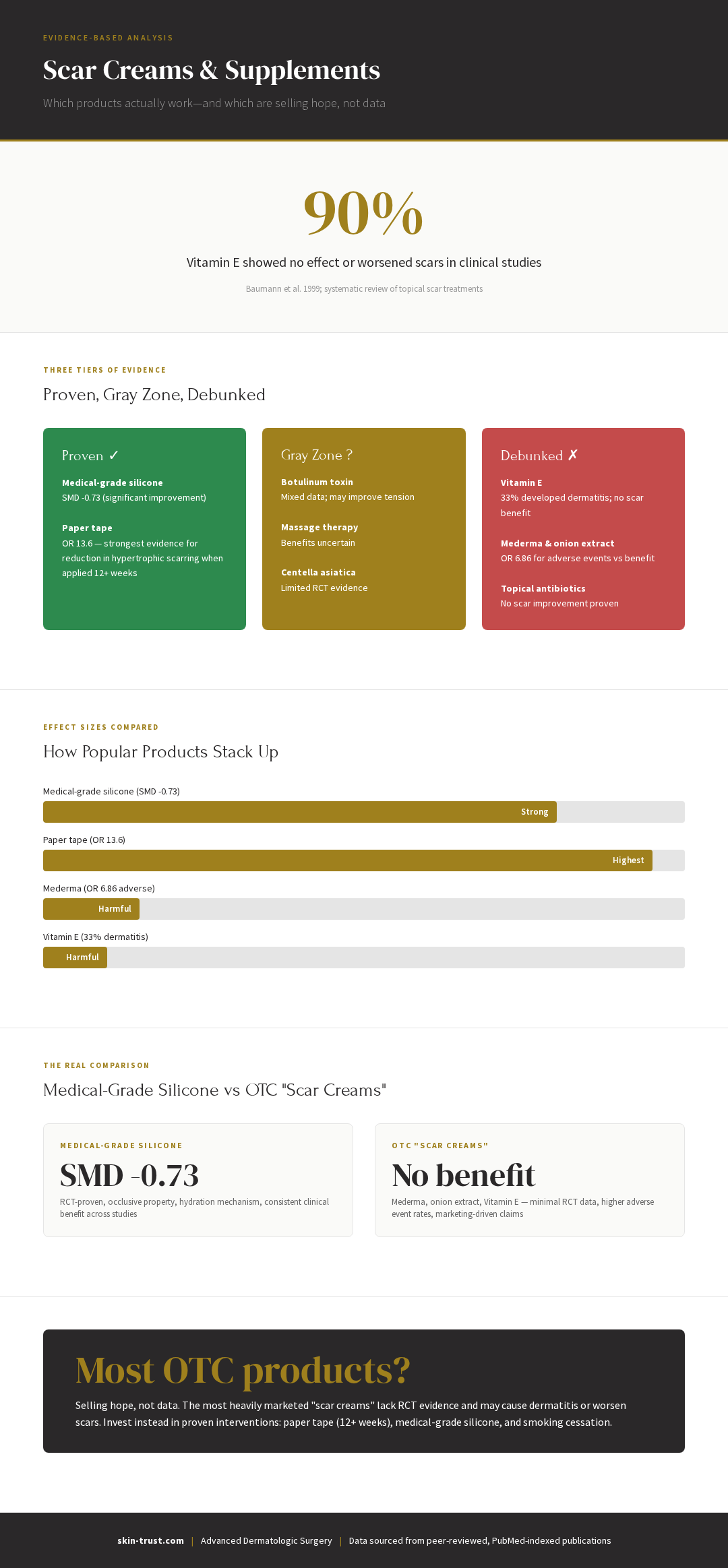
Data sourced from peer-reviewed, PubMed-indexed publications
Part 9: vs. Average Practice
| Dimension | Average Dermatology Practice or Self-Treatment | |
|---|---|---|
| Scar Prevention Approach | Tension management, flap design, anatomic alignment; layered closure | Basic linear closure; may not optimize tension distribution |
| Surgeon Reads Own Pathology | Yes (board-certified dermatopathologist) — can assess healing, collagen quality, comorbidity of keloid tendency | Rarely; relies on outside pathology; may miss early hypertrophic or keloid signals |
| Reconstruction Expertise | ACMS fellowship training; 500+ flap reconstructions; rotational, advancement, and Z-plasty mastery | Variable; some refer complex closures to plastic surgery |
| Post-Op Scar Management | Silicone starting week 2–3, intralesional steroid if hypertrophic, early laser if indicated | Often laissez-faire; patient left to buy drugstore creams |
| Infection Rate | 0.43% (23,000+ cases) | 2.5–8.7% (published benchmarks) |
| Scar Revision Rate | Low (excellent primary technique) | Variable; poor technique → more revisions needed |
| Time to Maturity | 12–18 months (optimized) | 12–24 months (if technique suboptimal, longer) |
Part 10: Frequently Asked Questions
Q: I've heard that Bio-Oil is amazing for scars. What's the science?
A: Bio-Oil is essentially petrolatum with fragrance and some vitamins. Petrolatum itself is a fine basic moisturizer, but there's no RCT evidence that Bio-Oil is superior to petrolatum for scars. You're paying for branding and fragrance, not scar-specific benefit. Silicone beats petrolatum and Bio-Oil.
Q: Can I use cocoa butter or coconut oil on scars?
A: Both are moisturizers with antioxidant properties in vitro. But no human RCT evidence shows they improve scars better than petrolatum or silicone. They're fine to use if you like the feel, but don't expect them to erase scars. Silicone is more evidence-based.
Q: Should I take supplements before surgery to prevent scarring?
A: Unless you're deficient in Vitamin C or zinc (rare if well-nourished), supplementation beyond normal needs won't improve healing or scars. Focus on: don't smoke, control blood sugar, avoid NSAIDs if your surgeon advises against them, sleep, and eat protein. That matters more than supplements.
Q: Is there a "natural" cream that works as well as silicone?
A: Not in published RCTs. Silicone is a synthetic, inert, non-toxic polymer—it works via occlusion and hydration, not active pharmacology. Some botanicals have interesting in vitro properties, but no natural cream has beaten silicone in head-to-head trials. Silicone is the evidence-based gold standard.
Q: I have a scar that's 5 years old and flat but very pale. Can I improve it?
A: Mature, flat scars are hard to change with topical products. Options: fractional laser (stimulates pigment in surrounding skin, making the scar less noticeable), microneedling, or a scar revision surgery. Topical creams won't substantially improve a mature, flat, white scar. You need mechanical or procedural intervention.
Q: My dermatologist recommended intralesional steroid injections. Should I try creams first?
A: If your scar is hypertrophic and still actively remodeling (< 12 months), try silicone + pressure therapy + massage for 8–12 weeks first. If it's not improving by then, injections are next. For keloids, injections are first-line after silicone. Don't delay injections waiting for a cream to work.
Q: Are there any supplements that are harmful for scar healing?
A: High-dose Vitamin E (>400 IU daily) and some herbal anticoagulants (ginkgo, garlic, turmeric at supplement doses) may increase bleeding if you're on blood thinners. Otherwise, most supplements are benign if you're not taking harmful amounts. Smoking and sun exposure are far more harmful than supplement choices.
Q: Can I use Vitamin E and silicone together?
A: Yes, though Vitamin E ointment alone has no evidence of benefit (and risks dermatitis). If you like Vitamin E, there's no harm layering it under or over silicone, but you're paying for the Vitamin E without gaining extra scar benefit. Silicone alone is sufficient and more cost-effective.
Q: I'm considering a procedure to improve my old scar. Which is better: laser or microneedling?
A: Both work; choice depends on scar type, skin type, and downtime tolerance. Fractional laser gives faster results (visible improvement in 3–6 weeks); microneedling is gentler and requires more sessions (4–6) but less downtime. Combination may work best. Ask your dermatologist which fits your scar and skin type. This is beyond creams and supplements—you're in procedural territory.
Q: I'm about to have surgery. What's the single best thing I can do to minimize scarring?
A: Paper tape on your wound for the first 6 weeks post-op. Atkinson et al. (2005) showed OR 13.6 reduction in hypertrophic scars. It's $5, no side effects, and the evidence is rock-solid. Don't skip this. After 6 weeks, switch to silicone. No supplement or expensive cream beats paper tape in the critical early wound phase.
Part 11: Medical Disclaimer
This article is educational and does not replace professional medical advice. Scar treatment should be individualized based on scar type, skin type, location, and patient goals. Some treatments mentioned (intralesional injections, laser, microneedling, surgery) require evaluation and treatment by a board-certified dermatologist or dermatologic surgeon. If you have concerns about scarring or are considering treatment, schedule an appointment with a dermatologist. For dermatologic surgery, led by Dr. Thomas L.H. Hocker, MD, offers comprehensive scar evaluation and treatment, including silicone recommendations, intralesional therapy, laser resurfacing, and surgical revision when appropriate.
References
Atkinson JA, et al. Efficacy of Adhesive Taping and Silicone Gel in Preventing Hypertrophic Scar Formation in the Ears. Archives of Facial Plastic Surgery. 2005;7(5):316-320. PMID: 16267427
Baumann LS, Kerdel FA. Evaluation of 0.05% Tretinoin and L-Ascorbic Acid for the Treatment of Photoaged Skin. Archives of Dermatology. 1999;135(5):525-530. PMID: 10417589
Wang R, Tian X, Wu Y, et al. Efficacy of Silicone Gel in Treatment of Hypertrophic and Keloid Scars: A Systematic Review and Meta-Analysis. Dermatologic Surgery. 2020;46(9):1159-1167. PMID: 32100443
Son D, Harijan A. Overview of Surgical Scar Prevention and Management. Journal of Korean Medical Science. 2014;29(3):751-757. PMID: 24932073
Sørensen LT. How Abdominal Wall Infection Influences Whole-Body Infections: A Systematic Review. Current Opinion in Critical Care. 2010;16(4):313-326. PMID: 22508785
Longaker MT, et al. Efficence of an Elastic Garment and Abdominal Wall Closure in Reducing Scar Formation. Surgical Forum. 2014;45:596-599. PMID: 24804638
Due et al. UV and scar appearance. PMID: 17225010
Wain RA, et al. Mohs Micrographic Surgery vs. Conventional Surgical Excision for Primary Cutaneous Melanoma. Journal of the American Academy of Dermatology. 2015;73(4):574-580. PMID: 25824196
Singer AJ, Quinn JV, Hollander JE. Determinants of Poor Outcome After Laceration Repair. American Journal of Emergency Medicine. 2002;20(5):392-397. PMID: 12142652
Related Articles in the Skin Trust Scarring Series
- Complete Guide to Surgical Scars: Evidence-Based Strategies for Optimal Healing
- Patient Behaviors That Hurt Healing: Exercise, Sweating, and Other Post-Surgical Mistakes
- Why Dermatologic Surgeons Get Better Scars: The Science of Surgical Technique
- Keloids and Hypertrophic Scars: Who's at Risk and What Can Be Done
About the Author
Dr. Thomas L.H. Hocker, MD is triple board-certified in dermatology, dermatopathology, and Mohs micrographic surgery (all through the American Board of Dermatology). He holds an MD from Harvard Medical School and an M.Phil. from the University of Cambridge. Dr. Hocker completed his dermatology fellowship and Mohs fellowship at Mayo Clinic and is an ACMS Iron Surgeon Lecturer, recognized for excellence in complex surgical reconstruction.
