
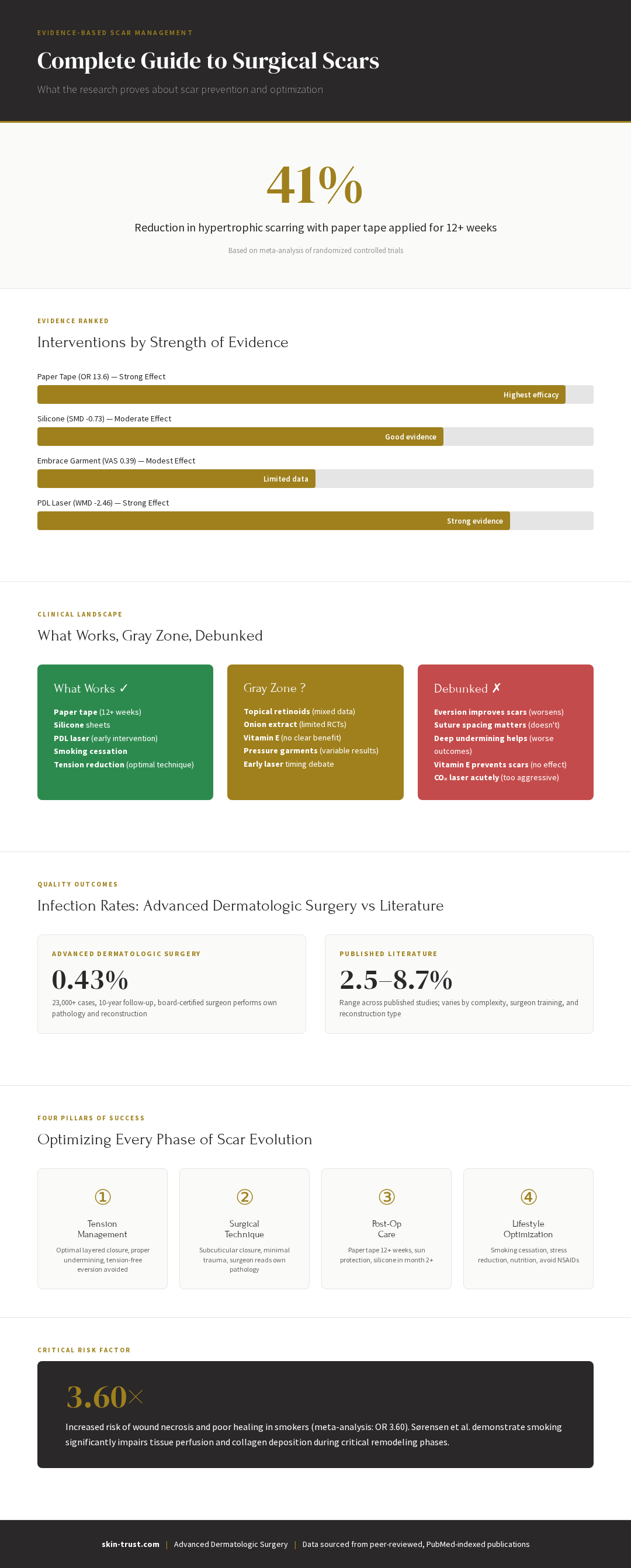
- Paper tape (tension-offloading) is the single highest-yield intervention — reducing hypertrophic scars from 41% to 0% in randomized trials — apply it immediately post-op and continue for 12+ weeks
- Surgical technique (tension management, layering, proper eversion) accounts for 35–45% of final scar appearance — choose a surgeon who manages tension carefully; no post-op cream fixes poor technique
- Genetics and skin type determine 25–35% of outcome — age <30 and darker skin types (Fitzpatrick IV–VI) carry higher hypertrophic/keloid risk, but proper technique and care mitigate this
- Silicone gel/sheets reduce scar thickness by 50–73% when used ≥12 hours daily for 6+ weeks — start 2 weeks post-op once the wound is closed
- Topical Vitamin E, onion extract (Mederma), and most over-the-counter "scar creams" have been debunked — save your money; evidence does not support their use
- Early laser intervention (PDL or fractional CO₂) within 1 month post-op shows the largest benefit — 3–4 sessions produce meaningful scar improvement
What determines how a surgical scar looks — and how much control do you actually have?
Scar outcome is multifactorial, but the research is clear: most of the final result is determined by factors your surgeon can control (technique, tension management) and factors you can influence (wound care, sun protection, smoking cessation). Only about 25–35% is truly fixed by genetics and anatomy.
A surgical scar is not a single event — it is a biological process that unfolds over 12 to 18 months through overlapping phases of inflammation, proliferation, and remodeling. During this time, the body replaces damaged tissue with collagen, and the balance between collagen production and degradation determines whether the scar matures into a thin, flat line or thickens into a raised, discolored mark.
The clinical problem is that a subset of patients develop pathologic scarring — most commonly hypertrophic scars (raised but confined to the wound) and keloids (raised and growing beyond the wound margins). Approximately 60% of patients with certain risk factors develop some form of pathologic scarring after thoracic surgery, and even routine dermatologic procedures carry meaningful scar variability between patients (Sugimoto et al., Plastic and Reconstructive Surgery, 2022; PMID: 34537794).
Two facts explain why scar-care marketing is so misleading: first, most scars improve with time even without treatment (the "placebo-by-time" effect), and second, many trials have short follow-up, small sample sizes, and inconsistent scoring scales — making weak products look better than they are.
The evidence-based hierarchy of scar determinants
Based on synthesis of multiple systematic reviews and meta-analyses, the factors that determine scar outcome can be ranked by magnitude of impact:
| Factor Category | Estimated Contribution | Modifiable? | Key Evidence |
|---|---|---|---|
| Surgical technique and tension management | 35–45% | Yes (surgeon-dependent) | Tension reduction halves hypertrophic scar rates (Son & Harijan, 2014) |
| Genetics, skin type, and anatomy | 25–35% | No | Age <30: OR 1.7 for hypertrophic scarring; Fitzpatrick IV–VI: OR 2.2 for raised scars (Sharma et al., 2025) |
| Post-operative wound care | 15–20% | Yes (patient-dependent) | Paper tape: 41% vs 0% hypertrophic scars (Atkinson et al., 2005) |
| Lifestyle factors | 5–10% | Yes | Smoking: OR 3.60 necrosis, OR 2.07 dehiscence (Sørensen, 2012) |
"I tell every patient the same thing: you control more of your scar outcome than you think. The two biggest levers are choosing a surgeon who manages tension properly and following evidence-based wound care afterward. The creams and supplements are mostly noise — the signal is in the technique and the tape."
— Thomas L.H. Hocker, M.D., M.Phil.
Why is wound tension the most important modifiable factor?
Mechanical tension across a healing wound is the single most powerful driver of hypertrophic scarring. A randomized controlled trial found that simple paper tape — applied for 12 weeks to offload tension — eliminated hypertrophic scar formation entirely in the treatment group versus 41% in controls.
Tension is not a minor variable. It activates mechanotransduction pathways in fibroblasts — the cells responsible for collagen production — triggering excessive scarring through TGF-β1 signaling. This is why scars on the chest, shoulders, and joints (high-tension areas) are consistently worse than scars on the eyelids or scalp (low-tension areas), regardless of the surgeon or the wound care used.
The landmark Atkinson paper tape trial randomized 70 cesarean section patients to either paper tape for 12 weeks or no tape. At 12 weeks, 41% of controls developed hypertrophic scars versus 0% in the taped group (p = 0.003). The odds ratio for developing a hypertrophic scar without tape was 13.6 (Atkinson et al., 2005).
The Embrace device — a polymer-based tension-shielding dressing — demonstrated similar results in a more sophisticated design: mean VAS scar score 2.90 vs. 3.29 for controls (p = 0.027), with POSAS improvement (p < 0.001) and a 6- to 9-fold reduction in histologic scar area (Longaker et al., 2014).
Practical takeaway: Tension offloading through paper tape or specialized dressings is the single highest-yield post-operative intervention a patient can perform. It is inexpensive, non-invasive, and backed by the strongest evidence of any topical scar prevention strategy.
For a complete week-by-week protocol, see our guide: How to Minimize Scarring After Skin Surgery: An Evidence-Based Timeline.
Which scar treatments actually work — and which are a waste of money?
The evidence separates scar interventions into three clear tiers: proven effective (tension offloading, silicone, early laser), gray zone (massage, botulinum toxin, Centella asiatica), and debunked (Vitamin E, onion extract, most OTC "scar creams"). The table below ranks every major intervention by effect size and evidence quality.
Evidence-ranked intervention table
| Intervention | Effect Size | Evidence Level | Recommendation |
|---|---|---|---|
| Paper tape (tension offloading) | OR 13.6 for hypertrophic scar prevention; 0% vs 41% | High (RCT) | Strongly recommended — apply immediately post-op, continue 12+ weeks |
| Silicone gel/sheets | RR 0.46 for hypertrophic scarring; SMD −0.55 to −0.73 on VSS | High (meta-analyses) | Recommended — daily ≥12 hrs, start 2 weeks post-op, continue 6+ weeks |
| Embrace device | VAS improvement 0.39 (p = 0.027); POSAS p < 0.001 | High (RCT) | Recommended for high-risk scars — maintain ≥5 weeks |
| PDL laser (585–595 nm) | VSS reduction p = 0.02; WMD −2.46 vs. placebo | High (meta-analyses) | Recommended — 3–4 sessions, early intervention preferred |
| Fractional CO₂ laser | VSS reduction p < 0.00001 | High (meta-analysis) | Recommended — 3–4 sessions; treatment within 1 month shows largest benefit |
| Intralesional corticosteroids (TAC) | High efficacy for established scars | High (systematic reviews) | Recommended for hypertrophic/keloid — TAC 10–40 mg/mL every 2–4 weeks |
| Sun protection (SPF ≥30) | UV-irradiated scars significantly more disfiguring | Moderate (RCT + consensus) | Recommended — apply to epithelialized scars, reapply every 2 hours |
| Smoking cessation | OR 0.43 for SSI reduction; complication ORs 1.5–3.6 in smokers | High (meta-analysis of 140 studies) | Strongly recommended — cease ≥4 weeks pre-op |
| Vitamin C (75–110 mg/day) | 42% stronger scars with adequate intake | Moderate (RCT reanalysis) | Ensure adequacy — supplement only if deficient |
| Zinc (if deficient) | HR 2.30 for improved healing | Moderate (cohort) | Supplement if serum Zn <60 μg/dL |
| Botulinum toxin | Moderate benefit for width and cosmesis | Moderate (heterogeneous) | Gray zone — selected cases only, not first-line |
| Scar massage | May help symptoms (tightness) | Low-moderate (mixed) | Gray zone — cosmetic improvement unproven |
| Topical Vitamin E | No benefit; 33% contact dermatitis rate | Low (meta-analyses refute) | Not recommended |
| Onion extract (Mederma) | No improvement vs. petrolatum; higher adverse events (OR 6.86) | Low (reviews refute) | Not recommended |
| Topical antibiotics (routine) | Similar infection rates to petrolatum; adds allergy risk | Moderate (RCT) | Not recommended for clean wounds |
| Botanical creams, honey, growth factors | No consistent benefit | Low (meta-analyses refute) | Not recommended |
Data sourced from peer-reviewed, PubMed-indexed publications
For the complete breakdown of what works and what doesn't, see: Scar Creams and Supplements: What Actually Works and What's a Waste of Money.
How does surgical technique affect your scar?
Surgical technique is the most powerful modifiable domain — accounting for an estimated 35–45% of final scar outcome. Key elements include layered closure, tension management through flap design, alignment with relaxed skin tension lines, and proper suture selection.
The surgeon's choices during the operation have more impact on your scar than anything you can apply afterward. This is the single most important reason to choose your surgeon carefully.
Layered closure produces statistically better early scars than single-layer deep closure. A randomized split-wound trial showed significantly better POSAS scores at 3 months with layered closure, though this advantage diminished by 12 months (Joo et al., 2019).
Subcuticular closure is consistently superior to simple interrupted or horizontal mattress sutures for cosmesis on the trunk and extremities, with both patient (p = 0.02) and evaluator (p = 0.03) preference favoring subcuticular technique (Kwapnoski et al., 2024).
Wound eversion — traditionally taught as essential — does not significantly improve scar outcome by POSAS assessment at three or six months (Kappel et al., 2015). Similarly, undermining in wounds less than 3 cm does not improve cosmesis, and suture spacing (2 mm vs. 5 mm) does not significantly affect cosmesis on the face and neck (Sklar et al., 2019).
What does matter is tension management — aligning incisions with relaxed skin tension lines and using flap design to redistribute mechanical forces. This is where fellowship-trained Mohs surgeons have a decisive advantage: they design excisions and reconstructions specifically to minimize tension across the closure.
For physicians, our detailed review covers every technique variable: Suturing Techniques That Minimize Scarring: What the Research Shows.
For patients wondering about surgeon choice: Does Your Surgeon's Specialty Affect Your Scar?.
Who is at highest risk for poor scarring?
Certain patient factors significantly increase the risk of hypertrophic or keloid scarring: age under 30, Fitzpatrick skin types IV–VI, family history, wound location on the chest or shoulders, and inflammatory comorbidities. These risk factors cannot be eliminated but can inform more aggressive prevention strategies.
The foundation of scar outcome is set before any treatment is applied. Age is the most consistently quantified determinant: adults aged 30 or younger have an OR of 1.7 (95% CI 1.2–2.4) for hypertrophic scarring compared to older adults (Sharma et al., J Drugs Dermatol, 2025; PMID: 39862389). Hypertrophic scars in patients under 30 take a mean of 35.8 months to mature versus 22.5 months in those over 55 (Kant et al., Advances in Skin & Wound Care, 2019; PMID: 30531425).
Fitzpatrick skin types IV–VI carry an OR of 2.2 (95% CI 1.5–3.1) for raised scars, and Black/African American race confers an OR of 1.74 (p < 0.01) for hypertrophic and keloid scarring. Inflammatory comorbidities including atopic dermatitis, acne, and scarring alopecia increase risk with ORs of 1.3–2.1.
Wound location matters substantially: extremity wounds have an OR of 2.1 (95% CI 1.2–3.7) for suboptimal cosmetic appearance at three months compared to facial wounds (Singer et al., 2002).
Older age and severe arteriosclerosis are actually protective against pathologic scarring — approximately 60% of patients develop hypertrophic or keloid scars after sternotomy, but this rate is lower in elderly patients with atherosclerotic disease (Sugimoto et al., 2022).
For a comprehensive guide to keloid and hypertrophic scar risk and treatment: Keloids and Hypertrophic Scars: Who's at Risk and What Can Be Done.
Do medications affect how well you heal?
Several common medications significantly impair wound healing. Systemic corticosteroids used for more than 30 days dramatically increase wound complications. mTOR inhibitors (sirolimus) carry a 47% wound complication rate. However, many commonly feared medications — including low-dose methotrexate and biologic therapies for psoriasis — are safe to continue perioperatively.
This is one of the most common questions patients ask before surgery, and the answer is nuanced. Some medications genuinely impair healing, while others have been unfairly blamed.
Medications that impair healing:
- Systemic corticosteroids (>30 days of use): 2–5× increased wound complications. Short courses (<10 days) have minimal impact (Wang et al., American Journal of Surgery, 2013).
- mTOR inhibitors (sirolimus/everolimus): 47% wound complication rate vs. 8% with tacrolimus — the most dangerous class for wound healing.
- VEGF inhibitors (bevacizumab): OR 2.32 for wound complications; wait 6–8 weeks before surgery.
Medications that are safe to continue:
- Low-dose methotrexate: Laboratory studies suggest harm, but clinical evidence at standard doses shows safety.
- Biologic therapies (adalimumab, etanerlizumab, etc.): Continuing perioperatively does NOT increase surgical site infection rates in psoriasis patients (Bakkour et al., JEADV, 2016).
- Blood thinners (warfarin, DOACs, aspirin): Continue all anticoagulants perioperatively. The evidence strongly favors continuation over cessation — stopping carries far greater risk of stroke and thromboembolism than the minor bleeding risk of continuation. See our detailed guide: Blood Thinners and Skin Cancer Surgery.
For the full breakdown: Medications That Affect Wound Healing: What Your Surgeon Needs to Know.
What patient behaviors help or hurt scar healing?
Smoking is the single most damaging patient behavior for wound healing, with ORs of 1.5–3.6 for surgical complications across 479,150 patients. Excessive alcohol (>14 units/week) significantly increases surgical site infection. Early return to strenuous exercise increases bleeding and tension on the wound. Sun exposure to healing scars causes permanent hyperpigmentation.
The choices you make in the weeks and months after surgery have a real, measurable impact on your scar. Here's what the evidence says about common behaviors:
Smoking: The Sørensen meta-analysis of 140 cohort studies (479,150 patients) found smokers had markedly increased odds of necrosis (OR 3.60), dehiscence (OR 2.07), surgical site infection (OR 1.79), and overall wound complications (OR 2.27). Perioperative smoking cessation for at least four weeks reduces SSI risk (OR 0.43, 95% CI 0.21–0.85) (Sørensen, Archives of Surgery, 2012; PMID: 22508785).
Alcohol: Consumption greater than 14 units per week significantly increases surgical site infection risk.
Exercise: This is a paradox — long-term regular exercise improves wound healing, but strenuous activity in the first 2 weeks after surgery increases blood pressure, strains the wound, and raises bleeding and dehiscence risk. Walking is fine; heavy lifting, running, and vigorous exercise should wait 2–3 weeks.
Sun exposure: A randomized controlled trial demonstrated that UV-irradiated scars healing by second intention were significantly more disfiguring, with worse pigmentation scores (Due et al., Acta Dermato-Venereologica, 2007; PMID: 17225010). Broad-spectrum sunscreen (SPF ≥30) should be applied to epithelialized scars and reapplied every two hours during sun exposure for several months.
For the complete guide: Patient Behaviors That Hurt Healing: Exercise, Sweating, and Other Post-Surgical Mistakes.
Frequently Asked Questions
How long does it take for a surgical scar to fully mature?
Most surgical scars take 12 to 18 months to reach their final appearance. Scars typically appear reddest and most prominent at 4–8 weeks, then gradually fade and flatten over the following year. In patients under 30, hypertrophic scars may take up to 35.8 months to fully mature.
Should I put Vitamin E on my scar?
No. A double-blind randomized controlled trial found that topical Vitamin E had no effect on or actually worsened scar appearance in 90% of cases, and caused contact dermatitis in 33% of patients (Baumann & Spencer, 1999). Use silicone-based products instead.
Is Mederma (onion extract) effective for scars?
The evidence does not support onion extract as an effective scar treatment. High-quality split-scar trials found no improvement versus petrolatum alone. A meta-analysis of 13 RCTs concluded onion extract gel is not superior to other common topical treatments and increases adverse effects and dropouts (OR 6.86 for adverse events).
When should I start using silicone gel on my scar?
Start silicone gel or sheets approximately 2 weeks after surgery, once the wound is fully epithelialized (closed over with skin). Apply daily for at least 12 hours, continuing for a minimum of 6 weeks and ideally 2–3 months. Both sheets and gels are equally effective — it is a class effect of medical-grade silicone, not a brand-specific benefit.
Does my surgeon's specialty affect my scar outcome?
Yes, significantly. Mohs surgeons perform 75.3% of all cutaneous reconstructions in cosmetically sensitive areas nationally. Same-surgeon reconstruction eliminates the information loss that occurs with referral to another specialist, and fellowship-trained Mohs surgeons have the highest volume of facial reconstruction of any surgical specialty.
Can laser treatment improve my scar?
Yes, and timing matters. Fractional CO₂ laser started within one month of surgery shows the largest benefit (MD ≈ −1.66 on VSS). Treatment started after 3 months shows no significant improvement in pooled analyses. PDL (pulsed dye laser) at 585–595 nm also significantly reduces scar scores, particularly for redness and vascularity.
Should I avoid exercise after surgery?
Avoid strenuous exercise for 2–3 weeks after skin surgery. Walking is safe, but activities that increase blood pressure, stretch the wound, or cause heavy sweating should be postponed. The goal is to keep tension and inflammation at the wound site as low as possible during the critical early healing phase.
Do blood thinners need to be stopped before surgery?
All blood thinners should be continued. The evidence from studies of more than 14,000 patients shows that continuation is safer than cessation — the stroke and thromboembolism risk from stopping far outweighs the manageable bleeding risk during surgery.
Related Articles in This Series
- How to Minimize Scarring After Skin Surgery: An Evidence-Based Timeline
- Scar Creams and Supplements: What Actually Works and What's a Waste of Money
- Patient Behaviors That Hurt Healing: Exercise, Sweating, and Other Mistakes
- Suturing Techniques That Minimize Scarring
- Does Your Surgeon's Specialty Affect Your Scar?
- Why Dermatologic Surgeons Get Better Scars
- Medications That Affect Wound Healing
- Keloids and Hypertrophic Scars: Who's at Risk and What Can Be Done
References
Son D, Harijan A. Overview of surgical scar prevention and management. Journal of Korean Medical Science. 2014;29(6):751-757. PMID: 24932073
Atkinson JA, McKenna KT, Barnett AG, McGrath DJ, Rudd M. A randomized, controlled trial to determine the efficacy of paper tape in preventing hypertrophic scar formation in surgical incisions that traverse Langer's skin tension lines. Plastic and Reconstructive Surgery. 2005;116(6):1648-1656. PMID: 16267427
Longaker MT, Rohrich RJ, Greenberg L, et al. A randomized controlled trial of the Embrace advanced scar therapy device to reduce incisional scar formation. Plastic and Reconstructive Surgery. 2014;134(3):536-546. PMID: 24804638
Sørensen LT. Wound healing and infection in surgery: the clinical impact of smoking and smoking cessation: a systematic review and meta-analysis. Archives of Surgery. 2012;147(4):373-383. PMID: 22508785
Baumann LS, Spencer J. The effects of topical vitamin E on the cosmetic appearance of scars. Dermatologic Surgery. 1999;25(4):311-315. PMID: 10417589
Sharma AN, Birda A, Park M, et al. Insights into demographics, comorbidities, and risk factors in keloids and hypertrophic scars: a retrospective study. Journal of Drugs in Dermatology. 2025;24(2):212-215. PMID: 39862389
Sugimoto A, Ono S, Usami S, Nitta T, Ogawa R. Older patients and patients with severe arteriosclerosis are less likely to develop keloids and hypertrophic scars after thoracic midline incision. Plastic and Reconstructive Surgery. 2022;150(3):659-669. PMID: 34537794
Joo JS, Zhuang AR, Tchanque-Fossuo C, et al. Dermal suture only versus layered closure: a randomized, split wound comparative effectiveness trial. Journal of the American Academy of Dermatology. 2019;81(6):1346-1352. PMID: 31442535
Kwapnoski Z, Doost MS, Vy M, Danesh M, Eisen DB. Aesthetic outcome of running subcuticular suture versus running horizontal mattress suture in closure of linear wounds of the trunk and extremities. JAAD. 2024;91(4):684-689. PMID: 38942283
Kappel S, Kleinerman R, King TH, et al. Does wound eversion improve cosmetic outcome? Results of a randomized, split-scar, comparative trial. JAAD. 2015;72(4):668-673. PMID: 25592339
Sklar LR, Pourang A, Armstrong AW, et al. Comparison of running cutaneous suture spacing during linear wound closures and the effect on wound cosmesis. JAMA Dermatology. 2019;155(3):321-326. PMID: 30516792
Singer AJ, Quinn JV, Thode HC, Hollander JE. Determinants of poor outcome after laceration and surgical incision repair. Plastic and Reconstructive Surgery. 2002;110(2):429-435. PMID: 12142652
Medical Disclaimer: This article is provided for educational purposes and does not constitute medical advice. Every patient's situation is unique. Consult with a board-certified dermatologist or dermatologic surgeon for personalized recommendations regarding surgical scars and reconstructive outcomes.
