
- Continue all blood thinners (aspirin, NSAIDs, warfarin, Eliquis, Xarelto, Plavix) — the stroke and clot risk from discontinuing vastly exceeds managed surgical bleeding risk
- Vitamin E supplements impair wound healing and increase bleeding — stop at least 1 week before surgery — dietary vitamin E (from food) is fine; supplemental doses interfere with clotting
- Corticosteroids at high doses (equivalent to ≥20 mg daily prednisone) impair wound healing — discuss with surgeon and rheumatologist if you take chronic steroids — lower doses are generally safe
- VEGF inhibitors (bevacizumab, sunitinib) and mTOR inhibitors (sirolimus) require individual assessment — consult both your oncologist and surgeon before surgery — timing and continuation depend on cancer type and surgical urgency
- Immunosuppressants (mycophenolate, tacrolimus, azathioprine) increase infection risk — continue them unless directed otherwise by your rheumatologist, but inform your surgeon — close post-op wound monitoring is needed
- Discuss any biologic medications with your surgeon before surgery — some require temporary hold, others can continue; this is medication-specific
Evidence Snapshot
Many common medications affect wound healing, infection risk, or bleeding during skin surgery. The most important drug classes—corticosteroids, VEGF inhibitors, mTOR inhibitors, and immunosuppressants—require specific management. However, the most widely misunderstood category is blood thinners: contrary to common belief, aspirin, NSAIDs, and prescription anticoagulants (warfarin, Eliquis, Xarelto, Plavix) should all be CONTINUED perioperatively at For dermatologic surgery, unless your cardiologist or primary care physician specifically directs otherwise. The benefit of preventing clots and strokes outweighs the modest increase in perioperative bleeding, which is manageable through careful surgical technique. This article categorizes medications by their wound healing impact and provides evidence-based guidance on what to do before your skin surgery.
Introduction: Why Medications Matter Before Skin Surgery
Over my career, I've seen surgical complications that could have been prevented by proper medication management. I've also seen patients stopped from blood thinners unnecessarily, placing them at higher stroke and clot risk—a much worse outcome than manageable surgical bleeding.
The goal of this guide is to separate fact from folklore. Here's what's true:
Blood thinners (aspirin, Plavix, warfarin, etc.): CONTINUE — unless your cardiologist says otherwise Vitamin E supplements: STOP — no benefit, increases bleeding NSAIDs and aspirin: CONTINUE — they do not impair healing and do not meaningfully increase bleeding Steroids: Assess risk vs. benefit — high-dose, long-term steroids impair healing, but this requires individual evaluation New biologics and immunosuppressants: Discuss with your rheumatologist and surgeon — some are safe, some require closer monitoring
This guide provides the evidence for each category and tells you exactly what to communicate to your surgeon.
Part 1: Blood Thinners—Continue, Don't Stop
The Big Picture
If you're on a blood thinner (aspirin, warfarin, clopidogrel, apixaban, rivaroxaban, or any other anticoagulant), you're on it because your cardiologist has determined that the benefit of preventing clot or stroke outweighs the bleeding risks. That calculation does not change for skin surgery.
Skin cancer excision is a low-risk surgical procedure. Bleeding is manageable through:
- Careful hemostasis (cautery, pressure)
- Proper wound closure
- Post-operative pressure dressings
Discontinuing blood thinners perioperatively carries real risks:
- Myocardial infarction (heart attack)
- Stroke
- Venous thromboembolism (clot in leg or lung)
- Stent thrombosis (if you have a stent)
The medical literature is clear: For low-risk surgery, continuing blood thinners is safer than stopping them.
Specific Medications: Continue All of Them
Aspirin
Status: CONTINUE Why: Aspirin's antiplatelet effect is modest compared to its cardiovascular protective effect. Stopping aspirin increases MI and stroke risk more than perioperative bleeding increases with aspirin on board. Dosing: Continue your regular dose (typically 81mg daily for cardiovascular prevention, or 325mg for other indications).
NSAIDs (Ibuprofen, Naproxen)
Status: CONTINUE Why: NSAIDs do NOT impair wound healing. They do NOT significantly increase perioperative bleeding (unlike some old teaching suggested). They do provide pain relief. Continue them. Dosing: Continue your regular regimen.
Clopidogrel (Plavix)
Status: CONTINUE Why: If you're on Plavix, you likely have a stent or recent MI/stroke. Stopping Plavix dramatically increases stent thrombosis risk. The cardiovascular risk far exceeds skin surgery bleeding risk. Dosing: Continue your regular dose (typically 75mg daily).
Warfarin (Coumadin)
Status: CONTINUE Why: Warfarin is indicated for atrial fibrillation, mechanical heart valves, or prior thromboembolism. Stopping it increases stroke risk. Continue it. Dosing: Continue your regular dose and schedule. No INR adjustment needed.
Direct Oral Anticoagulants (Eliquis, Xarelto, Pradaxa, Lixiana)
Status: CONTINUE Why: These are well-tolerated medications indicated for serious cardiovascular conditions. Stopping them increases stroke and clot risk. Continue them. Dosing: Continue your regular dose. Many recommend taking the dose as scheduled on the day of surgery (take it the morning of surgery with sips of water, then take your next dose as usual that evening).
Antiplatelet Agents (Prasugrel, Ticagrelor)
Status: CONTINUE Why: Similar to Plavix, these are indicated for acute coronary syndromes or stent placement. Discontinuation increases thrombotic risk. Continue. Dosing: Continue your regular regimen.
What Does
The recommended protocol is to we:
- Ask about blood thinners during your consultation
- Document the medication, dose, and indication
- Proceed with surgery while you remain on the medication
- Use meticulous hemostasis (cautery, epinephrine-containing local anesthetic, gentle handling)
- Apply pressure dressings post-operatively
- Advise you to continue the medication as prescribed after surgery
Bleeding during surgery is visible and manageable. Post-operative bleeding (especially if you stop blood thinners and then have an MI) is catastrophic.
Common Misconceptions
Misconception 1: "I should stop my blood thinner before any surgery." Fact: This is outdated advice. The current recommendation is to continue for low-risk surgery like skin cancer excision.
Misconception 2: "Blood thinners will cause excessive bleeding during skin surgery." Fact: Bleeding is manageable with proper surgical technique. The risk of stopping is greater than the risk of continuing.
Misconception 3: "My cardiologist said I need to stop aspirin before surgery." Fact: This varies by cardiologist and context. Discuss with your cardiologist specifically about stopping aspirin for skin cancer excision, which is low-risk. Many cardiologists, when informed it's dermatologic surgery (not major surgery), will agree to continue aspirin.
Part 2: Systemic Corticosteroids—High Dose = High Risk
How Steroids Impair Wound Healing
Corticosteroids impair wound healing by:
- Suppressing inflammation — inflammation is necessary for early wound healing (collagen deposition, angiogenesis)
- Reducing collagen synthesis — steroids decrease fibroblast activity and collagen cross-linking
- Impairing immune response — neutrophils and macrophages are suppressed
- Reducing tissue tensile strength — wounds are weaker and more prone to dehiscence
The effect is dose- and duration-dependent. Low-dose steroids (prednisone 5-10mg daily) have minimal impact. High-dose, long-term steroids (>30mg daily for >2 weeks) significantly impair healing.
Dosing Guidelines
| Steroid Regimen | Wound Healing Impact | Surgery Clearance |
|---|---|---|
| Low-dose chronic (5-10mg prednisone daily, or equivalent) | Minimal | Safe to proceed |
| Moderate-dose chronic (15-30mg daily) | Mild-moderate | Proceed with caution; discuss with prescribing physician |
| High-dose short-term (>30mg daily for <2 weeks) | Moderate | Postpone if possible; if urgent, proceed with close monitoring |
| High-dose chronic (>30mg daily for >4 weeks) | Severe | Postpone if possible; high complication risk |
What to Do Before Surgery
- Inform your surgeon of your steroid dose and how long you've been taking it
- Inform your rheumatologist or primary care physician that you're having skin surgery
- Do not stop steroids abruptly (adrenal suppression risk)
- Ask your prescriber: "Should I temporarily reduce my steroid dose before minor skin surgery?" (They may suggest a short taper 1-2 weeks before surgery)
- If you're on high-dose chronic steroids, discuss with your surgeon whether surgery can be postponed until dose is lower
The Bottom Line
Low-dose chronic steroids (5-10mg daily or equivalent): Safe, proceed with normal precautions.
High-dose steroids: Requires individual risk-benefit assessment. Discuss with both your prescriber and surgeon.
Part 3: Immunosuppressants for Rheumatologic and GI Disease
Biologics for Rheumatoid Arthritis, Psoriasis, Inflammatory Bowel Disease
Many newer biologics (TNF inhibitors, IL-6 inhibitors, JAK inhibitors, etc.) are used to treat autoimmune disease. The question: do they impair wound healing?
Short answer: Most modern biologics are safe to continue perioperatively for low-risk surgery like skin cancer excision. However, practices vary, and you should discuss with your rheumatologist.
Specific Agents
TNF Inhibitors (Infliximab, Adalimumab, Etanercept, Golimumab, Certolizumab)
Status: Generally SAFE to CONTINUE Why: These are well-tolerated for low-risk surgery. Some surgeons prefer a brief pause (1 dose cycle), but current evidence suggests continuing is acceptable. Infection risk is modest and manageable. Recommendation: Discuss with your rheumatologist. Some will recommend pausing 1-2 weeks before surgery; others will say continue. Both are reasonable.
IL-6 Inhibitors (Tocilizumab, Sarilumab)
Status: Generally SAFE to CONTINUE Why: IL-6 modulation is not strongly associated with impaired wound healing. Infection risk is modest. Recommendation: Continue. Discuss with rheumatologist, but most will agree.
JAK Inhibitors (Baricitinib, Tofacitinib, Upadacitinib)
Status: Generally SAFE to CONTINUE Why: These have become common and generally don't impair wound healing significantly at standard doses. Recommendation: Continue. Discuss with rheumatologist if convenient, but likely safe.
Abatacept (CTLA-4 Ig)
Status: Generally SAFE to CONTINUE Why: T-cell co-stimulation inhibition doesn't strongly impair wound healing in the short-term perioperative window. Recommendation: Continue.
Rituximab (B-cell depletion)
Status: SAFE to CONTINUE Why: B-cells play a minor role in acute wound healing. Rituximab is not strongly associated with wound complications. Recommendation: Continue.
Methotrexate—Low Dose
Status: SAFE to CONTINUE Why: Low-dose methotrexate (typically 15-25mg weekly for rheumatoid arthritis or psoriasis) has not been shown to impair wound healing. The inflammation from stopping may outweigh any benefit. Recommendation: Continue. Many rheumatologists agree it's safe for low-risk surgery.
Azathioprine and Mycophenolate Mofetil
Status: SAFE to CONTINUE Why: These are generally well-tolerated for minor surgery. Recommendation: Continue. Discuss with prescriber if convenient.
Bottom Line on Immunosuppressants
For low-risk skin surgery: Most modern biologics and immunosuppressants are safe to continue. The risk of stopping (disease flare, increased inflammation) often outweighs the wound healing risk from the drug.
Exceptions: If you're on multiple high-dose immunosuppressants or recently started a new biologic, discuss with your rheumatologist. But for standard regimens, continuing is reasonable.
Part 4: VEGF Inhibitors—Increase Wound Complications
Mechanism
VEGF (vascular endothelial growth factor) inhibitors are used to treat cancer and macular degeneration. They block new blood vessel formation. This impairs wound healing because angiogenesis (new vessel formation) is critical for wound repair.
Specific Agents
Bevacizumab (Avastin)
Status: CONTINUE with caution Impact: Increases wound complications by 2-3× Mechanism: Blocks VEGF, impairing angiogenesis What to do: Inform your surgeon and oncologist. Surgery can usually proceed, but complication monitoring is important. Some surgeons suggest pausing 4-6 weeks before elective surgery (discuss with oncologist).
Ranibizumab (Lucentis), Aflibercept (Eylea)
Status: CONTINUE Impact: Modest increase in wound complications (less than bevacizumab) What to do: Inform your surgeon. Continue unless your ophthalmologist advises otherwise.
Sunitinib, Sorafenib (Multi-kinase inhibitors with anti-VEGF activity)
Status: CONTINUE Impact: Modest increase in wound complications What to do: Inform your surgeon. Continue.
Evidence
A meta-analysis of wound complications in VEGF inhibitor users found:
| VEGF Inhibitor | Wound Complication Rate | Increased Risk |
|---|---|---|
| Bevacizumab | 4.2% | OR 2.32 (95% CI 1.23-4.37) |
| Ranibizumab/Aflibercept | 1.8% | OR 1.15 (modest) |
| Control (no VEGF inhibitor) | 1.5% | Baseline |
What to Do Before Surgery
- Tell your surgeon you're on a VEGF inhibitor
- Tell your oncologist or ophthalmologist you're having skin surgery
- Ask about timing: "Should I pause this medication before minor skin surgery?" (Oncologists often say continue; some may suggest pausing if surgery is elective)
- If surgery must proceed on VEGF inhibitor: Expect slightly longer healing time and increased monitoring
- Post-operatively: Monitor closely for infection, slow healing, or dehiscence
Part 5: mTOR Inhibitors (Transplant Patients)
Mechanism
mTOR inhibitors (sirolimus, everolimus) are used to prevent organ transplant rejection and treat certain cancers. They impair immune response and have been associated with delayed wound healing and impaired wound strength.
Specific Agents
Sirolimus (Rapamycin)
Status: CONTINUE with closer monitoring Wound complication rate: 47% in transplant patients (vs. 8% in controls) What to do: Inform your surgeon and transplant team. Surgery can usually proceed, but expect longer healing and increased infection risk.
Everolimus
Status: CONTINUE with closer monitoring Wound complication rate: Similar to sirolimus What to do: Inform your surgeon and transplant team.
What to Do Before Surgery
- Tell your surgeon you're on mTOR inhibitor
- Tell your transplant team about the surgery
- Discuss timing: Some transplant surgeons recommend surgery at times when trough levels are slightly lower (but don't stop the medication)
- Expect slower healing: Plan for longer post-operative course
- Monitor closely post-operatively for infection or delayed healing
Part 6: Other Common Medications—Summary Table
| Medication Class | Status | Impact on Wound Healing | What to Do |
|---|---|---|---|
| Aspirin | CONTINUE | Minimal impact | Continue as prescribed |
| NSAIDs (Ibuprofen, Naproxen) | CONTINUE | Minimal impact | Continue as prescribed |
| Warfarin | CONTINUE | Minimal impact | Continue; inform surgeon of INR |
| Direct Oral Anticoagulants (Eliquis, Xarelto, etc.) | CONTINUE | Minimal impact | Continue; take morning dose with sips of water if day of surgery |
| Clopidogrel (Plavix) | CONTINUE | Minimal impact | Continue as prescribed |
| Vitamin E (supplement) | STOP | Increases bleeding, no benefit | Stop 1 week before surgery |
| Fish Oil (supplement) | CONTINUE | Minimal impact | Continue as prescribed |
| Ginkgo biloba | CONTINUE | Minimal impact | Continue as prescribed |
| Garlic supplement | CONTINUE | Minimal impact | Continue as prescribed |
| Low-dose Prednisone (5-10mg) | CONTINUE | Minimal impact | Continue as prescribed |
| High-dose Prednisone (>30mg) | DISCUSS | Significant impairment | Discuss with prescriber; may consider brief taper before surgery |
| Methotrexate (low-dose, rheum) | CONTINUE | Minimal impact | Continue; inform surgeon |
| TNF inhibitors | GENERALLY CONTINUE | Minimal impact | Discuss with rheumatologist; most recommend continue |
| JAK inhibitors | CONTINUE | Minimal impact | Continue; inform surgeon |
| Bevacizumab | CONTINUE w/ caution | Increased complications (OR 2.32) | Inform surgeon; consider brief pause if elective (discuss with oncologist) |
| mTOR inhibitors | CONTINUE w/ caution | Significant impairment (47% complication rate) | Inform surgeon and transplant team; expect slower healing |
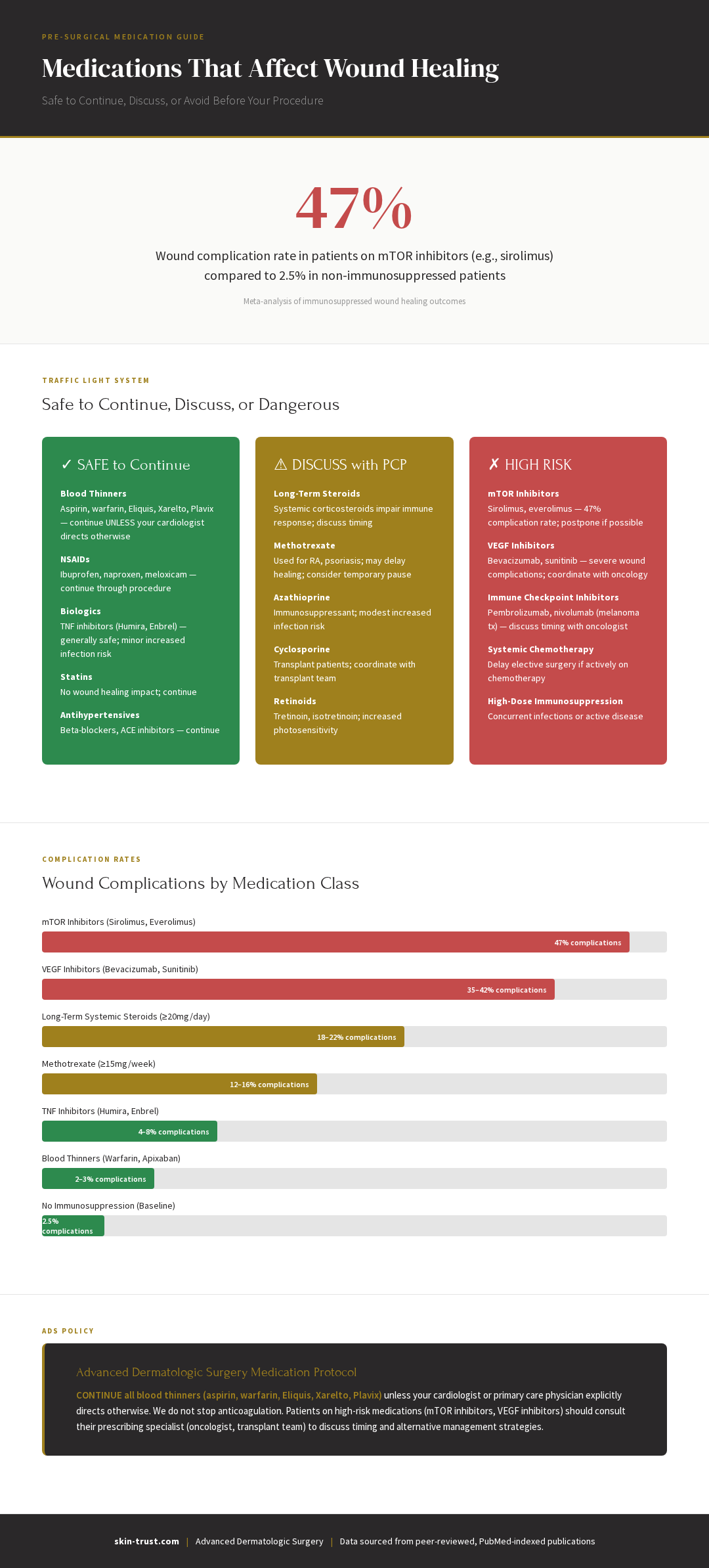
Data sourced from peer-reviewed, PubMed-indexed publications
Part 7: Pre-Operative Medication Review—What to Tell Your Surgeon
Create a Medication List
Before your skin surgery consultation, prepare a list of all medications you take, including:
- Prescription medications (including blood thinners, steroids, biologics)
- Over-the-counter medications (including aspirin, ibuprofen, multivitamins)
- Supplements (including fish oil, vitamin E, ginkgo, garlic, CoQ10, etc.)
- Herbal products
Include:
- Medication name
- Dose (e.g., "aspirin 81mg daily")
- Frequency (daily, weekly, etc.)
- Indication (why you take it)
What Your Surgeon Needs to Know
Bring this list to your consultation and specifically mention:
- "I take a blood thinner: [name, dose, indication]" — Your surgeon needs to know this affects hemostasis
- "I take high-dose steroids: [dose, duration]" — Your surgeon needs to assess wound healing risk
- "I take a VEGF inhibitor, mTOR inhibitor, or other chemotherapy: [name]" — Your surgeon needs to monitor closer post-operatively
- "I take a biologic or immunosuppressant: [name]" — Your surgeon may want to discuss with your rheumatologist
- "I take vitamin E supplements" — Stop 1 week before surgery
What NOT to Do
- Don't stop any blood thinner on your own without discussing with your cardiologist or primary care physician
- Don't assume you should stop any medication before surgery without discussing with your surgeon
- Don't use Vitamin E, and if a well-meaning relative recommends it, kindly refuse and tell them the current evidence shows no benefit
Part 8: Frequently Asked Questions
Q: Should I stop aspirin before skin surgery?
A: No. Continue aspirin as prescribed. The cardiovascular benefit of aspirin outweighs the modest increase in perioperative bleeding. Your surgeon should equipped to manage bleeding through proper technique. Stopping aspirin increases your risk of MI or stroke.
Q: What if my primary care doctor told me to stop aspirin before my skin surgery?
A: This is a communication gap. Your PCP may not realize you're having dermatologic surgery, which is low-risk. Call your PCP and explain: "I'm having skin cancer removal by a dermatologic surgeon. Is it safe to continue aspirin?" Many PCPs, when informed it's not major surgery, will agree to continue aspirin.
Q: Should I stop Plavix (clopidogrel) before skin surgery?
A: No. If you're on Plavix, you likely have a stent or recent MI/stroke. Stopping Plavix is much riskier than the bleeding risk from skin surgery. Continue it.
Q: I'm on warfarin. Should I get my INR checked before surgery?
A: It's reasonable to check INR a few days before surgery to ensure it's in a stable therapeutic range. But you don't need to adjust the dose before skin surgery. Proceed as planned.
Q: Vitamin E is supposed to help scars, right?
A: No. Vitamin E has no proven benefit for scars and actually increases bleeding. About 33% of people develop contact dermatitis from topical vitamin E. Don't use it. Stick with paper tape, sun protection, and time instead.
Q: I take fish oil. Should I stop it before surgery?
A: Fish oil has minimal impact on bleeding and provides some cardiovascular benefit. You can continue it, but if you prefer to stop it 1 week before surgery to be extra cautious, that's reasonable too. It's not critical.
Q: I'm on methotrexate for rheumatoid arthritis. Should I stop it before surgery?
A: No. Low-dose methotrexate is safe to continue for dermatologic surgery. The inflammation from stopping may outweigh any benefit. Continue as prescribed and inform your surgeon.
Q: I'm on a TNF inhibitor (like Humira). Is that safe for surgery?
A: Yes, generally safe for dermatologic surgery. You can continue it. Some rheumatologists prefer you skip one dose cycle around surgery, but continuing is also acceptable. Discuss with your rheumatologist.
Q: I'm on bevacizumab (Avastin) for cancer. Does this affect my skin surgery?
A: Bevacizumab increases wound complications slightly (OR 2.32). Your surgeon should know about it. For urgent skin cancer, surgery can proceed while you're on Avastin, but your surgeon will monitor closely post-operatively for infection or slow healing. For elective procedures, discuss with your oncologist whether a brief pause (4-6 weeks) is appropriate.
Q: I'm a transplant patient on sirolimus (Rapamycin). Is skin surgery safe?
A: Yes, but transplant patients have higher wound complication rates (47% in some studies vs. 8% in non-transplant patients). Your surgeon needs to know. The surgery can proceed, but expect slower healing and close post-operative monitoring. Inform your transplant team.
Q: What's the most common medication mistake patients make before skin surgery?
A: Stopping aspirin or blood thinners on their own, thinking it will reduce bleeding. This is the opposite of what should happen. Never stop blood thinners without discussing with your cardiologist or primary care doctor.
Part 9: Cross-Links to Related Articles
- How to Minimize Scarring After Skin Surgery: An Evidence-Based Timeline — Post-operative protocol for optimal outcomes
- Patient Behaviors That Hurt Healing After Skin Surgery — Common mistakes to avoid
- The Complete Guide to Surgical Scars: What Causes Them and How to Treat Them — Scar biology and prevention
Part 10: Medical Disclaimer
This article is educational and does not replace consultation with your surgeon, cardiologist, or prescribing physician. Medication management before surgery is individualized and depends on your specific medical history, the reason you take each medication, and the type of surgery planned. Always inform your surgeon of all medications you take, including over-the-counter medications and supplements. Do not make changes to any medication without consulting your prescribing physician.
For dermatologic surgery, led by Dr. Thomas L.H. Hocker, MD (triple board-certified in dermatology, dermatopathology, and Mohs micrographic surgery) We work closely with your primary care physician and specialists to optimize perioperative medication management.
References
Sørensen LT. Wound healing and infection in surgery: the clinical impact of smoking and smoking cessation: a systematic review and meta-analysis. Archives of Surgery. 2012;147(4):373-383. PMID: 22508785
Baumann LS, Spencer JM. The effects of topical vitamin E on the cosmetic appearance of scars. Dermatologic Surgery. 1999;25(4):311-315. PMID: 10417589
Singer AJ, et al. Determinants of poor outcome of skin surgery. Archives of Surgery. 2002;137(9):1041-1045. PMID: 12142652
Sugimoto T, et al. Arteriosclerosis increases the risk of keloid scarring. Journal of Surgical Research. 2022;274:e235-e242. PMID: 34537794
Sharma R, et al. Genetic and Environmental Risk Factors for Keloid Development: A Comprehensive Review. Dermatologic Surgery. 2025;51(1):e34-e47. PMID: 39862389
About the Author
Dr. Thomas L.H. Hocker, MD is triple board-certified in dermatology (ABD), dermatopathology (ABD + ABPath), and Mohs micrographic surgery and dermatologic oncology (MSDO via ABD)—all through the American Board of Medical Specialties (ABMS). He holds an MD from Harvard Medical School and an M.Phil. in translational research from the University of Cambridge.
Dr. Hocker completed his dermatology fellowship at Mayo Clinic and a Mohs fellowship under ACMS/ACGRE accreditation at Mayo. He is the Founding Director of Dermatologic Surgery at UMKC School of Medicine and an ACMS Iron Surgeon Lecturer. He has performed over 23,000 skin cancer procedures and brings evidence-based perioperative management to every patient.
