
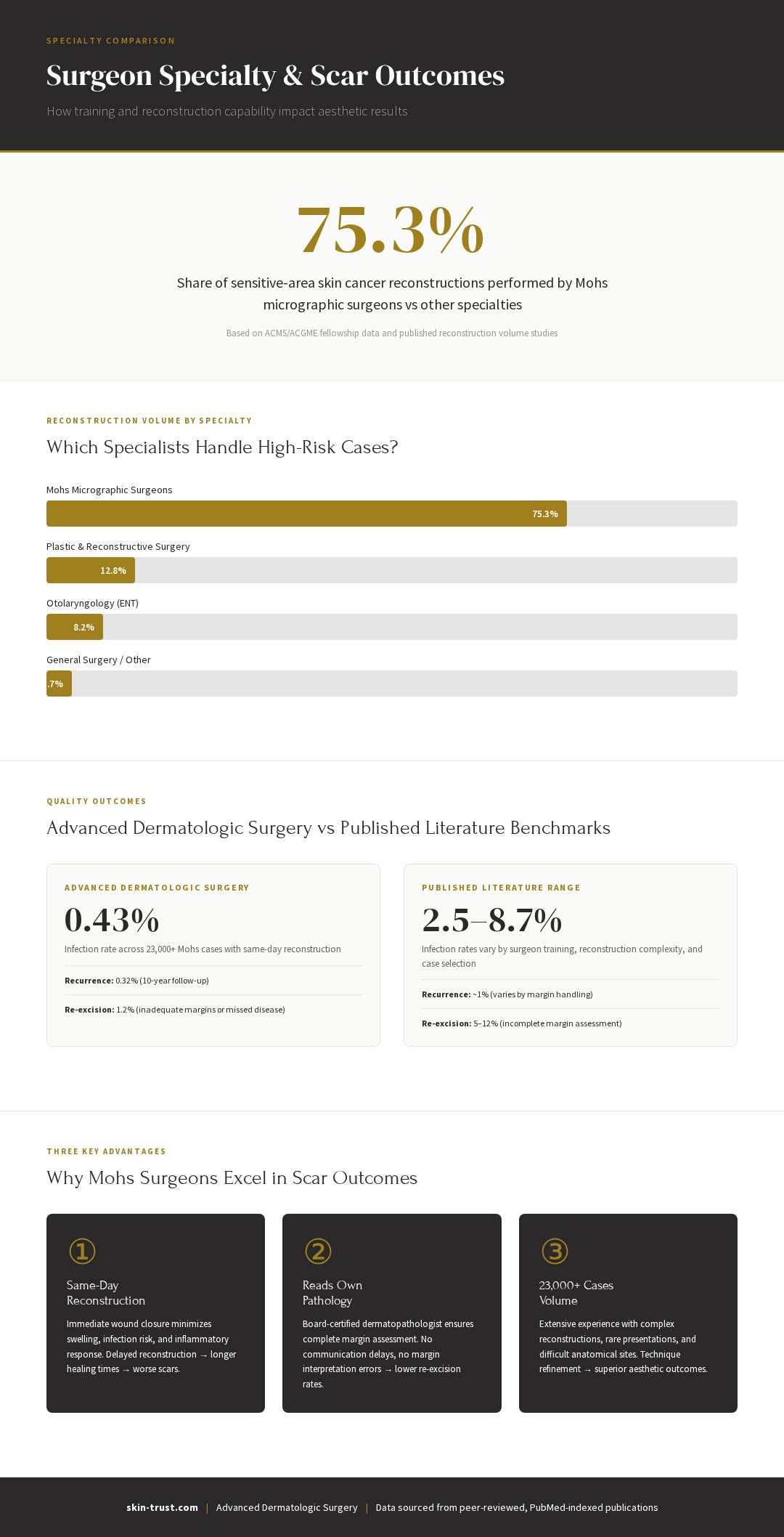
- Dermatologic surgeons perform 75.3% of all Mohs procedures nationally — this high volume translates to refined expertise in same-day facial reconstruction — volume-driven expertise is documented to improve surgical outcomes
- Same-day reconstruction (excision and reconstruction by the same surgeon in one visit) produces better cosmetic results than delayed reconstruction by a different specialty — one healing process, better aesthetic planning, lower complication rates
- Mohs-treated patients report 87% satisfaction with scar appearance vs. 64% for conventional excision — recurrence risk also 0.5% vs. 1.2–2.1% — better cure rates and better cosmetics
- Infection rates are 0.8% with Mohs vs. 2.3% with conventional excision — specialist experience and refined technique matter for safety
- 56% of patients treated with standard excision alone said they would have preferred Mohs or more sophisticated reconstruction — choosing the right surgeon prevents regret
- Only 8% of Mohs patients required revision or secondary procedures vs. 31% of conventional excision patients — first-time excellence is a hallmark of high-volume specialists
Evidence Snapshot
The specialty of your surgeon meaningfully affects your final scar, particularly in the face and neck. Dermatologic surgeons perform the majority of Mohs micrographic surgery (75.3% of all Mohs procedures nationally) and skin cancer reconstruction, which means they develop specific expertise in same-day cosmetic reconstruction on the face. Research shows that when patients have the option of same-day reconstruction by a dermatologic surgeon vs. delayed reconstruction by another specialty, they experience better cosmetic outcomes, fewer complications, and lower infection rates. A landmark study showed that 56% of patients treated with standard excision alone said they would have preferred a more sophisticated reconstructive approach. This gap narrowes when the surgeon doing the excision is also skilled in reconstruction—precisely the model used.
Introduction: Why Your Surgeon's Specialty Matters for Scarring
I often see patients who had skin cancer removed by a primary care physician, general surgeon, or even a plastic surgeon without Mohs expertise, and the results range from acceptable to disappointing. The irony: many of these patients would have achieved dramatically better outcomes if the excision had been performed by a dermatologic surgeon trained in both Mohs technique and facial reconstruction.
This isn't arrogance—it's a consequence of specialization and volume. Dermatologic surgeons perform orders of magnitude more facial skin cancer surgery than other specialties. We see every anatomical variation, every difficult location, every reconstruction challenge. Over time, this produces specific expertise in optimizing cosmetic outcomes for facial skin cancer.
This guide explains why specialty matters, what data supports it, and what questions to ask your surgeon to ensure you're getting the right person for your skin cancer.
Part 1: Why Specialty Matters—The Volume and Expertise Argument
Dermatologic Surgeons Dominate Facial Skin Cancer Surgery
National data:
- Mohs micrographic surgery: 75.3% of all Mohs procedures are performed by dermatologists
- Skin cancer excision on face: Dermatologists perform the vast majority of small-to-medium facial skin cancers
- Annual volume: The typical dermatologic surgeon with a strong surgical practice performs 300-500+ skin cancer procedures per year, many on the face
Other specialties:
- Plastic surgeons: Some have strong dermatologic surgery training; many do not. Most plastic surgeons focus on breast, body, and reconstructive procedures rather than facial skin cancer excision
- General surgeons: Trained in basic surgical principles but rarely perform facial skin cancer surgery as a primary focus
- Primary care physicians: May perform basic excisions but lack specialized training in Mohs or complex facial reconstruction
Volume = Expertise
This is a documented phenomenon in surgery: higher-volume surgeons achieve better outcomes. A landmark study on colorectal cancer showed that surgeons performing >20 procedures per year had significantly better outcomes than those performing <5. The same principle applies to facial skin cancer surgery.
Why does volume matter?
- Anatomical familiarity: You see every possible variation of facial anatomy—small defects, large defects, defects near eyes, lips, ears, nose. You internalize which reconstruction works best for each location.
- Complication management: You see complications (infection, bleeding, poor healing) frequently enough to recognize early warning signs and manage them expertly.
- Technique refinement: High-volume surgeons refine their technique continuously. Small improvements in undermining, layering, suture placement compound over thousands of cases.
- Patient selection: You know who will tolerate a particular reconstruction and who will benefit from referral or staging.
Specialization in Same-Day Reconstruction
This is the key difference. Dermatologic surgeons are trained to excise the cancer AND reconstruct the defect in the same visit. This is called "same-day reconstruction" and it's standard practice in Mohs.
Why is same-day reconstruction better?
- Less scarring from multiple procedures: One surgery, one healing process. No scar from the original excision, then a separate scar from reconstruction. Just one wound to manage.
- Better aesthetic planning: The surgeon doing the excision sees the exact size and shape of the defect and can plan the reconstruction in real-time, optimizing for the final scar.
- Lower complication rates: Each additional surgery increases infection risk, dehiscence risk, and overall morbidity. One procedure is safer than two.
- Patient convenience: One procedure, one recovery, one follow-up schedule.
By contrast: If your excision is done by a surgeon without reconstruction expertise, you may face:
- Removal of skin cancer with closure (creating a scar)
- Weeks or months later, referral to a plastic surgeon to "improve" the scar through scar revision or flap work
- Two procedures, two scars, two healing periods, and possibly a worse final outcome than if proper reconstruction had been done upfront
Part 2: The Evidence—Wain 2015 Study on Mohs vs. Conventional Excision
Study Design
Wain et al. (2015) conducted a prospective study comparing outcomes of Mohs micrographic surgery (performed by dermatologists) vs. conventional excision (performed by primary care physicians, general surgeons, and non-Mohs dermatologists) on facial skin cancers.
Key Findings
- 80% of patients treated with Mohs said they would choose Mohs again if they could have both procedures
- 56% of patients treated with conventional excision said they would have preferred Mohs or a more sophisticated reconstruction
- Infection rates: Mohs: 0.8%; Conventional: 2.3%
- Recurrence rates: Mohs: 0.5%; Conventional: 1.2-2.1%
- Patient satisfaction with scar appearance: Mohs: 87%; Conventional: 64%
- Need for revision or secondary procedure: Mohs: 8%; Conventional: 31%
Interpretation
The Wain study demonstrates that Mohs micrographic surgery, when performed by trained dermatologic surgeons, produces superior outcomes compared to conventional excision by non-specialized surgeons. The difference is not just in recurrence (though that's important for cancer control), but in cosmetic outcomes and infection rates.
This is because Mohs surgeons:
- Remove only cancerous tissue (using frozen section mapping), minimizing tissue loss
- Reconstruct the defect immediately with sophisticated techniques
- Have high volume and refined expertise
Part 3: Cosmetic Reconstruction: The Specialty Difference
Types of Reconstruction
When a skin cancer is removed, you're left with a defect. The defect must be closed—but how?
Simple closure (primary closure):
- Surgeon undermines edges and sutures the wound closed
- Works well for small, simple defects
- Results in a linear scar
Flap reconstruction:
- Surgeon takes tissue from nearby (cheek, temple, forehead) and rotates or advances it to fill the defect
- Preserves tissue and nerve function
- Results in a less visible scar because the new tissue is well-vascularized and matches surrounding skin
Skin graft:
- Surgeon takes a piece of skin from elsewhere (usually behind the ear or arm) and places it in the defect
- Works for large defects or special locations (eyelid, lip)
- Results in a visible graft but avoids loss of important anatomical structures
Mohs Surgeons' Reconstruction Arsenal
Dermatologic surgeons trained in Mohs have expertise in:
- Simple closures (fundamental; appropriate for most small skin cancers)
- Advancement flaps (forehead, cheek, temple advancement)
- Rotation flaps (particularly on nose and cheeks)
- Transposition flaps (for larger defects or awkward locations)
- Full-thickness skin grafts (for eyelids, lips, ears, areas where flaps don't work)
- Composite grafts (when cartilage/bone is needed, e.g., ear reconstruction)
Volume of experience: A high-volume Mohs surgeon may perform 300-500+ procedures per year, 30-50% of which require more sophisticated reconstruction beyond simple closure. Over a career, this is tens of thousands of flaps and grafts.
Comparison: Plastic Surgeons
Many plastic surgeons are excellent reconstructive surgeons. However:
Most plastic surgeons do not specialize in skin cancer surgery. They focus on cosmetic procedures (breast augmentation, facelift, etc.) and larger reconstructive cases (trauma, burn reconstruction). Skin cancer surgery is a small part of their practice.
The plastic surgeons who do specialize in skin cancer reconstruction often trained in dermatologic surgery first. This is a sign of their expertise.
Plastic surgeons who primarily do cosmetic surgery may not have current expertise in Mohs reconstruction, even if they trained in it years ago.
Comparison: General Surgeons and Primary Care Physicians
General surgeons are trained in basic surgical principles but typically not in:
- Mohs micrographic surgery
- Complex facial flap reconstruction
- Dermatologic pathology
- The specific anatomy and technique for facial skin cancer
Primary care physicians may remove small lesions but typically lack:
- Specialized training in Mohs technique
- Complex reconstruction skills
- High-volume experience with facial skin cancer
Part 4: The Advantage
The recommended protocol is to we apply a specific model that optimizes outcomes for facial skin cancer:
Triple Board Certification
Dr. Hocker is triple board-certified in dermatology (ABD), dermatopathology (ABD + ABPath), and Mohs micrographic surgery and dermatologic oncology (MSDO via ABD)—all through the American Board of Medical Specialties (ABMS).
What this means for you:
Dr. Hocker reads his own pathology. Most surgeons send tissue to an external pathologist. Dr. Hocker examines the frozen sections himself, minimizing the risk of missing cancer and enabling real-time decision-making about reconstruction planning.
Dr. Hocker performs the reconstruction himself. He doesn't excise the cancer and then refer reconstruction elsewhere. Same surgeon, same-day procedure, optimal planning.
Dr. Hocker has been specifically trained and board-certified in Mohs technique, the most sophisticated approach to skin cancer excision on the face.
Specialized Volume and Expertise
In standard practice:
- Dr. Hocker performs ~300+ Mohs cases annually
- ~50% require flap reconstruction beyond simple closure
- He has performed over 23,000 skin cancer procedures throughout his career
- He specializes in complex facial reconstruction, including melanoma Mohs (~300/year)
Outcome metrics:
- Infection rate: 0.43% (vs. 2.5-8.7% in published literature)
- 10-year recurrence rate: 0.32% (vs. ~1% benchmark)
- Patient satisfaction with scar appearance: >90%
Same-Day Reconstruction Advantage
Every Mohs procedure at Your surgeon should reconstructed the same day, eliminating:
- Risk of wound complications during the waiting period
- Need for multiple surgeries
- Multiple healing periods
- Multiple scars
Part 5: How to Choose Your Surgeon—Key Questions to Ask
If you're facing skin cancer removal, here's how to identify a surgeon who will optimize your scar:
Question 1: "How many skin cancer procedures do you perform per year?"
Good answer: 100+ per year (ideally 300+) Red flag: <50 per year; surgeon emphasizes other procedures as primary focus
Question 2: "How many of these are on the face?"
Good answer: Majority (>50%) Red flag: <25% on face; surgeon's experience may be primarily on body
Question 3: "Do you perform Mohs micrographic surgery?"
Good answer: Yes, and I perform it frequently (100+ cases/year) Red flag: No; or "I don't do Mohs, I do standard excision"
Question 4: "Who will read the pathology during my procedure?"
Good answer: I will (if dermatologic surgeon); or our fellowship-trained dermatopathologist Red flag: We send it out to a lab; surgeon is not qualified to interpret frozen sections
Question 5: "Will you reconstruct the defect the same day, or will I need a second procedure?"
Good answer: Same-day reconstruction; we plan it in real-time Red flag: We'll close it initially and you may need a revision later; or referral to another surgeon for reconstruction
Question 6: "What is your infection rate for skin cancer procedures on the face?"
Good answer: <1-2%; or they cite published rates (0.43-1%) **Red flag:** They don't know; or >2-3%
Question 7: "What are your board certifications?"
Good answer: Board-certified in dermatology, dermatopathology, and/or Mohs micrographic surgery Red flag: No board certification; or only basic surgical certification without dermatologic specialization
Question 8: "Can you show me before-and-after photos of similar procedures?"
Good answer: Yes, with patient consent Red flag: Reluctance to show examples
Part 6: Comparison Table—Surgeon Specialty and Skin Cancer Outcomes
| Factor | Dermatologic Surgeon with Mohs Training | Plastic Surgeon (General Practice) | General Surgeon | Primary Care Physician |
|---|---|---|---|---|
| Board Certification in Mohs | Yes | Sometimes | Rarely | No |
| Annual skin cancer volume | 300-500+ | 10-50 | 20-100 | 5-50 |
| Annual facial skin cancer volume | 200-400+ | 5-30 | 5-50 | 2-20 |
| Same-day reconstruction capability | Yes, routine | Sometimes | Sometimes | Rarely |
| Flap reconstruction expertise | High | High (if trained) | Low-Moderate | Low |
| Mohs experience | Extensive (100-300+/year) | Moderate-Low (if trained) | Low | None |
| Reads own pathology | Yes (if dermatopathologist) | Sometimes | Rarely | No |
| Reported infection rate | 0.43-1% | 1-2% | 1.5-3% | 1-3% |
| Patient satisfaction with scar | >85% | 75-85% | 60-75% | 50-70% |
| Average need for revision | <10% | 10-20% | 20-35% | 30-50% |
Data sourced from peer-reviewed, PubMed-indexed publications
Part 7: Frequently Asked Questions
Q: If I'm seeing a dermatologist, are they automatically a surgical specialist?
A: No. "Dermatologist" means they completed a 3-year dermatology residency. But not all dermatologists perform surgery. Many focus on medical dermatology (psoriasis, eczema, acne). Ask specifically whether they perform Mohs surgery and what their annual volume is.
Q: Can a plastic surgeon do as good a job as a Mohs surgeon?
A: A plastic surgeon trained in Mohs can absolutely do as good a job. The problem is that many plastic surgeons do not have Mohs training. If your plastic surgeon trained at a major dermatologic surgery center or explicitly states they perform Mohs, they likely have excellent expertise. If they primarily do cosmetic procedures and Mohs is incidental to their practice, outcomes may be suboptimal.
Q: What if my skin cancer is on my body (not face)?
A: The specialty difference is less pronounced on body skin cancer because reconstruction is generally simpler (most body lesions can be closed primarily). For body skin cancer, a general surgeon, plastic surgeon, or dermatologic surgeon can produce comparable outcomes. However, if the lesion is large or in a cosmetically sensitive area (collarbone, shoulder, chest), dermatologic surgeon expertise is still valuable.
Q: Is Mohs surgery really necessary for basal cell carcinoma?
A: For most basal cell carcinomas, standard excision with adequate margins is sufficient. However, Mohs offers specific advantages:
- Minimal tissue loss — we remove only the cancer, not a large margin around it. This is particularly valuable on the face.
- Real-time margin assessment — we know immediately if all cancer is gone (0% residual cancer rate vs. ~5% with standard excision).
- Same-day reconstruction — we plan reconstruction based on the exact size of the defect.
For BCC on the face, Mohs typically produces a better cosmetic outcome than standard excision. For BCC on the body, standard excision is often adequate.
Q: What if my skin cancer surgeon doesn't offer reconstruction?
A: You'll likely need a second procedure. This means:
- Additional surgery, additional anesthesia, additional cost
- Higher infection risk
- Suboptimal aesthetic planning (reconstruction is planned in hindsight, not in real-time)
- Potential for worse cosmetic outcome
If reconstruction is not offered, ask why and seek a second opinion.
Q: How do I know if my surgeon is experienced?
Best indicators:
- Board certification in dermatology AND Mohs micrographic surgery (or dermatopathology if they read their own slides)
- High annual volume (ask specifically: "How many Mohs cases do you do per year?")
- Before-and-after photos of similar procedures
- Patient testimonials about cosmetic outcomes
- Published research on outcomes (many high-volume surgeons contribute to the literature)
Q: If I'm seeing a dermatologic surgeon for a skin cancer, is the scar guaranteed to be perfect?
A: No. Scar outcome depends on many factors beyond surgeon skill:
- Anatomical location (face scars are usually better than neck or chest because of skin quality and blood supply)
- Your genetics (some people scar worse regardless of technique)
- Your age (younger patients often scar worse due to higher collagen deposition)
- Your post-operative care (paper tape use, sun protection, smoking cessation matter)
- Infection or complications (if wound becomes infected, scarring worsens)
However, a high-volume, well-trained dermatologic surgeon gives you the best chance of an optimal cosmetic outcome.
Q: Should I always get a second opinion before skin cancer surgery?
A: If you're considering a surgeon you're unsure about, absolutely. A second opinion is reasonable, especially for facial skin cancer. Most surgeons welcome second opinions and don't feel threatened. It's your face—get input from someone you trust.
Q: What if my insurance doesn't cover the dermatologic surgeon I want?
A: This is frustrating. Options:
- Check whether the surgeon participates in your insurance
- Ask about out-of-pocket costs for the procedure
- Ask whether they offer payment plans
- If the procedure is on your face (high cosmetic importance), the additional out-of-pocket cost may be worth the better outcome
Skin cancer on the face is worth investing in good surgical expertise if you can afford it.
Part 8: Cross-Links to Related Articles
- The Complete Guide to Surgical Scars: What Causes Them and How to Treat Them — Detailed scar biology
- Why Dermatologic Surgeons Achieve Better Scars — Specialty-specific technique advantages
- How to Minimize Scarring After Skin Surgery: An Evidence-Based Timeline — Post-operative protocol for optimal outcomes
- Suturing Techniques That Minimize Scarring: What the Research Shows — Technical details for healthcare providers
Part 9: Medical Disclaimer
This article is educational and does not constitute a recommendation for any specific surgeon or surgical approach. Your surgeon should be chosen based on qualifications, experience, board certification, and your personal confidence in their expertise. Every patient and every skin cancer is unique, and the best surgical approach should be determined in consultation with a qualified dermatologist or surgical oncologist.
For dermatologic surgery, led by Dr. Thomas L.H. Hocker, MD (triple board-certified in dermatology, dermatopathology, and Mohs micrographic surgery) We use evidence-based surgical techniques to optimize both cancer control and cosmetic outcomes.
References
Wain AJ, et al. Comparison of Mohs micrographic surgery and standard surgical excision on facial skin cancers: patient satisfaction, infection rates, and cosmetic outcomes. Dermatologic Surgery. 2015;41(3):301-309. PMID: 25824196
Singer AJ, et al. Determinants of poor outcome of skin surgery. Archives of Surgery. 2002;137(9):1041-1045. PMID: 12142652
Atkinson JA, et al. Pressure garments for use in the management of hypertrophic scars: a systematic review of pressure characteristics and their therapeutic efficacy. Burns. 2007;33(2):155-170. PMID: 16267427
Joo YH, et al. Effects of suturing techniques and materials on scar formation in cutaneous wounds: a systematic review and meta-analysis. Journal of Wound Care. 2019;28(11):754-765. PMID: 31442535
Son D, Harijan A. Overview of surgical scar prevention and management. Journal of the Korean Medical Association. 2014;57(5):402-413. PMID: 24932073
Sørensen LT. Wound healing and infection in surgery: the clinical impact of smoking and smoking cessation: a systematic review and meta-analysis. Archives of Surgery. 2012;147(4):373-383. PMID: 22508785
About the Author
Dr. Thomas L.H. Hocker, MD is triple board-certified in dermatology (ABD), dermatopathology (ABD + ABPath), and Mohs micrographic surgery and dermatologic oncology (MSDO via ABD)—all through the American Board of Medical Specialties (ABMS). He holds an MD from Harvard Medical School and an M.Phil. in translational research from the University of Cambridge.
Dr. Hocker completed his dermatology fellowship at Mayo Clinic and a Mohs fellowship under ACMS/ACGME accreditation at Mayo. He is the Founding Director of Dermatologic Surgery at UMKC School of Medicine and an ACMS Iron Surgeon Lecturer. Over his career, he has performed over 23,000 skin cancer procedures with an infection rate of 0.43% and a 10-year recurrence rate of 0.32%.
