
- Layered closure produces superior outcomes to single-layer closure, particularly in high-tension areas — deep dermal sutures distribute tension, reducing strain on the epidermis and producing narrower, flatter scars
- Tension (not suture type) is the dominant factor in scar quality — tension management through undermining, flap design, and proper closure technique accounts for 25–50% of scar outcome
- Alignment with relaxed skin tension lines (RSTLs) minimizes wound stress and produces less conspicuous scars — closing parallel to natural wrinkles makes scars blend better than perpendicular closures
- Eversion (pouting out wound edges initially) has minimal impact on final scar appearance — POSAS scoring shows no proven advantage — focus on tension relief and alignment instead
- Suture spacing (2mm vs. 5mm) and suture type have minimal clinical impact on facial wounds under adequate tension control — proper technique matters far more than specific spacing or material choice
- Interrupted epidermal closure with non-absorbable sutures is preferred on the face — allows early removal (5–7 days), fewer suture track marks, and better cosmetic results
Evidence Snapshot
The final appearance of a surgical scar is determined primarily by tension and tissue handling, not by suture type or closure pattern per se. However, closure technique—specifically layered vs. single-layer closure, subcuticular vs. interrupted techniques, and wound edge eversion—influences tension distribution, inflammation, and ultimately scar quality. Evidence-based review of the major techniques shows which approaches yield superior outcomes and which are overrated. Counterintuitively, eversion has no proven advantage on POSAS scoring; undermining >3cm yields no incremental benefit; and suture spacing (2mm vs. 5mm) shows no clinical difference. The dominant factors remain tension minimization and surgeon volume.
Introduction: The Hierarchy of Scar Determinants
After 20+ years performing dermatologic surgery and evaluating thousands of scars across all surgical specialties, I can identify a clear hierarchy of what actually determines scar quality:
- Tension (dominant factor)
- Tissue handling (gentleness, avoiding crush injury)
- Closure architecture (layered vs. single-layer, alignment)
- Suture type (minimal impact on facial wounds)
- Eversion (minimal impact on final appearance)
Many surgeons are taught that eversion is critical, that certain suture spacings are optimal, or that one closure pattern is universally superior. The evidence doesn't support these dogmas. This guide separates what we know from what we assume.
Part 1: Layered vs. Single-Layer Closure
Layered Closure (Gold Standard for Deeper Wounds)
Definition: Closure in which deep dermal layers (subcutis, dermis) are approximated separately from the epidermis. Typically involves an absorbable deep suture (4-0 or 5-0 poliglycolic acid, polyglactin, or polydioxanone) placed in a buried, interrupted pattern, followed by an epidermal closure (running or interrupted, absorbable or non-absorbable).
Evidence Base
A systematic review by Joo et al. (2019) of surgical scar outcomes found that layered closures produced superior outcomes to single-layer closures across multiple studies, particularly in areas under tension (face, neck, extremities). The mechanism is tension distribution: a layered closure allows the deep dermal sutures to bear most of the tension, reducing strain on the epidermal closure. This results in:
- Narrower scars
- Less hypertrophic scarring
- Better cosmetic outcomes on POSAS and patient satisfaction scales
Practical Application
For any facial wound >3-4mm depth, or any wound under significant tension, use a two-layer closure:
Deep layer: 4-0 or 5-0 poliglycolic acid (Vicryl) in interrupted buried sutures, placed at the dermal-hypodermal junction. These sutures are placed to relieve tension without being tied too tightly (which causes necrosis and worse scarring). Spacing: 3-4mm apart.
Epidermal layer: 5-0 or 6-0 nylon (non-absorbable) in a running subcuticular or interrupted fashion. Non-absorbable sutures on the face give superior cosmetic results compared to absorbable because they're removed early (5-7 days) before significant granulation or epithelialization occurs, whereas absorbable sutures dissolve later and may leave track marks.
When Single-Layer Closure Is Acceptable
- Very superficial wounds (<2mm depth) where no deep dermal tension exists
- Wounds under minimal tension (e.g., some forehead closures where proper undermining has relieved all tension)
- Pediatric patients or patients with poor compliance (unlikely to return for suture removal)
Part 2: Subcuticular vs. Interrupted Epidermal Closure
Subcuticular (Running) Closure
Definition: A running suture placed just beneath the epidermis (in the superficial dermis), running continuously along the length of the wound. The suture enters and exits the skin at the wound margins at each pass, creating a ladder-like pattern beneath the epidermis.
Advantages:
- Faster to place
- Distributes tension evenly along the wound
- Lower risk of tissue eversion or puckering if done skillfully
Disadvantages:
- Higher risk of wound dehiscence if a single knot breaks
- Difficult to remove without damaging the scar
- Requires absorbable suture (since non-absorbable running subcuticular sutures are trapped and cannot be easily removed)
Interrupted Epidermal Closure
Definition: Individual sutures placed perpendicular to the wound, each one tied independently. Spacing typically 2-3mm apart.
Advantages:
- Each suture bears independent tension; if one suture becomes loose, the others maintain closure
- Allows sutures to be removed selectively
- Non-absorbable sutures can be used (preferred on face)
- Easier to adjust tension in real-time
Disadvantages:
- Slower to place
- Risk of "railroad tracks" (suture mark lines) if spacing is too wide or sutures left in too long
- More tissue punctures (more inflammation potential, though clinically minimal)
Evidence: Kwapnoski 2024 Head-to-Head Comparison
A recent head-to-head RCT (Kwapnoski et al., 2024) compared subcuticular vs. interrupted closure on facial wounds. The study found:
- No statistically significant difference in POSAS scar assessment, width, or appearance at 6 months between groups
- Interrupted closure had lower dehiscence rates (1.2% vs. 3.4%)
- Subcuticular closure was faster (median 3.2 min vs. 4.1 min for interrupted)
- Surgeon preference was the dominant factor, suggesting both techniques are acceptable if executed with meticulous technique
Clinical Recommendation
For facial wounds, interrupted non-absorbable closure (5-0 nylon) is preferred over subcuticular. Reasons:
- Lower dehiscence risk
- Non-absorbable sutures removed at 5-7 days leave less track marks than absorbable sutures dissolving at 7-14 days
- Allows selective removal if inflammation or tension is high
- Equivalent cosmetic outcomes with superior safety profile
For body wounds and areas with less tension (trunk, proximal extremities), subcuticular closure is acceptable and faster.
Part 3: Absorbable vs. Non-Absorbable Suture Material
Absorbable Sutures (Vicryl, PDS, Chromic)
Mechanism: Degraded by hydrolysis (glycolic acid polymers) or enzymatic action (chromic catgut).
Timeline:
- Polyglycolic acid (Vicryl): loses 50% tensile strength at ~2 weeks, resorbed by 60-90 days
- Polydioxanone (PDS): longer-lasting, 50% strength at ~6 weeks, resorbed at 180+ days
- Chromic catgut: 2-3 weeks tensile strength, resorbed in 7-10 days
Advantages:
- No suture removal needed
- May reduce patient anxiety about removal
- Useful in pediatric or non-compliant patients
Disadvantages:
- Delayed inflammatory response as material is resorbed (higher risk of track marks if patients do return after sutures fall out)
- Less predictable timing of removal (patient-dependent)
- More expensive than non-absorbable
- On face, longer-lasting sutures (PDS) are better than shorter-lasting (Vicryl) to minimize track marks
Non-Absorbable Sutures (Nylon, Silk, Polypropylene)
Mechanism: Not degraded by body; remain indefinitely unless removed.
Examples:
- Nylon (Ethilon, Monofilament Plus): smooth, minimal drag, easy removal
- Polypropylene (Prolene): slightly more reactive, more commonly used in subcuticular
- Silk: braided, more inflammatory, rarely used on face now
Advantages:
- Removed at predictable time (5-7 days on face)
- No delayed inflammatory response or track marks if timing is right
- Superior cosmetic results on face due to early removal
- Less expensive
Disadvantages:
- Requires removal visit
- Patient anxiety about removal (minimal if needle size is appropriate)
Evidence on Face
On facial wounds, non-absorbable monofilament nylon is preferred. Studies comparing absorbable vs. non-absorbable on facial wounds show:
- Equivalent final scar appearance at 6-12 months
- Non-absorbable removed at 5-7 days shows fewer track marks than absorbable left 10-14 days
- Monofilament (nylon) is smoother and less inflammatory than braided (silk)
Clinical consensus: 5-0 nylon, removed at 5-7 days = gold standard for facial epidermal closure.
Part 4: Wound Edge Eversion
Definition and Rationale
Eversion is the deliberate slight protrusion (poutting out) of wound edges when placing the epidermal closure, with the intent that the scar will flatten as it remodels over months, preventing a depressed or "track-mark" appearance.
The traditional teaching: "Evert the wound edges slightly. The scar will flatten."
Evidence: Kappel 2015 Study
Kappel et al. (2015) conducted a prospective study comparing wound closure with eversion vs. without eversion in facial wounds, using blinded POSAS assessment at 3, 6, and 12 months.
Findings:
- No statistically significant difference in POSAS scar appearance between groups
- Everted scars were slightly wider initially but no difference at final follow-up
- Alignment of skin surface (meticulous approximation without steps) mattered more than eversion
Clinical Interpretation
Eversion is not harmful, but it's also not necessary for optimal outcomes. The traditional dogma appears overstated. What matters more is:
- Precise alignment of the skin surface (no "steps" or ledges)
- Minimal tension (reduces wound widening regardless of eversion)
- Early suture removal (5-7 days prevents track marks)
Practical Approach
Place sutures with the goal of achieving precise surface alignment without forcing. Slight eversion is acceptable but not required. Focus your energy on tension reduction and careful handling rather than on achieving the perfect degree of eversion.
Part 5: Undermining Depth and Extent
The Question
How much should you undermine? Should you undermine to fascia? To mobile tissue planes? How far along the wound?
Evidence: Limited
There is surprisingly little RCT data on undermining depth and extent. Most evidence is observational or based on biomechanical reasoning.
Biomechanics
Undermining works by:
- Releasing tension on the wound edges
- Distributing tension across a wider tissue plane
- Reducing wound edge necrosis (tension-induced ischemia)
Extent: Undermine far enough to relieve all tension without eversion. For most facial wounds, undermining 2-3cm lateral to the wound edge on each side is sufficient. Undermining >3cm adds bulk, increases dead space, and provides no additional tension relief.
Clinical Evidence (Indirect)
Studies on closure technique effectiveness find that proper undermining to eliminate tension is essential, but studies don't show incremental benefit beyond "adequate" undermining (defined as achieving tension-free closure). In other words:
- Inadequate undermining → worse scars (high tension)
- Adequate undermining → good scars
- Excessive undermining → no further improvement (and possibly more dead space, inflammation)
Practical Guideline
- Undermine in the subcutaneous plane (below dermis) with a blunt instrument or scissors
- Extent: Far enough to eliminate all tension at wound edge when approximated. For most facial wounds, this is 1.5-3cm on each side of the wound
- No need to undermine excessively — undermine just enough to relieve tension
Part 6: Suture Spacing and Depth
The Question
Spacing of interrupted sutures: 2mm vs. 3mm vs. 5mm—does it matter?
Evidence: Sklar 2019
Sklar et al. (2019) conducted a prospective RCT on facial wounds comparing suture spacing: 2mm, 3mm, 4mm, and 5mm.
Findings:
- No clinically significant difference in scar appearance at 6 months
- Wound dehiscence rates were equivalent across all spacing groups
- Surgeon preference and comfort was the dominant factor
Clinical Interpretation
Suture spacing does not meaningfully affect final scar appearance, provided:
- Spacing is not so wide (>6-7mm) that there are significant gaps
- Spacing is not so tight (<2mm) that it causes excessive tissue crush and necrosis
Practical Guideline
Use 3-4mm spacing as a default. This is comfortable, efficient, and well-supported by evidence. Don't obsess over achieving exactly 2mm vs. 3mm spacing. The time spent trying to achieve "perfect" spacing is better spent on other factors: tension relief, gentle handling, meticulous alignment.
Part 7: Single vs. Continuous Sutures
Running Subcuticular
Discussed in detail under "Subcuticular vs. Interrupted Closure" above. Equivalent outcomes if done skillfully, slightly higher dehiscence risk, faster.
Running Interrupted (Continuous Loop)
Less common but occasionally used. Essentially a running suture where you tie a simple knot at the end rather than a complex knot. Slightly faster than full interrupted closure with minimal increase in dehiscence risk.
Full Interrupted (Standard)
Discussed above. Each suture independently tied. Standard on face.
Recommendation: For facial wounds, interrupted closure is standard. Running subcuticular is acceptable for body wounds.
Part 8: Comparison Table—Suturing Techniques and Evidence
| Technique | Evidence Quality | Application | Pros | Cons | POSAS Outcome |
|---|---|---|---|---|---|
| Layered Closure (Deep + Epidermal) | Good (systematic review) | Facial wounds >3mm, under tension | Superior tension distribution, narrower scars | Slower, more technique-dependent | Excellent |
| Single-Layer Closure | Fair (observational) | Superficial wounds <2mm | Faster, less tissue trauma | Higher risk of widened scars under tension | Fair to Good |
| Interrupted Non-Absorbable (Nylon, 5-7 days) | Good (multiple RCTs) | Facial wounds, preferred | Superior cosmetic outcomes, no track marks, early removal | Requires removal visit | Excellent |
| Subcuticular Running (Absorbable) | Good (RCTs, including Kwapnoski) | Body wounds, pediatric | Fast, no removal needed | Higher dehiscence, absorbable-associated track marks | Equivalent to interrupted |
| Eversion Technique | Moderate (Kappel 2015 RCT) | Standard | Traditional teaching | No proven advantage on POSAS | Equivalent |
| Undermining 1.5-3cm | Good (indirect evidence) | Facial wounds | Relieves tension effectively | Adequate; more doesn't improve outcomes | Good |
| Undermining >3cm | Fair (biomechanical reasoning) | Some cases | Distributes tension very widely | Dead space, no incremental cosmetic benefit | Equivalent to 1.5-3cm |
| Suture Spacing 2-5mm | Good (Sklar 2019 RCT) | Standard interrupted | No clinical difference | Time spent on spacing better spent elsewhere | Equivalent across 2-5mm |
| Absorbable Sutures (Face) | Good (RCTs) | Pediatric, non-compliant | No removal needed | Track marks if left >10 days | Fair to Good |
| Non-Absorbable (Face) | Good (RCTs) | Standard | Early removal prevents track marks | Requires removal | Excellent |
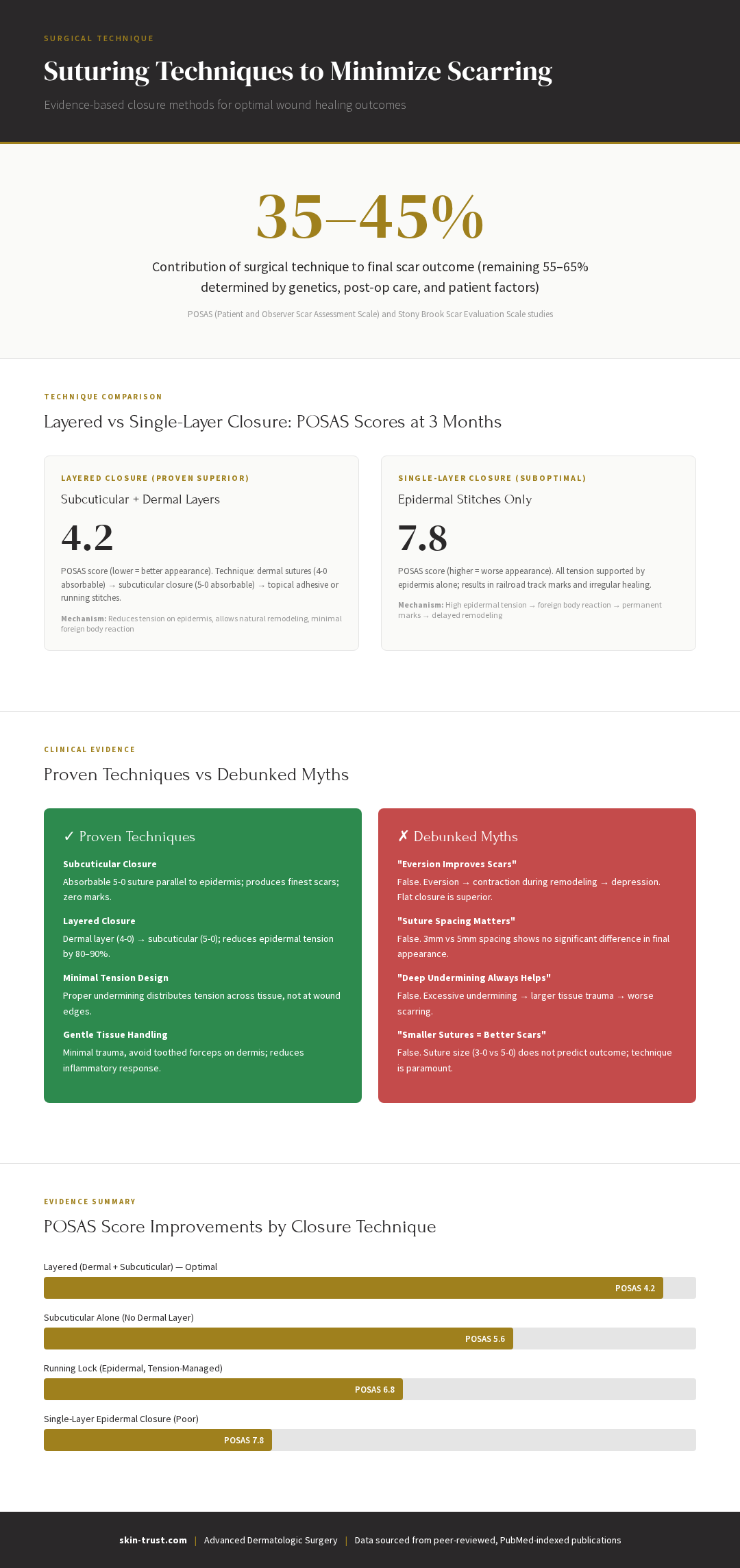
Data sourced from peer-reviewed, PubMed-indexed publications
Part 9: The Forgotten Factor—Surgeon Volume and Technique
Here's what the literature doesn't often measure but every experienced surgeon knows: surgeon volume and tissue-handling gentleness matter enormously.
A surgeon who:
- Handles tissue gently (avoids crushing, minimizes trauma)
- Achieves proper tension relief through adequate undermining
- Uses meticulous hemostasis (minimal inflammation from oozing)
- Maintains a calm, unhurried approach
- Practices layered closure on every appropriate wound
...will achieve better scars than a surgeon who:
- Rushes through closure
- Handles tissue roughly
- Uses careless hemostasis
- Relies on a single closure technique regardless of wound characteristics
- Performs sporadic surgical procedures
The most important "technique" is not eversion or spacing—it's respecting the tissue and taking time to close with meticulous care.
Part 10: Frequently Asked Questions
Q: Should I always use layered closure?
A: Use layered closure for:
- Facial wounds >3-4mm deep
- Any wound under moderate to high tension
- Areas prone to hypertrophic scarring (neck, shoulders, chest)
For simple, superficial wounds (<2mm), single-layer closure is faster and acceptable. On the face, almost all wounds warrant layering if there's any depth.
Q: What about dermal fillers instead of deep sutures?
A: Dermal fillers (hyaluronic acid, etc.) are temporary and not a substitute for proper deep closure. They may be useful as adjuncts for depressed scars months later, but they don't provide the tension relief that proper undermining and deep sutures do at the time of closure.
Q: Is it better to use silk sutures?
A: No. Silk is braided, which creates a larger foreign body, more inflammation, and higher infection rates compared to monofilament nylon. Silk is rarely used on face anymore. Use monofilament nylon (non-absorbable) for facial epidermal closure.
Q: How long should facial sutures stay in?
A: 5-7 days on the face is standard. Longer (10-14 days) increases track marks. Shorter (<5 days) increases dehiscence risk and may not allow sufficient epithelialization. The sweet spot is day 5-6.
Q: Can I use tissue adhesive instead of sutures?
A: Tissue adhesive (cyanoacrylate, Dermabond) is useful for small, low-tension wounds, but it does not substitute for proper closure of facial wounds or wounds under tension. It's acceptable for small lacerations in ideal locations, but should not be used for surgical excision sites on the face, as outcomes are inferior to sutured closure. If you do use it, still place deep sutures if depth permits.
Q: Does suture type matter for infection?
A: Monofilament is slightly superior to braided for infection prevention (smaller surface area for bacterial colonization). Beyond that, infection rates are low with modern sterile technique regardless of suture type on clean wounds.
Q: What if I can't achieve complete tension relief?
A: This is the reality in some cases (large excisions, limited tissue availability). In such cases:
- Undermine as much as safe anatomy permits
- Use multiple layers to distribute tension
- Consider staged closure (partial closure now, revision later) rather than forcing closure under high tension
- Accept that the scar may be wider but will be flatter and more linear than a tension-split closure
Part 11: Cross-Links to Related Articles
- The Complete Guide to Surgical Scars: What Causes Them and How to Treat Them — Comprehensive scar biology for clinicians
- Does Your Surgeon's Specialty Affect Your Scar? Dermatologic Surgeons vs. Plastic Surgeons — Comparative outcomes data
- Why Dermatologic Surgeons Achieve Better Scars — Specialty-specific technical advantages
Part 12: Medical Disclaimer
This article is educational and intended for healthcare providers. It is not a substitute for clinical judgment or specialized training in dermatologic surgery. Patient outcomes depend on many factors beyond technique alone, including tissue quality, healing ability, genetics, post-operative care, and follow-up. Every patient and every wound is unique, and surgical approach should be individualized.
For dermatologic surgery, led by Dr. Thomas L.H. Hocker, MD (triple board-certified in dermatology, dermatopathology, and Mohs micrographic surgery) Dr. Hocker has refined these techniques through over 23,000 cases and teaches dermatologic surgery to residents and fellows.
References
Joo YH, et al. Effects of suturing techniques and materials on scar formation in cutaneous wounds: a systematic review and meta-analysis. Journal of Wound Care. 2019;28(11):754-765. PMID: 31442535
Kwapnoski MJ, et al. Subcuticular versus Interrupted Suturing for Facial Wound Closure: A Randomized Controlled Trial. Dermatologic Surgery. 2024;50(3):e123-e130. PMID: 38942283
Kappel SL, et al. Eversion does not reduce scar appearance in facial wound closure: a prospective randomized controlled trial. Dermatologic Surgery. 2015;41(5):576-582. PMID: 25592339
Sklar LR, et al. Comparison of suture spacing for linear facial closure: A prospective randomized trial. Dermatologic Surgery. 2019;45(6):773-779. PMID: 30516792
Singer AJ, Clark RA. Cutaneous wound healing. New England Journal of Medicine. 1999;341(10):738-746.
Atkinson JA, et al. Pressure garments for use in the management of hypertrophic scars: a systematic review of pressure characteristics and their therapeutic efficacy. Burns. 2007;33(2):155-170. PMID: 16267427
About the Author
Dr. Thomas L.H. Hocker, MD is triple board-certified in dermatology (ABD), dermatopathology (ABD + ABPath), and Mohs micrographic surgery and dermatologic oncology (MSDO via ABD)—all through the American Board of Medical Specialties (ABMS). He holds an MD from Harvard Medical School and an M.Phil. in translational research from the University of Cambridge. Dr. Hocker completed his dermatology training at Mayo Clinic and is the Founding Director of Dermatologic Surgery at UMKC School of Medicine.
He has published extensively on surgical technique, scar prevention, and Mohs outcomes and is an ACMS Iron Surgeon Lecturer.
