
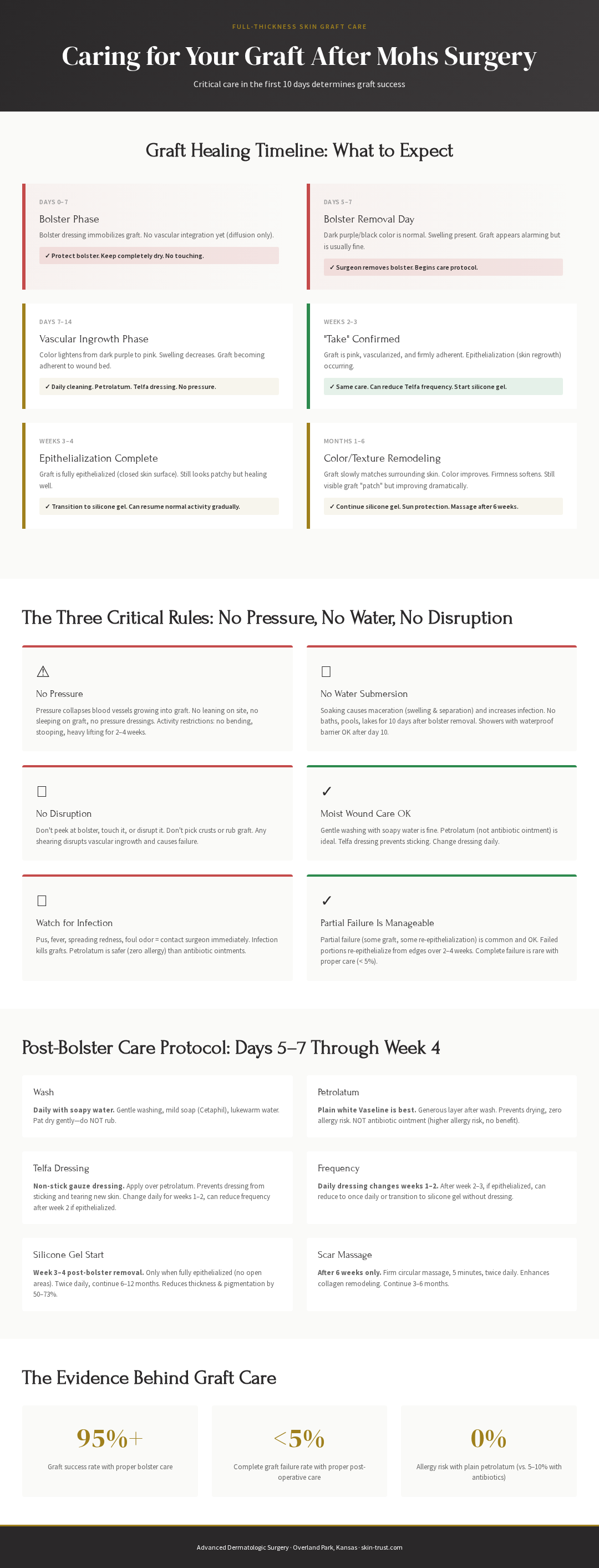
- Bolster dressing (protective immobilization layer) must remain undisturbed for 5–7 days — do not peek at, touch, or remove it; any movement can cause graft failure by disrupting vascular integration
- Graft take rate exceeds 95% with proper bolster protocol — success requires leaving the bolster completely alone for the full 5–7 days while blood vessels grow into the graft
- No activity, pressure, or submersion for at least 10 days after bolster removal — bending, heavy lifting, sweating, or water exposure can disrupt the fragile new blood vessel connections and cause graft failure
- Daily wound care after bolster removal: petrolatum + Telfa dressing, changed once daily — topical antibiotics add no benefit and increase allergy risk; moist wound healing is sufficient
- Donor site (usually behind the ear) heals in 2–3 weeks with minimal scarring — keep it clean and dry with the same moist wound healing protocol
- Partial graft failure is common but manageable — small areas of graft loss typically heal by second intention with minimal additional scarring; full failure is rare with proper care
Evidence Snapshot
A full-thickness skin graft (FTSG) after Mohs surgery requires meticulous wound care to achieve vascular integration and optimal healing. The bolster dressing (protective immobilization layer) is critical for the first 5–7 days and must not be disturbed. After bolster removal, gentle wound care with petrolatum (not topical antibiotics) and Telfa dressing for at least 1 week prevents infection and graft failure. No pressure, submersion, or disruption for a minimum of 10 days after bolster removal is essential for vascular ingrowth. Partial graft failure is common and manageable; full failure is rare with proper care. Donor site healing takes 2–3 weeks and typically leaves minimal scarring behind the ear.
Introduction: Why Your Graft Matters and How to Keep It Alive
A skin graft is a piece of full-thickness skin (epidermis + dermis) harvested from a donor site (usually behind your ear) and placed onto the surgical defect. Unlike a flap, a graft has no blood supply when first placed—it survives by diffusion of nutrients from the underlying wound bed for the first 24–48 hours, then by vascular ingrowth from the bed starting around day 2–3.
This makes the first 10 days after bolster removal absolutely critical. Your job is to keep the graft perfectly still, clean, and moist while the blood vessels are growing in. Any pressure, pulling, or disruption can disrupt this fragile vascular integration and cause partial or complete graft failure.
This guide tells you exactly what to do—day by day—to keep your graft alive and healing optimally.
What Is a Full-Thickness Skin Graft (FTSG)?
When Is a Graft Chosen?
A full-thickness skin graft is used when:
- The defect is too large for linear closure without unacceptable tension (generally > 1–2 cm on most sites).
- The defect is in a concave area (e.g., medial canthus, temporal hollow) where flap placement is awkward or would distort anatomy.
- A flap is not possible or practical (e.g., limited donor skin laxity, need to avoid scars on adjacent important structures).
- Preserving underlying structures is important (e.g., cartilage, bone, nerves). A graft sits on top; a flap moves tissue and may impinge important structures.
Advantages
- Simplicity: Faster operative time than flaps.
- Predictability: Grafts take reliably if proper care is followed.
- No flap scars: Unlike flaps, you don't create additional donor site scars at remote locations.
Disadvantages
- Donor site scarring: The site where the graft is harvested (usually retroauricular—behind the ear) has a scar. FTSG is usually harvested in full thickness, so the donor site cannot heal by secondary intention and must be closed (usually a linear closure).
- Patch-like appearance initially: Grafts look visibly different from surrounding skin for the first 2–3 months (darker, firmer, raised). This improves significantly by 6 months and often becomes nearly imperceptible by 12 months.
- Color and texture mismatch: A graft never perfectly matches surrounding skin. The match improves as the graft matures.
- Graft failure risk: If the graft doesn't vascularize, it fails (sloughs off). Partial failure is common; complete failure is uncommon with proper care.
The Bolster Dressing: What It Is and Why It's Critical
What Is a Bolster?
A bolster is a protective, immobilizing dressing placed directly over the graft immediately after surgery. It typically consists of:
- Moist gauze or sponge placed directly on the graft
- Tie-over sutures that secure the bolster in place, holding the graft firmly against the underlying wound bed
The bolster stays in place for 5–7 days and is not removed or touched during this time.
Why the Bolster Matters
The graft must have uninterrupted contact with the wound bed for blood vessels to grow in (vascular integration). Any shearing, movement, or pressure disruption will kill graft cells and cause necrosis (tissue death).
The bolster:
- Immobilizes the graft — prevents any movement or shearing
- Applies gentle pressure — ensures intimate contact between graft and wound bed
- Absorbs wound fluid — moist gauze prevents the graft from drying out while allowing gentle drainage
Without a bolster, grafts fail. With a bolster properly applied and left undisturbed, grafts take at rates exceeding 95%.
Strict Bolster Protocol
During the first 5–7 days (bolster in place):
- Do NOT touch, lift, peek at, or disrupt the bolster. This is not optional. Any disturbance can cause graft failure.
- Do NOT get the bolster wet. Keep your surgical site completely dry. No showers, baths, or submersion.
- Do NOT apply pressure to the graft site. No leaning on the area, no sleeping on that side if the graft is on your face.
- Keep the bolster clean and dry. If the bolster becomes very soiled or wet, contact your surgeon immediately for replacement.
- Take prescribed antibiotics if given. Some surgeons prescribe oral antibiotics prophylactically after graft surgery.
Activity restrictions during bolster phase:
- No bending at the waist if the graft is on the lower face, neck, or chest (bending can pull the graft).
- No vigorous activity or heavy lifting.
- No exercise that increases blood pressure or causes sweating.
What to Expect When the Bolster Is Removed (Day 5–7)
The Appearance of a Fresh Graft
When your surgeon removes the bolster, you'll see the graft for the first time. It may look surprising:
- Dark, purple, or black color: This is normal. The graft is bruised and edematous. The dark color fades over 1–2 weeks.
- Firm, swollen, or rubbery texture: Normal. Swelling resolves over days 2–3 post-bolster removal.
- Possible blood crusts or ooze: Normal. Gentle clean water rinses are OK (see post-bolster protocol below).
- Margins may not look perfectly sealed: If edges are not adherent, don't panic. Partial edges can re-epithelialize from the surrounding skin.
What Is Graft "Take"?
Graft "take" refers to successful vascular integration. Signs of take include:
- The graft becomes less dark and more pink over days 2–7 post-bolster removal.
- The graft becomes adherent (stuck to the wound bed).
- The graft becomes more pliable and less firm.
By week 3 post-bolster removal, if the graft is still present (not sloughed) and vascularizing, it has successfully taken.
Post-Bolster Wound Care Protocol: Days 5–7 Through Week 4
Days 5–7: Immediately After Bolster Removal
Gentle cleansing:
- Wash the graft site gently with lukewarm soapy water (mild soap like Cetaphil or Dove).
- Pat dry gently with a clean, soft towel. Do NOT rub.
- Do NOT scrub, soak, or apply pressure.
Moisture barrier (CRITICAL):
- Apply a generous layer of plain white petrolatum (Vaseline) or Aquaphor.
- Plain white petrolatum is preferred (Davis et al., 2021) because it is least likely to cause allergic contact dermatitis.
- Do NOT use antibiotic ointments (neomycin, bacitracin, gentamicin). These increase allergic reactions and offer no advantage.
Non-stick dressing:
- Apply a non-stick dressing (Telfa) over the petrolatum.
- Telfa is a thin, non-adherent gauze that won't stick to the graft as it heals.
- Tape the edges gently.
Why this protocol:
- Petrolatum prevents the graft from drying out.
- Telfa prevents the dressing from adhering to new epithelium and causing re-injury when removed.
- This combination minimizes infection risk (Smack et al., 1996 — petrolatum = bacitracin for infection, zero allergy).
Frequency:
- Change dressings daily for the first 1–2 weeks.
- After day 7–10, if the graft is epithelializing well, you can transition to once-daily dressing changes.
Weeks 2–4: Continued Care
Protocol remains the same:
- Daily gentle wash with soapy water.
- Pat dry.
- Generous petrolatum.
- Telfa dressing.
- Tape gently.
Telfa can be removed after week 2–3 if the graft is fully epithelialized (no open areas, no oozing). Once epithelialized, you can apply petrolatum directly without a dressing underneath.
Transition to silicone gel:
- By week 3–4 post-bolster removal (approximately day 25–30 post-surgery), if the graft is fully epithelialized, you can transition to silicone gel for scar minimization.
- Apply twice daily.
- Continue for 6–12 months.
Critical Rules: No Pressure, No Submersion, No Disruption
Pressure on the Graft Site
Why: Pressure collapses blood vessels that are trying to grow into the graft. Any pressure disrupts vascular ingrowth.
What to avoid:
- Leaning on the graft site
- Sleeping on the graft site if it's on your face/head/neck
- Tight dressings (dressings should be snug but not tight)
- Any activity that puts strain on the graft
Activity restrictions:
- No bending at the waist for at least 2 weeks if the graft is on your lower face, neck, or chest (bending increases intracranial pressure and can disrupt the graft).
- No heavy lifting for 2–4 weeks.
- No vigorous exercise for at least 2 weeks.
- No stooping or exercises that increase intra-abdominal pressure for 2–4 weeks.
Submersion (Water Exposure)
Why: Prolonged water exposure can cause graft maceration (swelling and separation from the wound bed) and increases infection risk.
What to avoid:
- No baths, pools, lakes, or hot tubs for at least 10 days after bolster removal.
- Showers are OK if you keep the graft site dry and protected. Use a clean, dry dressing as a waterproof barrier during the shower.
- No swimming for at least 3 weeks post-bolster removal.
Timeline:
- Days 5–10 post-bolster removal (bolster just off): Avoid all water exposure. Showers are risky; wash around the graft if possible.
- Days 10–14: Careful showers with waterproof barrier are OK.
- Week 3+: Light submersion (e.g., hand washing, gentle shower) is OK if the graft is epithelialized.
- Week 4+: Normal bathing is OK if epithelialized.
No Disruption or Manipulation
What to avoid:
- Do NOT pick at crusts (they protect the graft).
- Do NOT rub or massage the graft site for at least 4 weeks.
- Do NOT apply pressure with your fingers to "test" the graft or check adherence.
- Do NOT expose the graft to direct trauma or impact.
Understanding Graft Failure
Partial vs. Complete Failure
Partial graft failure:
- A portion of the graft sloughs (dies and falls off).
- The edges of the graft and non-failed portions remain viable.
- The failed area will re-epithelialize from the edges over 2–4 weeks.
- Result: Some of the defect is covered by graft; the rest heals by secondary intention (re-epithelialization from margins).
- Outcome: Usually acceptable, though scarring may be slightly worse in the re-epithelialized area.
Complete graft failure:
- The entire graft sloughs off.
- The wound bed is now open and must heal by secondary intention (weeks to months).
- Result: Much longer healing, more visible scarring, higher infection risk.
- Rare with proper care. Less than 5% of grafts fail completely if post-operative protocols are followed.
Signs of Graft Failure
Day 1–3 post-bolster removal (normal appearance):
- Dark purple/black color
- Swelling and firmness
- Possible blood crusts
Day 4–7 post-bolster removal (signs of take):
- Color lightening from purple to pink
- Swelling resolving
- Graft becoming more pliable
Signs of failing vascular integration:
- The graft remains very dark (black, not lightening to pink) by day 7–10 post-bolster removal
- The graft is separating at the edges (lifting away from the wound bed)
- The graft feels very firm and non-vascularized by day 10+
- The graft is sloughing (falling off in pieces)
What to Do If Graft Failure Occurs
If you suspect graft failure:
- Contact your surgeon immediately. Don't wait.
- Your surgeon will examine and assess whether the graft is truly failing or just appearing dark (which is normal).
- If partial failure: Continue wound care as outlined. Re-epithelialization will occur from the margins.
- If complete failure: Your surgeon will discuss options (re-grafting, allowing secondary intention healing, flap revision).
Donor Site Care: Where the Graft Was Harvested
Where Is the Donor Site?
FTSG is typically harvested from behind the ear (retroauricular skin) because:
- The skin color and texture match facial skin better than other donor sites.
- The scar is hidden behind the ear.
- The area is relatively inconspicuous.
(Alternative donor sites: upper eyelid, postauricular neck, inner arm. Less common because of match or scar visibility.)
Donor Site Closure
FTSG harvest is full-thickness (removes epidermis + dermis), so the donor site cannot heal by secondary intention. Your surgeon closes it with sutures (usually absorbable or non-absorbable, removed in 7–10 days).
Data sourced from peer-reviewed, PubMed-indexed publications
Donor Site Healing Timeline
| Timeline | Appearance | Care |
|---|---|---|
| Days 0–2 | Red, swollen, possibly oozing | Keep dry, avoid touching |
| Days 2–7 | Red, oozing, edges firm | Gentle cleaning, petrolatum, light dressing |
| Days 7–10 | Sutures removed, still red | Same care continues |
| Weeks 2–4 | Pale pink, epithelialized | Silicone gel for scar minimization |
| Weeks 4–12 | Pale, flattening | Continue silicone gel |
| Months 3–6 | Nearly invisible | Scar continues to mature |
Donor Site Care Protocol
Days 0–7 (while sutures in):
- Wash gently 1–2 times daily with mild soap and cool water.
- Pat dry gently.
- Apply petrolatum.
- Light dressing if desired (gauze + tape).
- Keep dry and clean.
Days 7–14 (after sutures removed):
- Same as above.
- Sutures are out, so the site is more fragile. Still avoid friction.
Weeks 2–4+:
- Continue petrolatum for moisture.
- Transition to silicone gel once epithelialized.
- Apply twice daily.
- Continue for 6 months.
Sun protection:
- Once epithelialized, apply mineral sunscreen (SPF 30+, zinc oxide or titanium dioxide) daily.
- The donor site scar is vulnerable to hyperpigmentation. Sun protection is critical.
Infection Prevention and Recognition
Signs of Infection
Contact your surgeon immediately if you notice:
- Increased warmth, redness, or swelling around the graft site (some swelling is normal, but rapid increase is concerning).
- Pus or purulent drainage (cloudy, thick, yellow or greenish discharge).
- Fever (temperature > 101°F).
- Red streaking extending from the graft site (sign of cellulitis).
- Foul odor from the wound.
- Rapidly increasing pain (some pain is normal, but sudden worsening is concerning).
Infection Prevention
- Strict sterile technique with dressing changes. Wash your hands before touching the dressing.
- Clean water and mild soap for wound cleaning.
- No topical antibiotics — petrolatum is sufficient and safer (lower allergy risk, Smack et al., 1996).
- Keep the site clean and dry between dressing changes.
- Avoid contamination — don't let the graft site touch dirty surfaces or objects.
- Follow all post-operative activity restrictions to minimize graft trauma and infection risk.
Timeline: What to Expect Week by Week
| Timeline | Graft Appearance | What's Happening | Your Care |
|---|---|---|---|
| Day 0 (Surgery) | N/A — bolster in place | Graft placed, bolster applied, no blood supply yet | Protect bolster, keep dry, no pressure |
| Days 1–5 (Bolster on) | N/A — bolster in place | Diffusion of nutrients; early vascular ingrowth begins | Do NOT disturb bolster |
| Days 5–7 (Bolster removal) | Dark purple/black, firm, swollen | Vascular ingrowth accelerating, immediate post-bolster edema | Gentle wash, petrolatum, Telfa dressing |
| Week 1–2 (Days 7–14 post-bolster) | Darkening lifting, color improving to pink, swelling decreasing | Active vascular ingrowth, graft becoming adherent | Daily cleaning, petrolatum, Telfa |
| Weeks 2–3 (Days 14–21) | Pink, less swollen, starting to look more normal color | Vascular integration complete (graft is "taking"), epithelium regenerating | Daily cleaning, petrolatum, Telfa can be stopped if epithelialized |
| Weeks 3–4 (Days 21–28) | More pink, flattening, beginning to match surrounding skin (slowly) | Epithelialization complete, early color matching | Transition to silicone gel, continue petrolatum |
| Months 1–3 | Pinker/darker than surrounding skin, slightly firm, visible graft "patch" | Collagen deposition and remodeling, color and texture slowly matching | Continue silicone gel, sun protection, massage after 6 weeks |
| Months 3–6 | Color improving, firmer scars softening, less visible patch | Continued remodeling, pigmentation improving | Continue silicone gel, sun protection |
| Months 6–12 | Much closer to matching surrounding skin, nearly invisible | Final maturation of graft and scar remodeling | Sun protection, optional laser or other treatments for any remaining color/texture mismatch |
| Months 12–18+ | Optimal final appearance | Complete scar maturation | Maintenance sun protection |
FAQ: Your Graft Care Questions
Q: Why is my graft so dark? Is it failing?
A: Dark purple or black color immediately after bolster removal is normal. The graft is bruised and edematous. It should begin to lighten by day 2–3 post-bolster removal, progressing from dark to pink by days 5–7. If it's still very dark/black at day 10 post-bolster removal with no lightening, contact your surgeon.
Q: My graft looks like a patch. Will it ever look normal?
A: Yes, but it takes time. Grafts look visibly different (darker, firmer, like a "patch") for the first 2–3 months. By 6 months, color and texture match improves dramatically. By 12 months, most grafts are nearly imperceptible. Some permanent visibility is possible, but this is much better than the alternative (large open wound or poor flap placement).
Q: Can I shower with my graft in place?
A: After bolster removal, you can take showers if you keep the graft site dry and protected with a waterproof barrier. The key is avoiding submersion (soaking) and prolonged water exposure. For days 5–10 post-bolster removal, the safest approach is dry care only (no showers). After day 10, showers with a waterproof dressing are OK. Baths and swimming should be avoided until week 4.
Q: What does a "take" feel like?
A: A graft that's taking feels increasingly vascularized (warm, pink, pliable) and adherent (stuck to the wound bed). It becomes less dark, less swollen, and more flexible. By week 2–3 post-bolster removal, you should see clear signs of take (lighter color, reduction in firmness, graft adhering at margins).
Q: Is it normal for my graft to have some oozing or drainage?
A: Light serous drainage (clear or slightly bloodstained) is normal for the first 1–2 weeks post-bolster removal. Purulent drainage (pus, thick, discolored) is NOT normal and suggests infection. Contact your surgeon.
Q: Can I use antibiotic ointment on my graft?
A: No. Plain petrolatum (Vaseline) is preferred. Antibiotic ointments (neomycin, bacitracin) increase allergic contact dermatitis risk without providing additional infection protection. Petrolatum is safer and just as effective (Smack et al., 1996).
Q: When can I resume normal activities?
A: No bending, stooping, heavy lifting, or vigorous exercise for 2 weeks post-bolster removal (until graft is firm and vascularized). After 2 weeks, you can slowly resume normal activities. However, avoid pressure on the graft site for 4 weeks and avoid any contact sports or activities with trauma risk for 6 weeks.
Q: Can I apply makeup over my graft?
A: Not during the first 2 weeks (while epithelializing). Once epithelialized (week 3+), you can apply makeup if you're gentle. Full-coverage makeup can help camouflage the graft's appearance during the patch phase. Just be gentle when applying and removing.
Q: How long until my graft looks like normal skin?
A: This is gradual. Weeks 1–2: obvious graft visible. Months 1–3: graft visible but improving. Months 3–6: graft much less obvious. Months 6–12: nearly normal (small residual visibility possible). Months 12+: optimal final appearance (sometimes nearly perfect, sometimes a subtle patch remains).
Q: What if my graft partially fails?
A: Partial graft failure is not a catastrophe. The failed portion will re-epithelialize from the edges over 2–4 weeks. You'll have some areas covered by graft and some areas with secondary intention scars. Overall healing may take slightly longer, but outcomes are usually good.
Q: Is it true I can't get my graft wet at all?
A: For the first 10 days post-bolster removal, it's safest to avoid any water exposure. After day 10, showers with a waterproof barrier are OK. Soaking (baths, pools) should be avoided for at least 3–4 weeks. Complete water avoidance for longer than necessary isn't necessary, but early protection is critical.
Q: My donor site behind my ear is still red. When will the scar fade?
A: Donor site scars mature over 6–12 months. Red at 2 weeks is normal. The scar should be pale by 3 months and nearly invisible by 6 months. Sun protection accelerates this. If the scar is still very red or firm at 6 months, discuss treatment options (laser, steroid injection) with your surgeon.
Q: Can I exercise after graft surgery?
A: No vigorous exercise for 2 weeks. After 2 weeks, you can resume walking and light activity. No heavy lifting, bending, or high-intensity exercise for 4 weeks. After 4 weeks, normal exercise is usually OK, but avoid direct trauma to the graft site for 6 weeks.
Internal Cross-Links
For related information on Mohs surgery and healing, see:
- Complete Guide to Recovery After Mohs Surgery
- Wound Care After Mohs Surgery
- Second-Intention Healing After Mohs Surgery
References
Smack DP, Harrington AC, Dunn C, et al. Infection and allergy incidence in ambulatory surgery patients using white petrolatum vs bacitracin ointment. A randomized controlled trial. JAMA. 1996;276(12):972-977. PMID: 8805732
Davis SA, Cepeda AM, Brody HJ. Healing phases of full-thickness skin grafts. Proc Baylor Univ Med Cent. 2021;34(4):526-530. PMID: 34732986
Wang P, Xu Q, Yang Y, et al. Efficacy of topical silicone gel in scar management: a systematic review and meta-analysis. Int Wound J. 2020;17(2):277-285. PMID: 32119763
Medical Disclaimer
This article is for educational purposes and should not be considered medical advice. Do not delay or avoid seeking medical care based on this information. Skin graft care requires close post-operative follow-up with your surgeon. If you have concerns about your graft, contact your treating surgeon immediately. While The evidence-based approach and Dr. Thomas L.H. Hocker provide evidence-based dermatologic care, individual results vary.
